David Novak asked a roomful of Pepsi salespeople about merchandising. They kept returning to one colleague, Bob. He knew how to do it. He had taught them. As the compliments accumulated, Novak looked over and saw that Bob was crying. A routine visit to learn the business had become something much less comfortable for the executive asking the questions.
Bob had spent decades at the company. He had not realized how much his colleagues valued him. In Novak’s retelling, the shock was the distance between being useful and knowing you were appreciated. A business could depend on someone’s knowledge for years and still fail to say thank you. Novak came away determined to make recognition part of his job.
The response eventually included rubber chickens. At KFC, he handed them out to employees whose work deserved attention, along with cash bonuses. At Pizza Hut, recognition could take the form of a foam cheese head. The awards had the useful quality of being difficult to confuse with a solemn corporate plaque. Someone had done something worth celebrating; everyone was invited to notice.
Novak’s career makes more sense if you keep Bob in view. The former Yum! Brands chief has spent years talking about people, learning and results, subjects that can become soft upholstery in a business book. His stories usually contain something harder to evade: an overlooked employee, an unwelcome objection, a question he should have asked sooner.
Twenty-three states before seventh grade
He was born in Beeville, Texas, in 1952. His father worked for the U.S. Coast and Geodetic Survey, marking locations for mapmakers. The family’s home moved with the work. By twelve, Novak had lived in 32 trailer parks across 23 states. A promotion for his father finally brought a permanent address in Kansas City, Missouri.
Those journeys came with a traveling community of roughly fifteen families. The children had familiar company even as the towns changed. Novak remembers the families racing to get the best spot at the next trailer park. The childhood was crowded and mobile, with a top bunk, a small sofa and a dependable instruction from his mother: take the initiative in making friends.
That instruction had a deadline built into it. A child who might leave in a few months could hardly wait until the end of term to introduce himself. Years later, Novak connected that upbringing with his comfort in unfamiliar rooms. Before he had employees to motivate, he had practice finding his place among strangers.
At the University of Missouri, advertising gave him a direction. He graduated from its journalism school in 1974. His early work included a copywriting job paying $7,200 a year and a night shift at a Holiday Inn. The eventual restaurant executive started by learning how to get someone interested in a sentence.
The cola that needed an objection
Advertising accounts brought him close to the businesses he would later help run. He worked on Frito-Lay brands, moved into marketing at Pizza Hut and rose through marketing, sales and operations at Pepsi-Cola. He liked the speed with which restaurant customers delivered their verdict. A promotion could be tested against what people actually bought.
Crystal Pepsi supplied a particularly public verdict. Novak saw an opportunity in the growing appeal of clear drinks and helped develop a colorless cola, introduced in 1992. Test-market excitement encouraged him. He was moving toward a national launch with the conviction of someone who had found the answer and would prefer to get on with it.
The bottlers raised a practical problem: the drink did not taste enough like Pepsi. Novak wanted additional customers and a different proposition. The bottlers were thinking about the promise made by the name on the bottle. He pushed ahead. The distinction between getting people to try a drink and getting them to buy it again proved expensive.
He has kept returning to this failure in interviews and in his own writing. The embarrassing part, as he tells it, is that useful advice had been available. People had identified the problem while there was still time to listen. His enthusiasm had crowded them out. Clear cola gave him a remarkably durable reminder that confidence could interfere with the work it was supposed to help.
“No involvement, no commitment.”
David Novak, on bringing people into decisions
A chicken has to mean something
At KFC, recognition gave Novak a way to make performance visible. The joke mattered because it made the occasion memorable. So did the reason for the award. A rubber chicken without a particular achievement behind it would soon become another object on another shelf, waiting for the next office move.
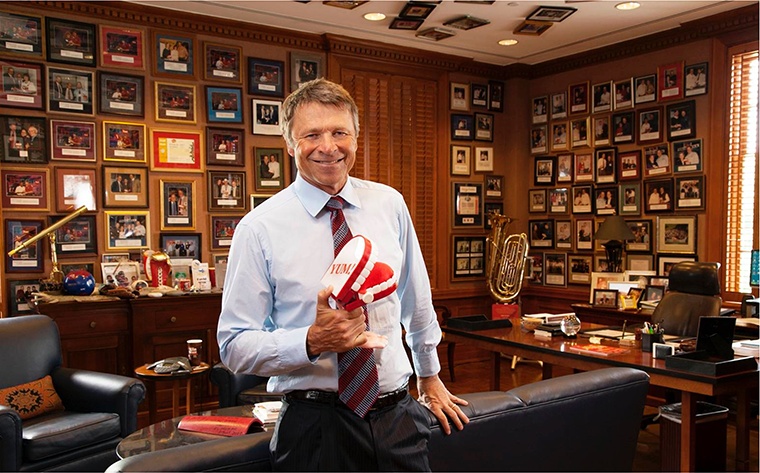
His later Yum! office made the idea physical. Employee recognition photographs covered the walls and reached onto the ceiling. In the photograph below, the room looks less like a place designed to impress visiting executives than somewhere a school reunion has continued indefinitely. There is a business purpose to all those faces: the people doing the work occupy the room.
Novak also saw what happened when recognition stopped. Visiting a Pepsi plant in 1993, he found an employee-awards display whose latest plaque dated to 1988. Workers remembered the gatherings and family atmosphere that had disappeared after a change in ownership. He asked local management to rebuild the habit of recognizing people and creating occasions they would remember.
The point was specific enough to require follow-through. Someone had to notice good work, explain what made it good and keep doing so after the executive’s visit. The funny trophy could start a conversation. The manager still had to deserve the employee’s belief that the conversation meant something.
The title came after the partnership
When PepsiCo spun off its restaurant businesses in 1997, Novak became vice chairman and president of the new company, Tricon Global Restaurants. The brands were KFC, Pizza Hut and Taco Bell. Andy Pearson was its first chief executive. Novak succeeded him effective January 1, 2000; the business later adopted the Yum! Brands name.
The sequence matters. Novak co-founded the independent company, then worked alongside an experienced chairman and CEO before taking the top job. Pearson’s announcement of the succession described a partnership in building the business. It is a more interesting route than a founder simply appointing himself to the largest office.
By the time Yum! announced his own CEO succession in May 2014, it operated more than 40,000 restaurants in over 125 countries and territories. The board put its market capitalization at $34 billion, compared with $6 billion when Novak became CEO. Those are the company’s figures from that announcement, a dated measure of scale rather than a claim that one management habit explains every dollar.
Greg Creed took over as chief executive on January 1, 2015. Novak stayed as executive chairman and retired from Yum! in 2016. He had also been personally teaching managers the leadership approach that became Taking People With You. The title neatly captured the practical problem of running a company whose execution depended on so many other people.
A second career with more questions
After Yum!, Novak kept the teaching and changed the venue. How Leaders Lead puts him on the asking side of conversations with people from business, sport and public life. Guests have included Jamie Dimon, Indra Nooyi, Tom Brady and Condoleezza Rice. The show gives him a continuing reason to find out how someone else works.
His books trace the same preoccupations. The Education of an Accidental CEO looks back at the route from his early life into business. Taking People With You develops the team-building approach; O Great One! centers on recognition. Take Charge of You, written with Jason Goldsmith, turns to self-coaching. How Leaders Learn, with Lari Bishop, followed in June 2024.
The educational work also returned him to Missouri. In September 2017, David and Wendy Novak announced a $21.6 million commitment to establish the Novak Leadership Institute at the journalism school. Its approach connects communication and marketing with leadership, using practical experience to help students learn to work with others.
His current organization reaches across age groups: Global Game Changers serves younger children, Lead4Change works with secondary-school students, and the Missouri institute serves university learners. How Leaders Lead offers interviews, an app and other resources for working leaders. The recurring ambition is to make leadership something people can practice before they receive an impressive title.
The refrigerator test
Novak has not confined himself to discussing an old restaurant career. In January 2026 he became a director of Versant Media Group, where he chairs the board. An April conversation with McKinsey returned to the familiar questions of involving employees, listening to franchisees and connecting culture with execution. A new boardroom has given the old lessons another setting.
His own annual review can be smaller than a board pack. On a three-by-five-inch index card, he considers the leader he is today and how he could become more effective tomorrow. On his January 2026 podcast, he described posting the card on his refrigerator. It is a pleasingly ordinary place to put a leadership strategy: somewhere you will encounter it while looking for something else.
The card also fits the more demanding side of his message. He asks people to examine their own behavior, including the parts that a good reputation might let them ignore. The executive who celebrates employees still has to accept correction himself. His clearest example remains the drink whose bottlers gave him an answer he did not want.
Bob, the bottlers and the refrigerator belong to the same career. One showed him what happens when appreciation goes unsaid. Another showed him the cost of dismissing inconvenient knowledge. The card makes room for a further revision. After all the restaurants and interviews, Novak still gives himself a small, recurring assignment: pay attention, then do something with what you learn.
Who am I as a leader?
How can I become more effective?
Keep the conversation going
Watch, listen and read more from David Novak.