David Broadbent is an enthusiastic amateur chef, a pleasing detail in a career otherwise crowded with satellite networks, government contracts and military communications. Cooking offers a rare corner of his biography where the word service might involve a plate. His professional work asks a less forgiving question: how do you keep people connected when somebody else is trying to stop them?
Broadbent became president and CEO of SES Space & Defense on July 17, 2025, as SES completed its acquisition of Intelsat. He inherited the task of bringing the two companies’ government and defense businesses together. A corporate combination supplied the occasion. A longer career, stretching from mechanical engineering to the machinery of defense procurement, supplied the preparation.
His story is particularly interesting at the points where he questions familiar ways of working. He has argued for different contracting habits, different relationships with competitors and different combinations of satellites. For someone whose working life has involved institutions built to endure, he spends a fair amount of time explaining why they need to change.
An engineer who learned the language of contracts
Broadbent earned his bachelor’s degree in mechanical engineering at Newcastle University and undertook postgraduate studies in contract law at Northumbria University. Those disciplines make an instructive pairing. One concerns whether a thing will work. The other concerns what everyone has agreed that it must do, and who carries the responsibility when the answer becomes complicated.
Before Raytheon, he worked at Vickers Defence Systems in Germany and the United Kingdom, covering engineering design, supply chain and program management. His early experience therefore included the movement from a design to the practical business of delivering it. The drawing, the supplier and the schedule all had a place in the same career.
In 2002 he joined Raytheon’s Integrated Defense Systems team in the UK. Over more than two decades, his responsibilities crossed business development, program execution, contracts, supply chain management and financial planning. Eventually he led the Space Systems business. The route matters because his subsequent arguments about commercial space reach well beyond the satellite itself. He had worked in several of the functions that determine whether a technical promise can become an operational service.
The useful admission in Colorado Springs
In April 2023, while leading Raytheon’s space and command-and-control systems business, Broadbent described a change in approach to military satellite competitions. Raytheon would pursue opportunities as a supplier of satellite buses and sensor payloads to other prime contractors. Leading the whole mission had not produced the results the company wanted.
“We are making a very deliberate pivot,” he said.
At the Space Symposium in Colorado Springs, he had been meeting contractors interested in components for future competitions. Blue Canyon Technologies and SEAKR Engineering, both within Raytheon, supplied capabilities that could find customers through partnerships. The company could participate in a mission without insisting on the starring role.
There is a modest act of professional honesty in saying that an established approach has disappointed. It also makes Broadbent’s later enthusiasm for commercial partnerships easier to understand. Working with somebody else had already become part of his proposed answer.
A new job inside an old satellite name
Intelsat announced Broadbent’s appointment as president of Government Solutions in November 2023. He took responsibility for its worldwide government business and joined its seven-member management committee. The move also brought him back into the orbit of Dave Wajsgras, Intelsat’s chief executive and another former Raytheon executive.
Government Solutions was the new name for Intelsat General. That detail captures the character of the assignment: a business with an established customer base was changing how it described, and intended to deliver, its work. Broadbent arrived with experience of the government customer and a recent willingness to reconsider the supplier’s role.
By March 2025, his team’s work included an Air Force commercial-space-internet program, completion of an Army satellite managed-service pilot, and a border-security contract with the sheriff’s department in Cochise County, Arizona. The customer list put the same broad challenge into quite different settings. A communications requirement can belong to a military service or a county office; somebody still needs to make the connection usable.
Give the signal another route
In May 2025, Broadbent laid out a strategy built around multiple orbits, satellite and terrestrial networks working together, and more software in the network architecture. His starting point was the customer’s mission. The combination of technologies would follow from that requirement.
The underlying idea is straightforward enough to escape the acronyms. A system that depends on one route has a problem when that route becomes unavailable. Broadbent wanted redundant connections and greater freedom to combine networks. He also argued that proprietary hardware and embedded software had made it harder to connect systems together. Virtualization offered a way to loosen those constraints.
He was equally interested in the purchasing process. New capabilities lose some of their usefulness if customers cannot acquire them quickly enough. His public position joined a technical argument about resilience to an organizational argument about speed. Better connections and better buying habits belonged in the same conversation.
At SOF Week that month, he discussed the approach in the context of special operations forces. Lightweight, rugged terminals and automated switching were part of the explanation. The setting made the engineering question concrete: people operating where infrastructure is damaged, absent or contested need equipment they can carry and connections that can adapt.
That is where the vocabulary has to earn its keep. A diagram can draw several routes with admirable ease. The terminal, the software and the service behind it must make those routes available to the person using them. Broadbent’s emphasis on integration places responsibility on the provider for how the pieces work together.
Two businesses, one operating problem
The July 2025 SES acquisition changed the scale and shape of his assignment. SES brought its government and defense operations together with Intelsat’s under SES Space & Defense, and its Proxy Board appointed Broadbent to lead the combined organization. He succeeded David Fields.
The integration gave an organizational form to the kind of combination he had been discussing. People, technology and customer relationships from two businesses would now have to function together. The appointment announcement put secure, resilient communications and government mission outcomes at the center of his remit.
His colleagues span the same mixture of practical concerns that appears in his own career: engineering, service delivery, strategy, finance and legal work. Nitin Bhat leads engineering; Michael Geist leads strategy and innovation; Rory Welch leads service delivery. A multi-orbit proposition still needs people responsible for the work on Earth.
The waiting room before the launchpad
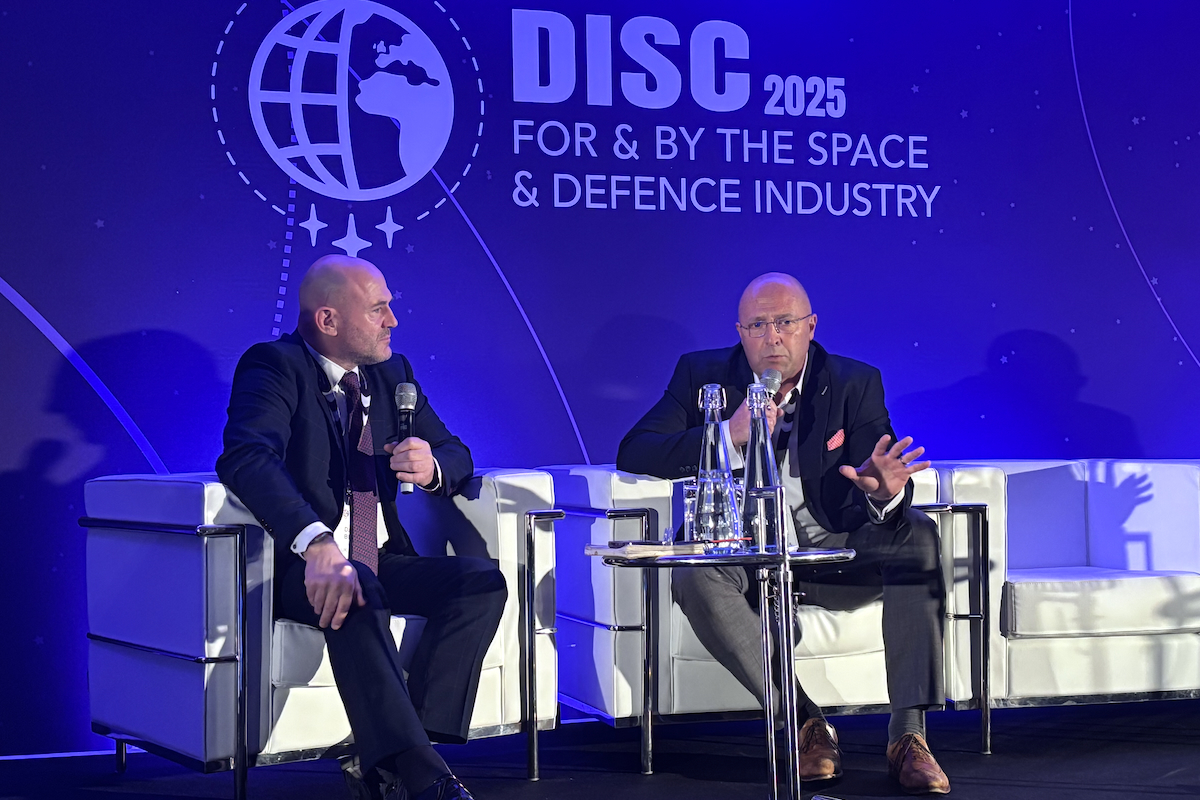
In London in October 2025, Broadbent discussed the changing relationship between government and industry with Dave Black, head of satellite coordination at UK Space Command. He described a shift toward collaboration and partnership, and praised small teams with greater freedom to deliver results.
His account of the older process was sobering: requirements could consume two years, followed by another five to seven years to put something into orbit. He presented that timetable as a reason to rethink how decisions are made. Space offers enough physical difficulties without adding a very long administrative queue.
Broadbent also pointed to the economics of serving both public and commercial customers. A wider potential market changes the investment calculation. A company developing a capability has more options when one government buyer is not its only possible customer. In his telling, military acceptance of commercial technology helps make that broader market possible.
“If the government doesn’t buy it, somebody else will.”
David Broadbent · Defence in Space 2025
What the next contracts ask of him
By May 2026, the company had announced a prime contract for the U.S. Space Force’s Protected Tactical SATCOM-Global program. Intelsat General Communications, an operating division within SES Space & Defense, was one of two companies selected to deliver space vehicles for a geosynchronous constellation designed to resist jamming. SES Space & Defense would manage the mission’s execution.
The award put a substantial delivery responsibility behind Broadbent’s argument about broader services. His company would have to integrate commercial technologies into a protected military communications mission. Selection begins that work; the intended constellation remains a delivery obligation.
A five-year blanket purchase agreement announced that July addressed another part of his agenda: making managed satellite services easier for military customers to order. It covered Ku-band services for users including people on the move and aircraft. The attraction of the managed-service model, as Broadbent explained it, is that the customer can use communications capabilities without maintaining all the underlying infrastructure.
Later in July, SES Space & Defense announced an agreement with Starlab for the commercial space station’s communications architecture. The plan uses O3b mPOWER satellites in medium Earth orbit to relay data from low Earth orbit toward ground networks. Teams had spent 2025 and 2026 modeling performance and assessing terminals. Here was another version of his recurring proposition: different parts of space working together, with considerable engineering required between the proposition and the service.
Broadbent’s July 2026 explanation of the company’s direction emphasized customers’ operational objectives and the provider’s responsibility for helping achieve them. That places a demanding test on the business he leads. The customer experiences whether a connection works when needed. Corporate lineage and an elegant architecture do little to soften an interrupted conversation.
The amateur chef’s biography supplies a tempting final metaphor, though it would be unfair to claim knowledge of his menu. What his working record does show is an executive repeatedly concerned with how separate ingredients become a usable result. His next chapter depends on making the combined organization deliver the service he has spent years describing. The signal has to get through.
Follow the conversation
More from Broadbent’s working life, in print and on camera.
- Official leadership biography · David Broadbent on LinkedIn · SES Space & Defense
- The 2023 Raytheon strategy discussion
- The May 2025 interview on space and defense
- Watch: Broadbent at SOF Week 2025 ↗ · Read the video introduction
- The 2025 executive profile
- The London conference conversation · Conference photograph and coverage
- PTS-G announcement · Managed-services agreement · Starlab agreement
- Broadbent’s July 2026 company perspective