Roam Robotics ships exoskeletons made of fabric and compressed air"Weight is horrible to wear" - Tim Swift's five-word design manifestoElevate ski exoskeleton offloads up to 30% of body weight$12M Series A led by Yamaha Motor Co.From Navy SEALs to ski slopes on one fabric-and-air platformTarget system weight: five pounds, not fifty
Founder · Engineer · Roam Robotics
Tim Swift.
He builds exoskeletons out of high-strength fabric and compressed air. The kind that weigh five pounds, not fifty - and that you might one day buy at REI.
exoskeletonswearable roboticspneumatic actuatorsUC Berkeley PhDSan Francisco
Mid-sentence, mid-workshop. The robots are behind him.
The Dispatch
Steel wants to be heavy. Tim Swift wanted something else.
Walk into Roam Robotics in San Francisco's Mission and you will not find the thing the word "exoskeleton" promises - no whirring steel armature, no forklift strapped to a spine. You will find sewing machines and injection molds. You will find high-strength fabric, the kind that holds a shape when you pump it full of air. And you will find Tim Swift, who decided the entire industry he helped invent had been solving the wrong problem with the wrong tools.
Swift is the founder and CEO of Roam, and his pitch is a subtraction problem. Conventional powered exoskeletons cost tens of thousands of dollars and weigh enough that you notice them with every step. Roam's bet was a full system - braces, a backpack holding battery, compressor and electronics - that targets five pounds and a price in the low thousands. The actuators are not motors and gearboxes. They are structured cavities in fabric, pressurized by compressed air, attached to braces at the joints. It is robotics that you stitch.
Today that platform points in three directions at once. There is the consumer mountain - Elevate, the company's first customer-facing product, a robotic ski exoskeleton released in 2018 that offloads up to 30% of the wearer's body weight so legs last longer on the slope. There is the military - Roam built work for the U.S. armed forces, including one of its first successful projects for the Navy SEALs, to extend a soldier's endurance and speed. And there is everyday mobility and knee support, the slow grind of making a robot ordinary enough to wear without thinking about it.
What ties them together is a single conviction Swift repeats like a metronome: people do not want heavy things on their bodies. "People don't want things that are really heavy on their body," he says. "Weight is horrible to wear. You really quickly notice it as far as your effectiveness and efficiency." It sounds obvious. It is the kind of obvious that an entire field spent years engineering around instead of toward.
His diagnosis of why is sharp. "They've been trying to build big, heavy bulking strong things and then switched over to building light things," he says of the legacy exoskeleton world, "but they never changed their toolset." Roam's whole reason for existing is the changed toolset - swap the metal and motors for fabric and air, and the math of the machine flips. "For the first time," Swift says, "the physics are in the favor of an exoskeleton."
~5 lb
Target system weight
30%
Body weight offloaded by Elevate
$12M
Series A, led by Yamaha
2014
Roam Robotics founded
The Turn
The wheelchair at the end of the hour
Before Roam, Swift was one of three people who invented the Ekso. At Ekso Bionics he sat on the original founding team behind a lower-extremity rigid exoskeleton built for gait rehabilitation and paraplegic mobility - a genuine breakthrough, a machine that let people who could not walk stand up and take steps. It is the kind of resume line most engineers would frame and hang on a wall.
It is also where the doubt started. There was a scene that kept repeating. A patient would spend an hour upright, walking inside the device, doing the impossible thing the robot made possible. And then the hour would end. "At the end of every hour, I had to sit and watch my customer transfer back into their wheelchair," Swift has recalled. The machine worked. The life around the machine did not change. The gap between what the robot could do in a room and what a person could do in the world became the problem Swift could not unsee.
So in 2013 he joined Otherlab, the San Francisco invention shop run by Saul Griffith, to chase a different kind of machine - one that traded brute strength for lightness, and lab-grade cost for something a person could actually own. The fabric-and-air approach came out of that work. A year later, in 2014, it became Roam.
The early money, tellingly, did not come from skiers. It came from defense. The military applications funded the first real development push, and the Navy SEALs project proved the lighter plastic-and-fabric approach could survive contact with the real world. Only later did Roam turn its public face toward the mountain, toward a product a civilian could strap on and point downhill.
The Trail
A career measured in pounds removed
UC BERKELEY
The doctorate
Earns a PhD in Mechanical Engineering, developing foundational technology that underpins many of today's commercial wearable robots.
EKSO BIONICS
One of three
Joins the original three-person team that invents the Ekso, a rigid lower-body exoskeleton for gait rehab and paraplegic mobility.
2013
Otherlab
Joins Saul Griffith's invention lab to build a robotic platform that cuts weight and cost with high-strength fabric and compressed air.
2014
Roam Robotics is born
Founds Roam to make lightweight, affordable wearable robots for everyday people - not just labs and hospitals.
2018
Elevate hits the slopes
Ships Roam's first consumer product - a robotic ski exoskeleton that offloads up to 30% of body weight - and closes a $12M Series A led by Yamaha.
ONGOING
Three markets, one platform
Expands into U.S. military work (including Navy SEALs) and everyday mobility and knee support.
In His Own Words
The gospel of light
"People don't want things that are really heavy on their body. Weight is horrible to wear."
"For the first time, the physics are in the favor of an exoskeleton."
"They never changed their toolset. They built heavy things, then tried to build light things with the same tools."
"The goal is to make devices regular people can get access to."
The Horizon
A robot you buy at Foot Locker
Ask Swift where this ends and he does not describe a hospital or a battlefield. He describes a shopping trip. "It could be you go to Foot Locker and buy a shoe that makes you run 25 percent faster," he says, "or you go to REI to buy a device that helps you hike farther." The end state of wearable robotics, in his telling, is retail. Mundane. On a shelf, next to the socks.
That is the whole arc, really - from a machine that let one paralyzed patient walk for an hour in a lab, to a thing a weekend hiker grabs without a doctor's note. The technology is the same lineage. What changed is who gets to use it, and that change is mostly a weight problem and a cost problem dressed up as an engineering problem. Swift's answer to both was fabric and air.
He is, by his own account, not a man who lives entirely inside the robots. He describes himself as "a good dad, loving husband," and counts quiet family time among the things he would not trade. It is a useful corrective for a founder whose product is literally about not carrying more than you have to.
The Margins
Things that don't fit in a press release
01
Roam's exoskeletons run on compressed air. The "muscle" is a fabric cavity that gets stronger when you inflate it.
02
The target for an entire system - braces, battery, compressor, electronics - is five pounds or less.
03
A conventional powered exoskeleton can cost tens of thousands of dollars. Swift's number is the low thousands.
04
Roam's first dollars came from the military. Its first famous product was for skiers.
05
The Series A was led by Yamaha Motor Co. - the company is better known for engines than for fabric.
06
Robots here are partly manufactured by sewing machines and injection molds, not just CNC mills.
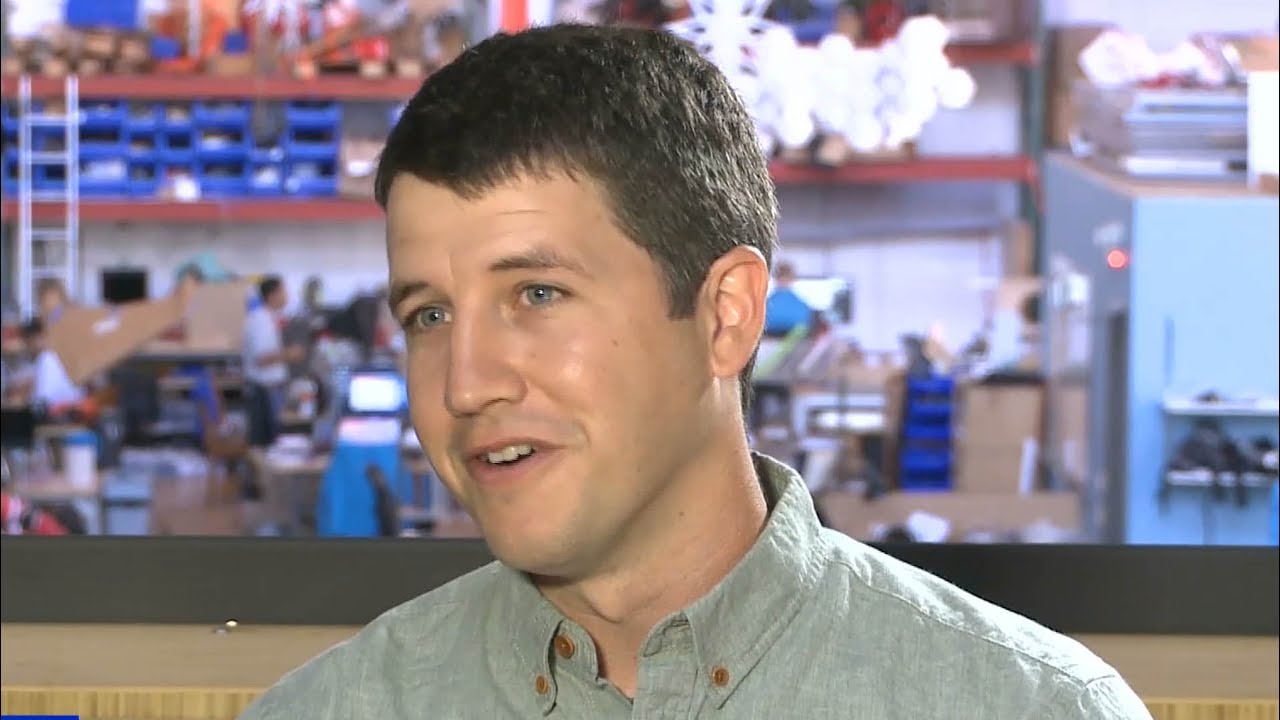 Mid-sentence, mid-workshop. The robots are behind him.