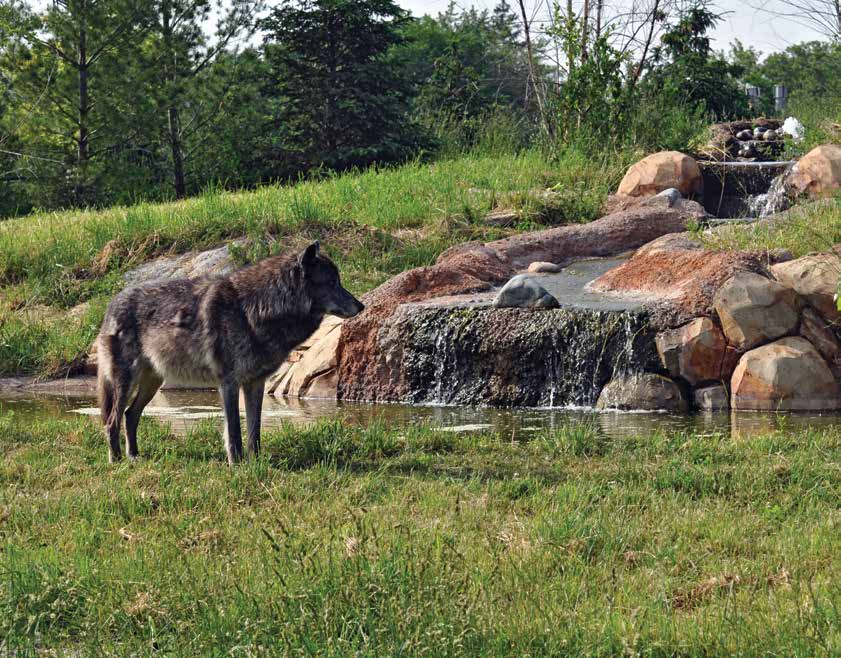
A wolf habitat is an awkward thing to wrap. It is also a rather good birthday present for someone who likes wolves. In 2015, Shery Cotton dedicated the Detroit Zoo’s Cotton Family Wolf Wilderness to David Cotton, her husband at the time. There were meadows, a stream, a pond and places for the animals to disappear from view. The family celebrated with dinner at the log cabin beside the habitat. Their grandchildren approved.
It is a useful place to begin with David B. Cotton. His business story has a number attached to it: approximately $2.5 billion, the price WellCare paid for Meridian in 2018. A number that large tends to swallow a biography. The wolves offer a way back to the person, and to a family whose business success became entangled with the places around them.
Follow that connection and the landscape changes. There is a downtown office building, a former gas station serving dinner, a church turned into a beer garden, and rental housing intended to bring students into Grosse Pointe Park. Cotton’s career reaches across these settings. The interesting question is how a family company came to leave so many marks outside its own offices.
The house went into the business
In 1997, David and Shery Cotton founded the business that became Meridian. They put their home behind the venture, borrowed on credit cards and cleaned the office themselves to save money. The household was helping finance the company and supplying its cleaning crew. Entrepreneurship can acquire an impressive vocabulary later. At the beginning, someone still has to empty the bins.
David served as chairman and chief executive. His sons Jon, Michael and Sean took senior positions as the company grew. By the time of the sale, Jon was corporate president, Michael was chief operating officer and Sean headed MeridianRx. The family retained ownership through the two decades between the founding and the transaction.
That arrangement gave the eventual exit an unusual shape. This was a sale of a business the family had financed, operated and owned together. A decision about its future was also a decision about the working lives of several people with the same surname. The price would be public. The adjustment was theirs to make.
An award with room for the employees
In June 2013, Cotton received the Ernst & Young Entrepreneur Of The Year award for Consumer Services in Michigan and Northwest Ohio. The ceremony took place at Detroit’s MGM Grand. By then, the company he had helped start had expanded beyond its original Michigan footprint into a business operating across several states.
His response widened the circle of credit. He told employees they shared in the recognition. It was a compact statement, especially for an occasion designed to celebrate an individual. A founder’s name fits comfortably on a trophy; the people required to keep a growing company running would need a considerably larger shelf.
The word “family” also appeared in his remarks about Meridian’s employees. In this company, that word had two jobs. It described the ownership and the management, but it also expressed the relationship he wanted to recognize with the workforce. The award offers a small, public glimpse of how Cotton presented his success: a personal achievement with other people standing inside it.
“Each and every employee is part of this award.”
David B. Cotton, June 2013
Twenty-one years, then a signature
The transaction agreement was dated May 28, 2018. WellCare announced the acquisition the following day, with a cash price of $2.5 billion, subject to adjustments. It bought the Meridian group from Caidan Enterprises. The purchase became effective on September 1, after the required approvals. For Cotton, the company’s founding and sale were separated by twenty-one years.
The paperwork records a transfer of ownership. Its personal significance follows from the history behind it: the home put at risk, the family members in management, the years spent building a business large enough to attract a public-company buyer. Those are different kinds of entries in the same account. The final price cannot tell the whole story of the work.
Nor should a company’s purchase price be mistaken for one person’s bank balance. The seller was a corporate entity, the ownership was shared, and the agreement allowed adjustments. The figure belongs to the transaction. It remains an important measure of what Cotton and his family built, without requiring it to explain everything else about him.
The other balance sheet was a neighborhood
Years before the exit, the Cottons had begun buying property in Grosse Pointe Park. After the 2008 property-market collapse, their early idea was to remove abandoned houses and create green space. Some buildings proved salvageable. Renovation opened another possibility: rent them to students and help cover the cost through the Grosse Pointe Housing Foundation.
By early 2013, the family’s holdings included 36 houses containing 53 units. The foundation offered a $350 monthly rent subsidy. Other landlords joined the program too. These were specific attempts to make it easier for young people to live in the neighborhood, with a recurring sum attached to the ambition.
The plan spread into commercial property along Kercheval. Housing brought a second question: what would the new residents find within walking distance? Restaurants and other businesses became part of the answer. The family bought seven commercial properties, including an old Standard gas station and a church. Jon worked with Rob Ermanni and David Quint on the effort.
There is something appealingly practical about this sequence. First consider whether a house can be saved. Then consider who could afford to occupy it. Then look down the street. Each decision changes the next one. A neighborhood becomes more complicated, and more interesting, than a collection of buildings on a property list.
Monthly student rent subsidy through the housing foundation.
Dinner at the old filling station
Red Crown opened in a converted gas station. Atwater in the Park brought a brewery and beer garden into a former church. By 2014, the two businesses were drawing attention beyond the immediate neighborhood, and Atwater was attracting busy weekend crowds. Buildings that had served quite different purposes were giving people fresh reasons to come to the area.
The address matters here. These projects sat near the boundary between Detroit and Grosse Pointe Park, a border carrying a long history of separation and disagreement. Redevelopment arrived amid arguments about access and belonging. New businesses could enliven the street while leaving those larger questions unsettled. A restaurant reservation does not settle a civic argument, however agreeable the evening.
Cotton’s local investments belong in that setting. They helped change what people could do on Kercheval, and they placed private capital in a public conversation about the neighborhood’s future. The physical results are easy to picture: tables, storefronts, a reused church. The relationship between investment and community is harder to put neatly on a menu.

A larger address downtown
The real-estate interests also reached into central Detroit. In late 2014, Meridian and Dan Gilbert’s Bedrock acquired the former Compuware building for $142 million. The property became One Campus Martius. Cotton’s company was participating in a substantial downtown purchase years before the WellCare transaction created its own headline.
The connection is useful because it changes the chronology. Local investment was already part of the family’s activity while Meridian was still theirs. The company and the property interests developed alongside one another. The downtown building put them in business with Gilbert’s real-estate operation; the smaller projects in Grosse Pointe Park involved a different set of partners and a different scale of work.
Cotton’s business interests have also included Caidan Enterprises, where he has served as a principal, and investments in One Campus Martius, Red Crown and Atwater in the Park. Seen together, those addresses show how his business life extended beyond the company he sold. They also give the biography a geography that a sale announcement alone would miss.
A birthday present with its own postcode
The zoo connection gives the story another scale. The Cotton family supported the wetlands boardwalk that opened in 2012, then helped make the wolf habitat possible. At the zoo, their name became attached to places visitors could enter and explore. These projects offered a different kind of return from an office building or a restaurant investment.
The Wolf Wilderness opened in June 2015. Its two acres included grass, native Michigan trees, water, dens and rocky vantage points. Visitors could watch from the historic log cabin. The animals had room to survey their audience as well. A viewing window is a surprisingly democratic piece of architecture when both sides can use it.
Shery later explained the birthday dedication and David’s particular affection for wolves. At the time of that account, he had two huskies and had been involved in wolf-protection advocacy. The family dinner beside the habitat gives the donation a personal dimension: a public place made possible partly through a gift, and a celebration remembered through the grandchildren’s enjoyment.
The business sale supplies a clear ending to one chapter of Cotton’s life. The places resist such a tidy conclusion. A company changes hands on an effective date. A converted building, a subsidized rental and a path through wetlands keep meeting people on ordinary days. Cotton’s story is easier to understand when the transaction and those everyday encounters are allowed to occupy the same page.