In the summer of 2011, David Singelyn and B. Wayne Hughes bought three houses in Las Vegas. Hughes had founded Public Storage; Singelyn had spent years in its orbit. They were testing whether a business could be built around renting single-family homes. Three houses made a manageable question. Almost 60,000 would eventually make a rather different management problem.
That opening number matters because it keeps the story at human scale. Before the stock-market ticker, the national footprint and the building program, there were individual properties to acquire and a proposition to examine. Singelyn personally acquired those first homes. The venture began with something he could inspect, rather than an abstraction he could merely admire.
By February 2024, when AMH announced his planned retirement, its homes accommodated more than 200,000 people. The distance between those two moments is the central fact of his professional life. It also raises a more interesting question than how many houses a company can buy: how does someone trained to account for a business learn to assemble one?
Singelyn’s answer took decades. It included auditing, a doughnut chain, self-storage, commercial property and a Canadian presidency that punctured his confidence in a useful way. His career offers little support for the romantic idea that founders arrive fully formed. He had a long apprenticeship, and he has been unusually willing to describe himself as an apprentice.
2011
February 2024
Portfolio snapshots, not a year-by-year growth series.
The accountant had a second subject
Singelyn grew up in Orange County. A visit to Cal Poly Pomona in the summer of 1978 helped determine where he would study; his father, an electrical engineer, valued the university’s practical approach. He began in accounting, then added computer information systems after taking classes in the department. His eventual combination of disciplines is a useful clue to the business career that followed.
He earned bachelor’s degrees in both subjects. The pairing joined the ledger to the machinery behind it: what a business earns, and how information moves through the organization. An accounting internship arranged through the university gave him a place to apply classroom work. In his telling, that experience helped him leave college with confidence about entering professional life.
Arthur Young & Company came first, where he worked in accounting and computer auditing. Then he served as controller of Winchell’s Donut House. Doughnuts are an agreeable interruption in a real-estate biography, but the job belonged to the same education: understanding an operating business from inside its accounts. A spreadsheet can describe a shop. Someone still has to run the shop.
At Public Storage in the United States, he held senior finance roles from 1989 to 2003, including treasurer. That brought him into the business built by Hughes, who became his mentor and later his co-founder. Their relationship supplies continuity to a résumé that otherwise moves between quite different kinds of property. The buildings changed; the professional connection endured.
Canada supplied the cold water
In 2003, Singelyn became president of Public Storage Canada. He later recalled thinking he knew what was required to oversee a company, only to discover how quickly the role could overwhelm that preparation. His own comparison was to drinking from a fire hose. A promotion had delivered both authority and an immediate education in its limits.
The lessons he singled out were delegation and decisiveness. They are unglamorous words, which may explain their usefulness. Delegation requires accepting that another person will do work you once considered yours. Decisiveness means choosing without the comfort of endless preparation. For a finance executive accustomed to examining details, those habits change the nature of the job.
His work expanded again in 2005 with American Commercial Equities, the private property business associated with Hughes and his family. Its holdings included retail and office properties in California and Hawaii. Singelyn helped build its management team and operating platform. He also helped take Public Storage Canada private in 2010. By the time the Las Vegas experiment arrived, he had experience with organizations as well as assets.
“Think big because serendipity can take you only so far.”David Singelyn, career reflections, 2017
A landlord with a building program
The early purchases in 2011 preceded the public company established in 2012. Singelyn became its chief executive and a trustee that October. Keeping those dates separate makes the origin easier to understand: first came the experiment and its operating venture; then came the corporate structure familiar to public-market investors. AMH did not materialize in one ceremonial instant.
Single-family rentals presented a particular operating puzzle. An apartment building puts many homes behind one entrance. A portfolio of houses spreads the work across streets and neighborhoods. The economics therefore depend on more than finding a house at an appealing price. They also depend on organizing the repeated work of leasing and maintaining it.
In 2017, the company was offering self-guided property visits through its “Let Yourself In” program and using logistics software in maintenance. These are modest-sounding details beside a national property count. For a prospective resident, however, being able to view a home without coordinating an appointment is a concrete service. It is also the sort of information-and-operations problem that fits Singelyn’s two-subject education.
The growth strategy was changing, too. AMH could acquire existing homes, purchase from builders, or develop homes itself. Internal development gave the company a different degree of control over what entered its portfolio. It also introduced the obligations of a builder: land, construction, timing and the long interval between deciding to create a home and having one ready to rent.
In 2020, a joint venture with J.P. Morgan Asset Management had been expanded to more than $625 million, with a goal of developing 2,500 rental homes across 15 markets. Singelyn described it as an “endorsement of our strategy.” The phrase was his assessment; the capital commitment and planned homes gave the assessment something measurable to stand on.
By June 2024, AMH announced delivery of its 10,000th newly built home. Its development work encompassed more than 170 rental communities. This was a meaningful change from the first Las Vegas purchases: the company had become a producer of housing as well as an owner. A house bought and a house built can look much alike from the sidewalk. They arrive on a balance sheet by different routes.
Singelyn explained the appeal of development in practical terms during the February 2024 earnings call. With acquisition opportunities less attractive, an established land pipeline could support continued deliveries. He described a business willing to keep examining purchases while relying on a building program for continuity. The original experiment had become an organization with several ways to grow, and reasons to choose among them.
By June 2024, AMH had delivered its 10,000th newly built home.
The return trip to Pomona
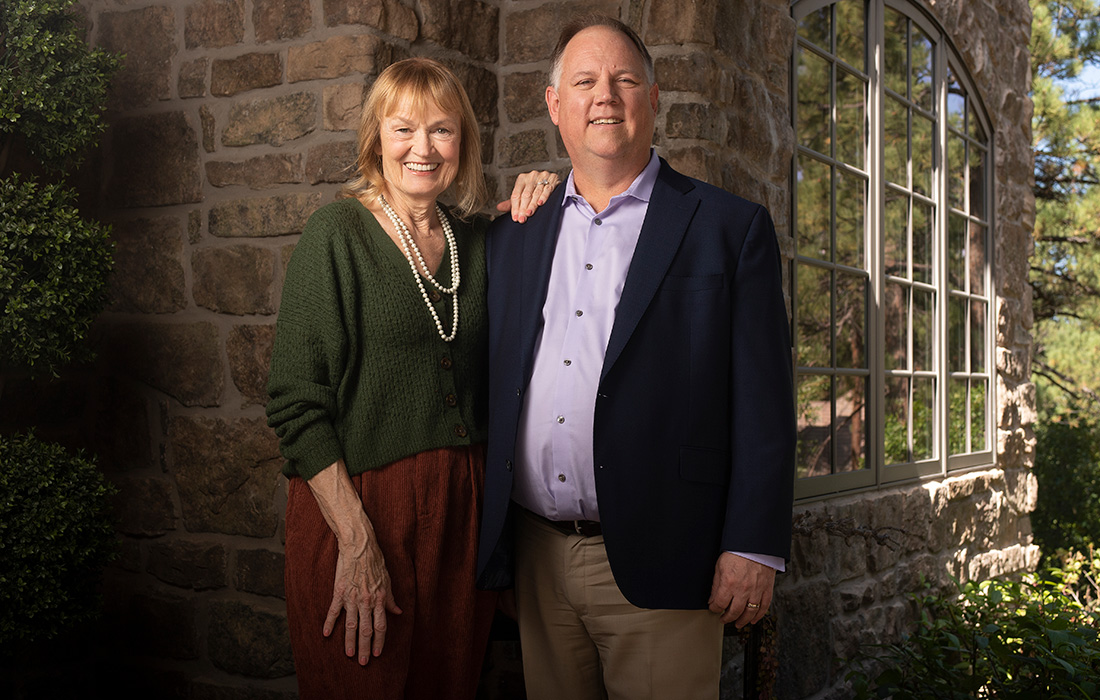
Cal Poly Pomona remained part of the story after it stopped being a line under education. Singelyn and his wife, Ruth, met there as undergraduates. She studied information systems and went on to work at IBM. The university’s place in their lives was shared, and so was the decision to support its next generation of business students.
A campus leadership forum in 2017 helped renew their relationship with the business college. Their support established the Singelyn Center for Innovative Analytics, including a visual analytics lab where students could work with faculty and professionals. It was a recognizable extension of his own training: bring business questions and computing tools into the same room, and give students work they can actually do.
Then came a $12.5 million commitment announced in 2022 to expand graduate business education. The graduate school took the Singelyn name. The gift supported more than a sign on a building: plans included broader master’s offerings, deanships, faculty support and scholarships. Support for students pursuing doctoral pathways was intended to help diversify the future faculty.
The educational ambition was specific. Singelyn wanted graduate programs to keep pace with changes in business, and he emphasized the ability to explain an analysis alongside the ability to produce it. “The value comes in not only the ability to produce, but also in the ability to explain.” It is a sensible demand from someone whose working life crossed both technical and executive roles.
A splendid chart can still leave a room bewildered. His interest in communication gives the analytics work an essential companion: someone must make the result intelligible to colleagues who have decisions to make. The point is especially apt for business education, where technical precision and a shared understanding have to survive contact with each other.
David and Ruth were recognized as Distinguished Alumni in 2019, and both received honorary Doctor of Humane Letters degrees in 2024. His involvement also included university advisory and foundation roles. Those commitments connect the donor to the institution through time and attention as well as money. The return trip to campus became a continuing relationship.
Leaving a business other people can run
The succession plan announced in February 2024 gave the next chapter a clear timetable. Bryan Smith, AMH’s chief operating officer, would become chief executive on January 1, 2025. Singelyn would retire on December 31, 2024 and provide transition advisory services through June 2025. Smith had been with the company since 2012, making the handover a promotion from within its operating ranks.
In October 2024, as the transition approached, Singelyn looked back at what the company had accomplished: “we accomplished more than I ever imagined”. The remark is revealing beside the enormous numbers that now describe AMH. It leaves room for the founder who began by trying something small, even after the experiment became a national enterprise.
He also retired from the board at the 2025 annual meeting. The end of his executive tenure and the end of his trusteeship were separate steps. Together with the defined advisory period, they made the transfer of responsibility explicit. Delegation, the lesson he had identified years earlier in Canada, had reached the top of the organization.
There is a pleasing circularity here. A young accountant learned how businesses worked, an executive learned to let others lead, and a founder eventually handed his company to a colleague. Meanwhile, he and Ruth helped equip students for careers whose destinations they could not predict. Three houses were enough to begin an experiment. Sustaining what followed required people who could carry it beyond its beginning.