Gregor Watson had a peculiar sales problem. He wanted to sell 500 rental houses in Dallas. The houses had tenants. In an ordinary business, paying customers would be an attraction. In a housing market organized around people buying somewhere to live, those customers complicated the sale. Emptying the houses could make them easier to market. It would also interrupt the thing an investor was buying: rent.
That is how Gary Beasley later described the idea behind Roofstock. Founded in 2015 by Beasley, Watson and Rich Ford, the company asked a sensible question: could an occupied house be sold as a working investment, with its tenancy intact?
- Keep the tenant. Make occupied rental homes easier for investors to evaluate and trade.
- Follow the owner. Add accounting, screening and property management.
- Mind the economics. Better information helps; borrowing costs and broken appliances still count.
The tenant was part of the product
Roofstock’s early marketplace assembled information investors usually had to collect separately: inspections, rental details and financial analysis. An investor elsewhere could study an income-producing house without first becoming an expert in every neighborhood. The seller could reach buyers who wanted a rental, rather than buyers waiting to move in.
The distinction mattered. A conventional listing sells the possibility of a home. An investment listing also has to explain the business already inside it. Who pays? What does upkeep cost? How credible is the projected income? Roofstock made that second set of questions central to the transaction.
Its founders knew the machinery. Beasley had operated a large rental business; Watson had built an investment firm; Ford came from investment banking in the sector. Their expertise was in making scattered houses legible as a portfolio. That is a different assignment from helping a family choose a kitchen.
A marketplace meets the mortgage rate
By March 2022, Roofstock reported more than $5 billion in transactions. It announced a $240 million Series E led by SoftBank Vision Fund 2, at a $1.94 billion valuation. The financing came with plans to double the workforce. Those figures capture the confidence of that moment; the valuation belongs to that round.
Then came cuts: 20% in October 2022, followed by 27% in March 2023. Expansion had run into a housing slowdown.
The chronology exposes a limit to the marketplace idea. Smoother transactions can remove friction, but they cannot make an expensive mortgage cheap. A buyer still needs the rent and purchase price to support the financing. When that arithmetic becomes harder, a better screen does not automatically produce another sale.
The work after the wire transfer
Roofstock had already begun widening its remit. It acquired Stessa in 2021 and RentPrep in 2022. The logic was straightforward: an owner who is finished buying still has books to keep, applicants to screen and a property to run. These jobs persist between transactions.
In May 2024, Roofstock and Mynd merged. Beasley initially remained CEO; Mynd co-founder Doug Brien became president. Current company materials list Brien as President & CEO and Beasley as Executive Chairman. The combination brought investment transactions and property management into the same corporate family, with management continuing under the Mynd brand.
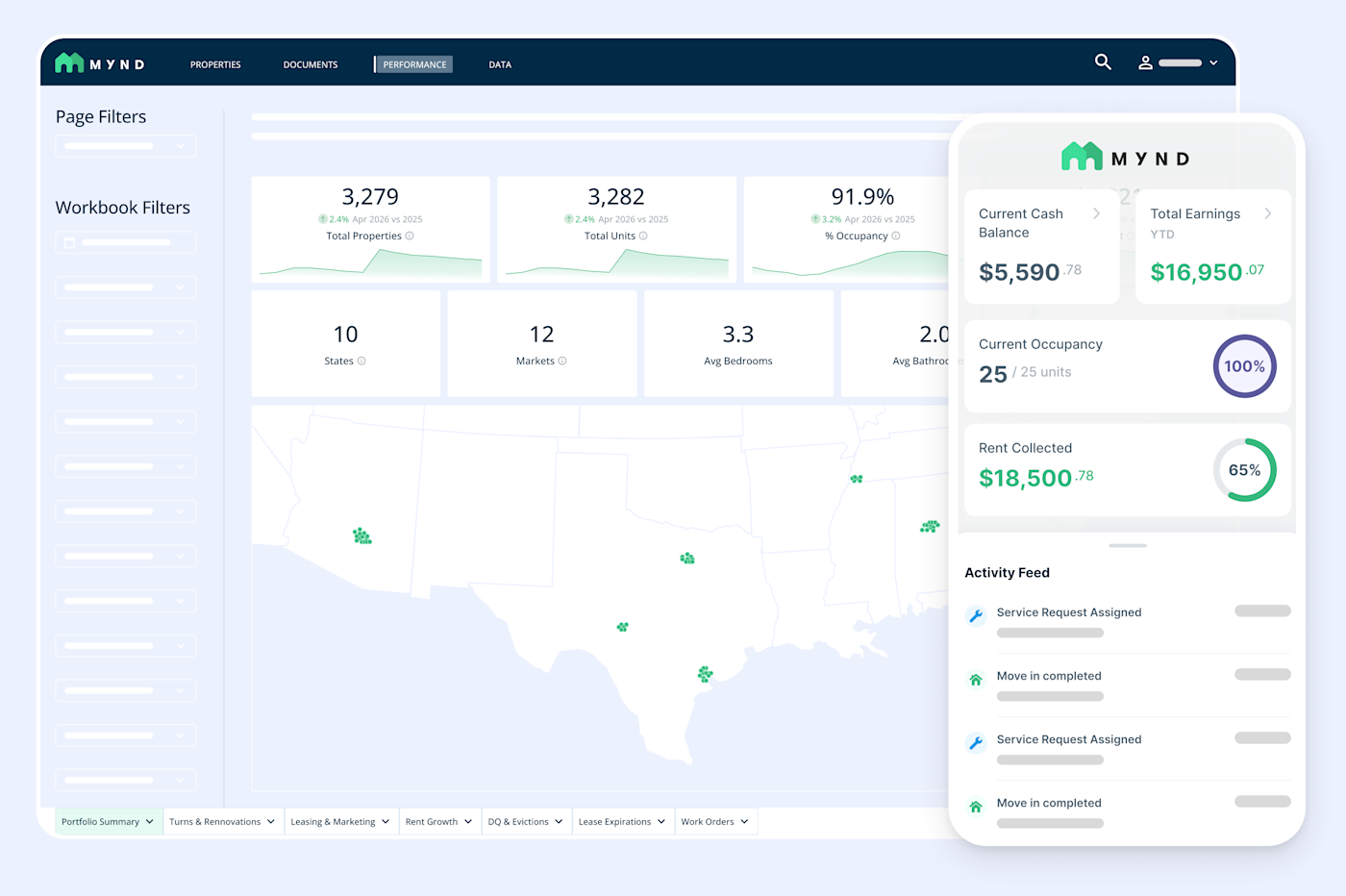
Today, the customer can be a first-time landlord, a family office or a fund. Individual property searches run through Stessa. Mynd manages single-family rentals and build-to-rent communities. Institutional services include sourcing, underwriting, asset management, valuations and sales. In October 2024, Roofstock announced that it had represented the seller in a nearly 1,700-home sale to AMH.
This puts Roofstock across several markets. A local broker competes for the transaction; a local manager competes for operations; landlord software competes for the owner’s records. Roofstock’s proposition is that connecting those jobs makes the whole investment easier to understand and run. The test is how well the handoffs work.
What “passive” costs
There is no single admission price for that collection of services. Stessa offers a free Essentials plan, with Manage at $12 a month and Pro at $28 a month when paid annually. Those are software subscriptions. Buying the house, borrowing the money and hiring management are separate expenses.
FreeEssentials
$12/moManage
$28/moPro
Roofstock’s business combines transaction services, management, software and screening; its disclosures also allow for partner referral compensation. Marketplace terms provide for a fee disclosed before the purchase agreement. Investors should judge the actual service contract alongside the property economics, including vacancy, taxes, insurance, repairs and reserves. A tidy dashboard is useful precisely because the underlying expenses are untidy.
Keep the decisions that matter
In a September 2026 interview, Brien argued that owners should retain control over rent approvals, turnover costs and repairs above a defined threshold. His point offers something readers can copy: delegation works better when approval rights are explicit. Decide which expenses need permission before the maintenance request arrives.
“The truth is that you probably need 5,000 doors with good market concentration to make it work.”
Doug Brien · on running property management internally · September 2026
That is Brien’s estimate, not a universal threshold. Density, technology and operating model change the calculation. Outsourcing may be less attractive to an owner with an efficient local team; national coverage is less useful when the provider cannot serve the markets a portfolio needs. Roofstock’s approach depends on execution as much as information.
The company is testing that execution beyond long-term leases, too. In May 2025, it announced an investment in Casago and short-term rental operations in Charleston, Tampa/St. Petersburg and the Oregon Coast. The owner now needs a guest experience as well as an income statement.
Go back to those Dallas houses. Roofstock began by recognizing that the tenant could stay while ownership changed. Its broader business follows the consequence: the property must keep working after the transaction. Someone still has to answer when the water heater stops.