Dave Hershberger’s career has the shape of a round trip. A teenager takes a job in production. He studies engineering, starts a company, brings it back into the orbit of his original employer, and eventually leads the combined business. By the time he hands over the chief executive’s job, the place where he began has become a company whose board he will chair. The return journey takes more than four decades.
The beginning was considerably less tidy than the retrospective. In the late 1970s, Hershberger was a high school student working part time at Prentke Romich Company in Ohio. Asked later about that period, he recalled: “Back then, I really didn’t know where I was going or what I was doing.” A production department is an admirably practical place to begin answering that question. There are things to make, and people who need them.
The work became a reason to keep learning. He attended the University of Akron in the evenings and earned a bachelor’s degree in electrical engineering. His working life moved through manufacturing, service, product development, and research. Those are different vantage points on the same object: how it is made, what happens when it goes wrong, and what the next version ought to do.
The founder who kept a connection
In 1996, Hershberger established Saltillo Corporation. He had already worked on communication devices at PRC; now he was developing a business around portable products with a simpler language interface. His new company addressed a different set of communication needs, extending the range of choices available to people using the technology. Starting another business meant taking on uncertainty without abandoning the field he knew.
Barry Romich, PRC’s cofounder and Hershberger’s mentor, supported the venture. Their connection adds an unusual wrinkle to the familiar tale of an employee leaving to become a founder. The older company had helped train someone who would now create another participant in its market. Mentorship, in this instance, left room for a separate company and a separate bet.
Years later, Sarah Wilds described an understanding between Hershberger and Romich: if the venture succeeded, PRC could buy it back after ten years; if it failed, Hershberger carried the risk. That account gives the relationship a pleasingly businesslike warmth. Encouragement was available. A guarantee was not. The arrangement also left open a future in which the two enterprises might belong together.
The acquisition came in late 2007. Hershberger continued leading Saltillo. The company he had built could retain its identity while joining a larger organization. Seen across the whole career, founding Saltillo was an outward journey that created something worth bringing home.
- 1978Begins at PRC
- 1996Founds Saltillo
- 2007Saltillo joins PRC
- 2019Leads the merger
- 2025Moves to board chair
Two names, then a hyphen
A merger can look like a single event when printed on a timeline. The work around it takes longer. PRC and Saltillo operated within the same family for years before their formal combination in 2019. Hershberger’s responsibilities increasingly crossed the boundary between them, including oversight of engineering as chief technology officer. The business structure gradually caught up with the connections already forming inside it.
His selection as chief executive was announced in November 2017, with the appointment effective January 1, 2018. He succeeded Dave Moffatt. In 2019, he led the merger that produced PRC-Saltillo. The hyphen is useful shorthand, although it conceals an unusually circular succession: a former production worker returned to lead the enterprise that had acquired his own company.
The product history gives this corporate story some texture. Saltillo introduced the TouchChat app in 2010 and its Android-based NovaChat 7 in 2012. PRC brought its LAMP Words for Life app to market in 2012. In 2020, the combined company released its first two products carrying both brands, AeroSwitch and Via Pro. Different technical paths were now represented within one organization.
PRC-Saltillo is employee owned. That fact belongs in Hershberger’s story because it describes the institution he led: ownership reaches beyond the founder or the executive office. A career that began among the people making the products eventually placed him in charge of a company owned by its employees.
A conversation ought to travel
One of the more revealing items in Hershberger’s working record is a paper presented at the 2012 Communication Matters conference. Its subject was access to social media through communication devices. Published in 2013, it considered an everyday problem: conversation had spread across email, instant messaging, text messages, and social networks, while the tools used to take part had not always kept pace.
The engineering question was concrete. Could online content come into a familiar communication interface, allowing someone to use the same controls and vocabulary pages they already knew? His paper explored using application programming interfaces to make that possible. It described bringing Facebook content onto NovaChat buttons and reported that beta testers found the interface more accessible than other approaches they had tried.
There is a quiet change of scale in that work. A device might help with an exchange across a table, but a person’s conversations also continue after everyone has gone home. The next message may be a reply to a friend, a family update, or a small contribution to a sprawling online discussion. Designing for those exchanges means following communication into the places people actually use it.
The words belong to their speaker
By March 2021, Hershberger was addressing another consequence of connected communication: data privacy. In material prepared for an ISAAC webinar, he explained how language data could improve word prediction. A system could begin with patterns gathered across many people, then adapt to the vocabulary and habits of the individual using it. Better predictions could make the tool more useful.
He also acknowledged that collecting such data could intrude on privacy. Manufacturers, he argued, needed to explain what they collected, who could see it, how it was protected, and what purposes it served. The person using the technology should have the final decision. He pointed out that the involvement of younger users made these choices more complicated.
It is an instructive position for an engineer running a technology company. The ability to measure something introduces a question about permission as well as performance. A conversation can be valuable to a system designer and still belong to the person having it. Hershberger’s contribution put that tension in view rather than treating improved prediction as an answer to every question.
A vocabulary needs somewhere to go
Language also runs through Hershberger’s connection to Bruce Baker, the linguist behind Minspeak, which represents language using icons with multiple meanings. Hershberger worked closely with Baker over many years. When PRC-Saltillo introduced the Minspeak Academy in October 2022, the undertaking extended beyond maintaining software: it established a dedicated home for education around the system.
The academy followed PRC-Saltillo’s acquisition of the Minspeak intellectual property in 2020. Training was integrated with the company’s AAC Learning Journey resources, including options for learning on demand. Keeping a vocabulary system useful requires people who understand it, places to ask questions, and teaching that can survive its original creators. Ownership of the underlying rights is only one piece of that work.
A related effort reached across languages. PRC-Saltillo partnered with ISAAC on the Bruce Baker AAC Globalization Initiative, supporting vocabulary development, translation, and materials in languages with fewer available communication resources. Hershberger appeared in the video announcing the inaugural recipients. The selected team’s project involved developing a family of Mandarin vocabularies.
The initiative connected a financial award with software and a route into actual devices and apps. That combination matters: a translated file needs a way to reach the people who will use it. Here, the company’s products became part of the delivery route for work developed with partners outside the business.
A detour through the playground
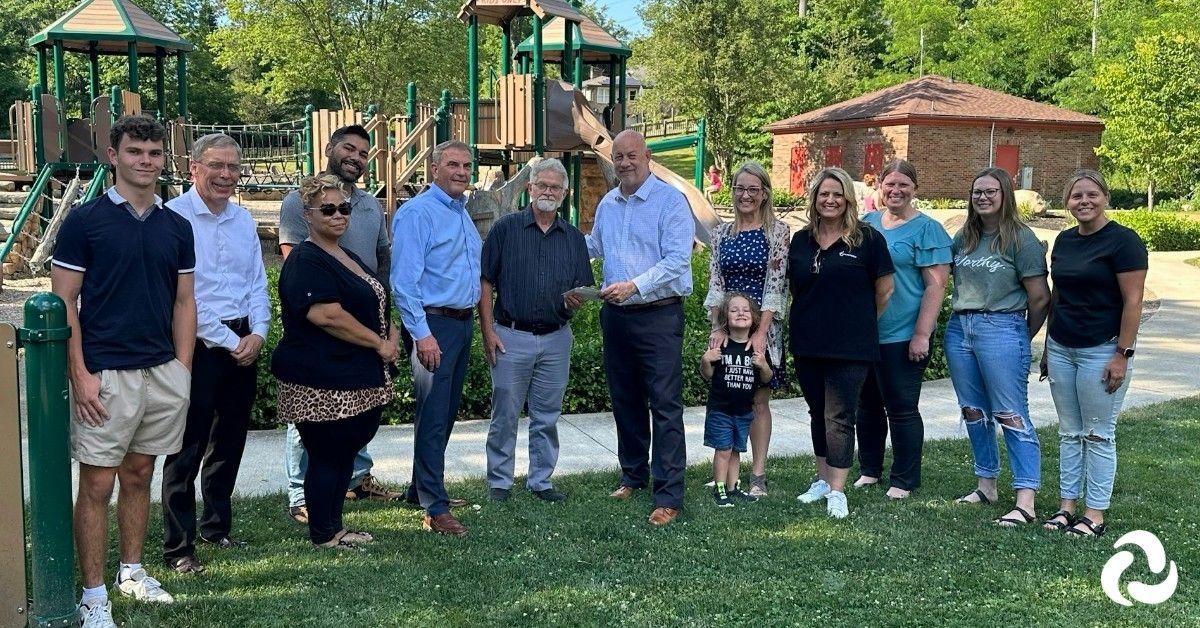
On June 24, 2024, Hershberger’s work brought him to Christmas Run Park in Wooster. He and board chairman Steve Matthew presented the city with a $10,000 company gift toward communication boards in local parks. Stacey Everhart had advocated for the project on behalf of her son Wesley. Community donations, the city’s recreation team, and IncludeAbility were also part of the effort.
The plan was to make five boards possible within the following year. These are large boards displaying symbols that people can use to communicate. After decades spent with electronic devices and software, the park project offered a particularly tangible expression of the same concern: making it easier to join in where other people already gather.
The group photograph has playground equipment behind the participants and grass under their feet. It is a useful companion to the dates and titles of an executive biography. Technology careers eventually meet ordinary places. In this case, one of those places had slides.
The handoff, and the next seat at the table
In November 2024, PRC-Saltillo announced Hershberger’s retirement as chief executive and named chief operating officer Sarah Wilds as his successor. She took over on January 1, 2025. He was to support the transition through March 31 and join the board as chairman. His next role kept him connected to the company while daily leadership passed to someone else.
Wilds had her own long relationship with the business, beginning with a student internship in 1995 and followed by roles across the organization. The handoff therefore carried an echo of Hershberger’s own route: a company encountered early in working life had become a place to build a career. Continuity can be an organizational habit as well as an individual choice.
Hershberger’s story is full of changing responsibilities: employee, engineer, founder, executive, board chair. The thread through them is remarkably steady. He kept working on how people could express themselves, as devices changed and conversations moved to new places. Asked in 2017 what he would tell the teenager beginning that first job, he offered a compact forecast: “It’s going to be a wild ride!” The teenager certainly found enough to keep him occupied.
“I have the greatest confidence in Sarah’s ability to lead the company through its next chapter.”
Dave Hershberger, November 2024