Tim Thornton had agreed to start a company. There was one small administrative omission: he had not chosen its name. In 2009, changes to government conflict-of-interest rules had left him weighing a new business against staying with his employer in a leadership role. After several days of consideration, his employer’s chief executive wanted an answer. Thornton chose to go. The stationery would have to catch up.
That decision became nLogic, the Huntsville engineering and technology company founded with investment from its initial employees. By 2017, it was entirely owned through an employee stock ownership plan. In January 2026, Thornton handed the chief executive’s responsibilities to Kevin Langjahr and became strategic advisor, continuing on the board. The business now has a name, an ownership structure, and a successor. A founder’s biography ought to make room for all three.
The engineer before the executive
Thornton arrived in Huntsville in 1981 with $1,000 and paid his own university expenses. He earned his undergraduate engineering degree at the University of Alabama in Huntsville in 1986, followed by a master’s in electrical engineering in 1994. As a boy, he had visited UAH for a science fair and gone to the U.S. Space & Rocket Center. The attraction to rockets preceded the company paperwork.
His working life began close to research. A co-op position as a research technician at Georgia Tech Research Institute appears at the beginning of his professional history. Later came responsibility for advanced technologies at Coleman Research Corporation and System Studies and Simulation. These are useful details in a founder’s story. Before he was responsible for a whole business, he had worked inside the technical organizations whose people and projects a business must support.
At Davidson Technologies, Thornton became a vice president and board member. He subsequently founded Torch Systems, a wholly owned subsidiary of Torch Technologies, and served as its president. nLogic therefore followed an earlier experience of establishing and leading an organization. The 2009 decision had uncertainty in it, but the person making it had already spent years learning what engineering work looks like from the laboratory, the division office, and the boardroom.
UAH selected him as a College of Business fellow for 2016-2017. There is a pleasing practicality to an engineering graduate returning under that heading. His career had expanded to include management, marketing, advisory services, commercial products, and international programs. Technical knowledge remained part of the job. So did explaining the work, winning it, organizing it, and finding people able to carry it out.
The people doing the work own the company
nLogic’s ownership began with the people joining it. The initial employees invested, and the company established both an Employee Stock Ownership Plan and an Incentive Stock Option Plan to provide future ownership opportunities. Its transition to full ESOP ownership came eight years after founding. That chronology matters because employee ownership was part of the original arrangement, before it became the arrangement for the entire company.
Ownership is easy to praise in a sentence. The more interesting question is how an employer gives it a working form. nLogic’s benefits describe an ESOP through which employees have beneficial ownership, with company contributions approved annually by the board. Alongside it sits a retirement plan with employee contributions, company contributions, and profit sharing. These are separate arrangements, with their own descriptions and purposes.
Other provisions are smaller and more domestic. Eligible employees can obtain interest-free loans for computer equipment and software for themselves or their families. Tuition reimbursement supports qualifying college work, while training includes seminars, courses, and conferences relevant to a person’s assignment. A computer on the kitchen table is a less ceremonial symbol of company culture than a plaque in reception. It may also get more use.
The company’s letter to employees and clients connects ownership with responsibility for customer goals. It describes employees being empowered to make decisions and solve problems efficiently, while working within limits of technology, schedules, and money. Those limits belong to the same picture. Owning a stake in an engineering contractor does not abolish deadlines. It gives the people meeting them another connection to the outcome.
A founding investment by employees became full employee ownership eight years later.
A first contract with a second life
One of Thornton’s earlier employers reappears in nLogic’s history as something else: its first customer. Davidson awarded the new company its first contract. Thornton had worked under the mentorship of Julian and Dorothy Davidson. The relationship subsequently acquired another form through DTechLogic, the joint venture between Davidson Technologies and nLogic. A career connection became an early commercial connection, and later a partnership.
In 2022, Davidson announced that a stay of performance had been lifted on the Missile Defense Agency’s Advanced Research Center contract and that DTechLogic would begin work immediately. The announcement described a total contract value of $146 million, a five-year base, and three option years. Those figures describe the contract awarded to the joint venture; they are not nLogic’s annual sales or Thornton’s personal balance sheet.
The work also gives some substance to the phrase “defense engineering.” nLogic’s capabilities include systems integration, modeling and simulation, software development, and test and evaluation. Requirements must be translated into designs; designs need verification; components need to work together. In simulation and testing, the job can involve learning how a system behaves before relying on it in the field. Much of the value resides in the checking.
For Thornton, the Davidson partnership carried a history that a contract number could not convey. His response singled out that first award to the young business. By the time of the joint venture’s announcement, the relationship had outlasted several changes in his job title. The story offers a concrete example of professional continuity: people move between organizations, then discover reasons to work together again.
“Davidson awarded us our first contract when we started the company and this is a special win for nLogic.”
Tim Thornton, 2022
Back at the university, holding an award
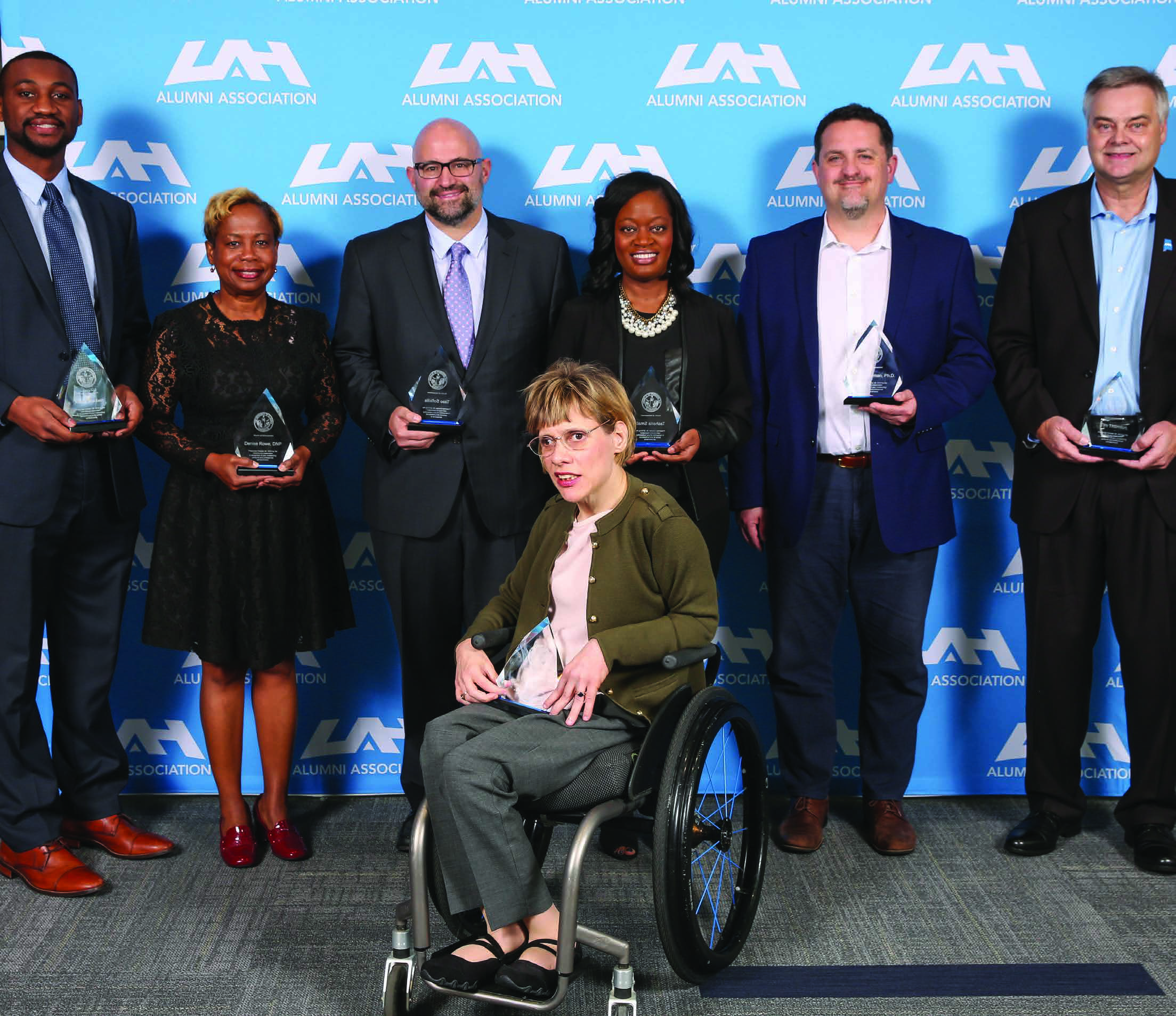
In 2019, Thornton received UAH’s Alumni of Achievement Award for the College of Engineering. The university created the award to recognize graduates’ professional accomplishments, community service, and support for UAH. His degrees supplied one connection to the institution. Board and advisory service supplied others, including the UAH Foundation, its Research and Technology Corporation, and advisory boards for the colleges of business and engineering.
His civic work also reaches beyond the campus. His record includes service with the Huntsville/Madison County Chamber of Commerce, the Better Business Bureau, HASBAT, and Cyber Huntsville’s advisory council. He graduated from Leadership Huntsville/Madison County’s Class 29 and received the Chamber’s Russell G. Brown Executive Leadership Award in 2016. Taken together, these commitments place his business career inside a network of local institutions.
There is an employee counterpart to that civic involvement. nLogic nAbles operates as an employee-run charitable organization, giving employees a way to direct donations toward qualifying local nonprofits. Its stated arrangement applies all donated funds to grants. The distinction is practical: employees participate in choosing the organizations that receive support. Community giving becomes another activity with a defined means of participation.
The founder changes chairs
Langjahr became nLogic’s president and chief executive on January 1, 2026. He had been with the company since its inception and had become president and a board member in 2024, after serving as vice president. The sequence put an intermediate step between the earlier role and the eventual appointment. Thornton’s move to strategic advisor was announced as part of that planned succession, with continued board service and support for corporate development.
The personal history behind the announcement was unusually long: Thornton said he and Langjahr had worked together for more than 26 years. That relationship preceded nLogic itself. A successor who knows the business from its beginning brings a different kind of familiarity to the office. Employees and customers can recognize the person taking responsibility as well as the title on the announcement.
Thornton described the leadership change as the completion of a detailed succession plan. His stated intention was to help ensure a smooth transition. Langjahr, in turn, emphasized shared responsibility and long-term thinking within an employee-owned company. These are commitments the next chapter will have to make concrete through everyday decisions. The announcement supplies the arrangement: a new chief executive, a continuing advisor, and an employee-owned business moving forward.
There is an appealing symmetry here. Thornton’s first step toward nLogic came when someone required a decision about his future. Seventeen years later, he helped implement a decision about the company’s future leadership. In between came the work of building an institution that other people could own and another person could lead. The name was settled long ago. The work continues.
Follow the working life
Explore nLogic’s leadership, Thornton on LinkedIn, the 2026 succession announcement, and the DTechLogic contract announcement.
Watch Thornton’s 2016 leadership award acceptance speech and his 2017 Huntsville Open Tech Coffee appearance. Read the UAH alumni profile and view the 2019 university annual report.