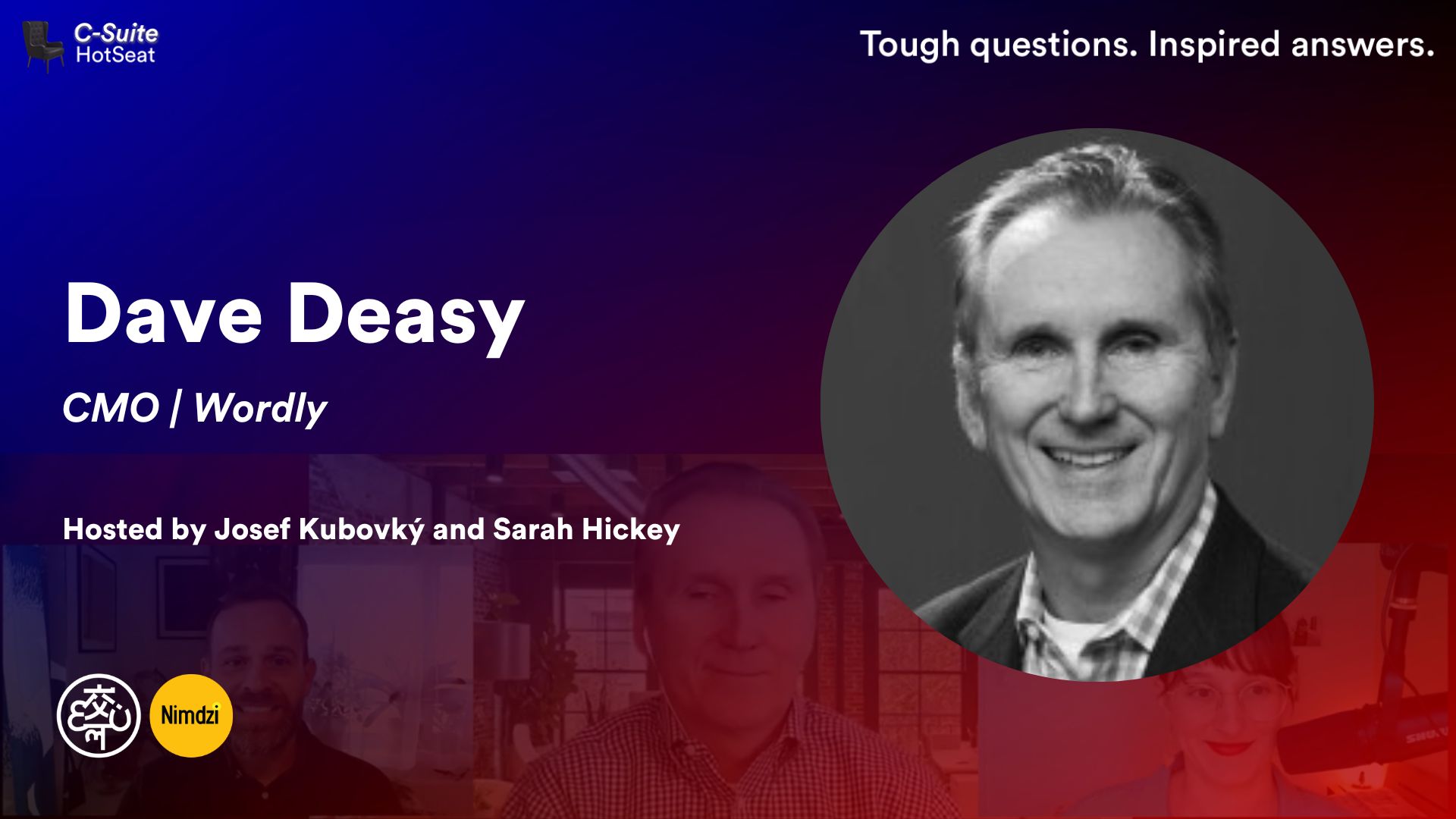
The phrase “live translation” suggests a theatrical trick: one person speaks, another language appears, and the room carries on as if Babel had merely been a bad software release. Dave Deasy’s work begins after the trick. As chief marketing officer and senior vice president of marketing at Wordly, he has to explain why the translation matters, how it fits into an ordinary meeting, and whether the person who needs it can join without a manual, a headset rental, or a small diplomatic mission.
This is a fitting assignment for a marketer whose career has repeatedly placed him beside technology that is consequential but hard to see. At HP, the subject was consumer e-commerce. At AOL, online services for small businesses. MarketTools brought web surveys; Phoenix Technologies brought software close to the machinery; TrustArc brought digital privacy; OPSWAT brought protection for critical infrastructure. Wordly brings speech rendered as captions and audio in the listener’s chosen language, in real time.
The nouns keep changing. The job underneath them does not. Deasy takes systems built by specialists and gives buyers a plain reason to care.
A career in four translations
An engineer learns the economy of a clear sentence
Deasy did not begin with the standard apprenticeship in ad copy. He earned a bachelor’s degree in mechanical engineering from the University of Pittsburgh, then an MBA from Carnegie Mellon’s Tepper School of Business. The combination feels less like a detour than a clue. Engineering asks what a system does and under which conditions it fails. Marketing, practiced well, asks the same questions in public.
His early operating roles put him inside the first broad commercialization of online behavior. He led marketing and operations for HP’s consumer e-commerce business and business operations for AOL Small Business. From 2003 to 2007 he founded MyFavoriteCity.com, then moved to MarketTools, where he served as vice president of SaaS marketing and general manager of the Zoomerang online survey business. He later led marketing and sales for consumer software at Phoenix Technologies.
These were not merely successive logos. They were lessons in asking people to do familiar things through unfamiliar interfaces: buy, manage a business, answer questions, trust software beneath the screen. Deasy also taught e-commerce to MBA students at Santa Clara University for two semesters in 2000 and 2001. Teaching is useful training for a marketer. Confusion cannot be blamed on the audience for very long.
The decade when trust became a product
At TRUSTe, later TrustArc, Deasy entered a category with a peculiar communications problem. Privacy is important precisely when nothing dramatic happens. The company was known for website certification, but its ambitions widened into enterprise software for managing data privacy and compliance. Deasy led marketing and product-management work during that transformation.
His public writing from the period is notably direct. “With free services, consumers are the product,” he wrote while discussing mobile privacy. He argued for understandable policies, transparent data collection, and controls designed into the product from the beginning. The subject was regulation and software, but his language stayed close to an ordinary person deciding whether a company deserved confidence.
That period also sharpened the commercial side of trust. Privacy was no longer a seal tucked into a website footer. Customers and business partners increasingly wanted proof that an organization could document compliance. The invisible quality had acquired budgets, platforms, and executive attention. Deasy’s role was to help name the category while it was still taking shape.
In 2020 he moved to OPSWAT, a cybersecurity company focused on critical infrastructure. There, the language became channel programs, resellers, system integrators, and global coverage. An expanded partner program involved more than 50 partners across over 20 countries. Once again, a technical system needed a human distribution system around it.
When the metaphor became literal
Deasy joined Wordly in 2022. The company had launched its live AI translation and captioning product three years earlier and was moving from event novelty toward working infrastructure. A presenter speaks. Attendees scan a QR code or follow a link. They read captions or hear translated audio on their own devices. No audience account is required. The complexity sits backstage.
His neatest formulation flips the usual demand placed on a multilingual audience. “Instead of requiring the audience to adapt to an event,” he has said, “AI-powered translation adapts to the audience.” It is a product sentence with a moral center. The listener should not have to apologize for arriving with the “wrong” language.
The use cases have expanded accordingly. Conferences remain an obvious home, but Wordly now discusses council chambers, employee training, classrooms, nonprofit gatherings, theaters, and religious services. These settings share little except a speaker, a group of people, and the cost of being misunderstood.
In May 2026, Wordly announced that it had delivered one billion minutes of live translation and captions to six million users across 5,000 organizations in 120 countries. Deasy made the first number graspable through cheerful absurdity: counting to a billion would take 31 years; in that span one might walk around Earth 3,300 times or brew 200 million pots of coffee. Marketing often consists of building a sensible bridge between a number and a mind.
Three months later, Wordly reported 668 percent revenue growth for the period measured by the 2026 Inc. 5000. It ranked No. 521 overall, up 1,186 places from the prior year, and No. 52 among software companies. Deasy credited the result across functions: technology development, sales, customer success, company leadership. A CMO taking a victory lap by naming everyone else is a small but revealing gesture.
Climbing the Inc. 5000 - lower is better
The team is part of the message
Deasy describes himself as a full-stack marketing executive, a phrase that can sound like a cupboard filled with acronyms. In his case, it refers to a long practice across brand, product marketing, digital work, demand generation, and operations. His public biography credits programs he has led across companies with more than $400 million in sales growth and more than $200 million in funding. Those figures span a career, not one campaign, and their more useful meaning is range.
Former colleagues fill in the manner. One remembered Deasy taking charge of a marketing department during the pandemic, with people scattered across disciplines and time zones, yet remaining people-focused, detailed, solution-driven, and optimistic. Another, who worked with him for three years at TRUSTe, recalled a strong partner to sales who built a broad demand-generation team and was “a lot of fun to work with.” Competence is often praised in abstractions. Fun is refreshingly difficult to counterfeit.
There are clues beyond the office. Deasy spent seven years coaching AYSO soccer and four coaching Little League baseball and softball. Coaching children provides a ruthless education in instructions: if nobody understands the drill, eloquence is irrelevant. He also holds credentials in digital marketing, privacy management, and cybersecurity, suggesting a willingness to keep becoming a student inside the categories he is paid to explain.
A language for the next ordinary meeting
The immediate temptation with AI is to lead with astonishment. Deasy’s advice is steadier. Begin with the problem. For an event planner, that might be an audience spanning several native languages and a budget that cannot stretch to a team of interpreters. For a city, it might be residents who cannot follow a public meeting. For a church, it might be neighbors who live nearby but remain outside the conversation.
His price comparison is brutally compact: Wordly costs roughly the same as one human interpreter while offering 60 languages. The point is not that software and people are identical. It is that the old economics forced organizers to choose which language communities could be included. Software changes the number of choices available at once.
Deasy’s current aspiration is visible in how he talks about Wordly’s expansion. Large conferences proved the model; everyday meetings are the larger territory. The company’s rebrand in early 2026 presented translation, captions, transcripts, summaries, and dubbed content as one continuous layer across the life of a meeting. A global summit is dramatic. A Tuesday stand-up is where habits become infrastructure.
A career that began around online commerce has arrived at a product concerned with understanding. The progression is tidier in retrospect than it could have felt while living it. Yet its through-line holds. Deasy has kept choosing markets where technical sophistication is abundant and clarity is scarce. His work is to close the distance.
That sentence does not ask the reader to admire artificial intelligence. It asks the organizer to notice the person who can now take part. For a marketer of translation, this may be the cleanest possible ending: the product gets quieter, and the room gets larger.