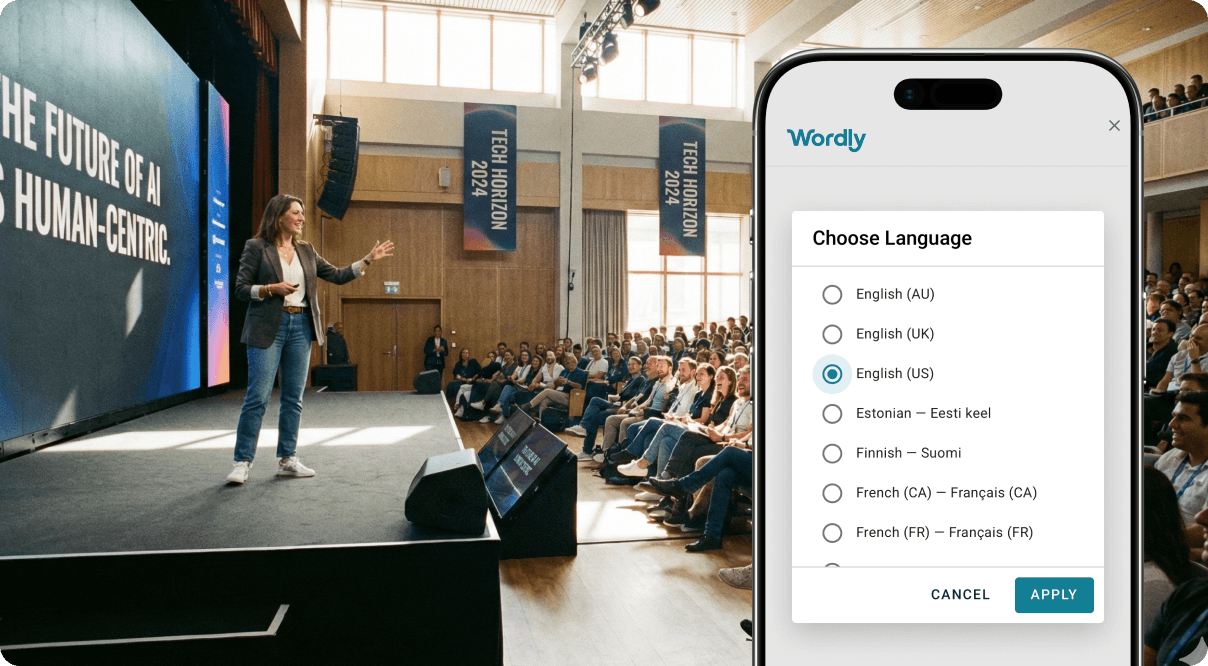
It's a packed conference hall, and nobody is wearing a headset.
Picture the keynote. A few years ago, a multilingual audience meant a booth in the back, two interpreters per language, a rack of receivers, and a budget line nobody enjoyed signing. Today the same audience pulls out their phones, scans a QR code, and the talk arrives in their language in real time - audio, captions, or both. The booth is empty. The translation is live on the glass.
That quiet swap is Wordly's whole business. The company, founded in 2017 and run out of the San Francisco Bay Area, sells cloud-based AI translation, captioning, transcription and summaries for meetings and events. More than 5 million people have now followed along through it, across 4,000-plus customers in 120 countries. In 2025 it landed on the Inc. 5000 list of fastest-growing companies.
"Nobody misses a word."
Wordly's mission, in three wordsLanguage is the most expensive seat in the room.
Human interpretation is excellent and scarce. It needs trained professionals, equipment, scheduling, and a price tag that climbs with every language you add. So organizations did the rational thing: they picked one language, usually English, and quietly hoped everyone could keep up. Plenty couldn't.
The cost wasn't only money. A city council holds a meeting that half its residents can't follow. A company runs an all-hands where its overseas teams nod politely and miss the nuance. A theater stages a show that a deaf patron experiences as silence. The technology to fix this existed in pieces - speech recognition, machine translation, text-to-speech - but nobody had stitched them into something an event organizer could switch on without a manual.
Interpretation is wonderful. It is also booked solid, two weeks out, in only the languages you could afford.
The gap Wordly walked intoOne engineer, 25 patents, and a stubborn idea.
Lakshman Rathnam started Wordly in 2017. His background is in human-machine interfaces, acoustics and audio - the unglamorous plumbing of how machines hear and speak - and he holds more than 25 patents. The bet was specific: that AI had finally gotten good enough to do live, multi-language translation that people would actually trust in a real meeting, not just a demo.
It was not an obviously safe bet. Machine translation in 2017 was the thing everyone mocked for mangling menus. Doing it live, out loud, in front of an audience, with no second take, raised the difficulty considerably. Rathnam's wager was that the quality curve would keep bending - and that being early to the live, event-shaped version of the problem would matter more than waiting for perfect.
He bet the awkward demo would become the obvious default. So far the audience keeps growing.
On Lakshman Rathnam, Founder & CEOThe short version of nine years
No app. No headset. A QR code does the introductions.
The mechanics are deliberately boring, which is the point. A speaker talks. Wordly transcribes, translates and - if you want - voices the result, then pushes it to every attendee's own device in their chosen language. It runs inside Zoom, Microsoft Teams, Google Meet, Webex and Cvent's Attendee Hub, and works just as well for a room full of people staring at a screen.
Live Translation
Real-time audio and on-screen translation across 60+ languages and 3,000+ language pairs.
Captions & Subtitles
Live captions and video subtitles for in-person and virtual sessions.
Transcription
Voice-to-text records of every session, ready for accessibility and archives.
AI Summaries
Automated post-event recaps generated from what was actually said.
Custom glossaries keep the proper nouns intact, a translation API plugs it into other systems, and SOC 2 Type II and ISO 27001 compliance is there so the security team signs off. Two attendees who share no common language can sit in the same talk and each follow along - which is the trick interpreters could never scale to.
The cleverest thing about it is how little the audience has to do. Scan, pick a language, listen.
On the Wordly experienceThe numbers, before the adjectives.
Reach, in the units the company reports
Reach is one thing; range is the convincing part. Wordly has translated San Jose city council meetings and Los Angeles County wildfire alerts. It has made the off-Broadway show The Perfect Crime accessible at the Theater Center in New York. It powers multilingual conferences like Cvent Connect and IMEX. The customer list runs from EY and Eli Lilly to Hyatt, Bloomberg, USC, The Nature Conservancy and the United Nations Foundation.
The partnerships matter as much as the logos. As a Cvent Premier Alliance Partner, Wordly translation lives inside the Attendee Hub millions of event-goers already use. Integrations with Zoom, Teams, Meet and Webex mean it shows up where meetings already happen, instead of asking anyone to move.
From a council chamber to a Broadway aisle to a wildfire alert. The thread is the same: someone who would have been left out, wasn't.
Where Wordly actually runsAccessibility, sold as a feature you can afford.
Plenty of companies talk about inclusion. Wordly's version is unsentimental: it makes inclusion cheap enough that organizations choose it without a values memo. When adding a language costs a fraction of an interpreter booth, the city adds the language. When captions are a toggle, the webinar turns them on. The mission travels on economics, which is usually how missions actually travel.
That framing also explains the push into local government - the City of Vancouver, San Jose's council, county emergency alerts. Public bodies have a legal and civic obligation to be understood, and rarely the budget to be understood in eight languages at once. It's a market and a public good wearing the same coat.
If your organization values inclusivity, Wordly is a game-changer.
A customer review, G2The headset isn't coming back.
Real-time translation is getting cheaper, faster and more lifelike every quarter, and the competition - Interprefy, KUDO, Interactio, plus big-tech captioning features - is crowding in. Wordly's edge is being early to the event-shaped version of the problem and wiring itself into the platforms organizers already run. Whether that lead holds as the models commoditize is the open question, and a fair one to ask of any AI company in 2026.
But the direction is hard to argue with. Every meeting that goes multilingual without a second thought is a meeting that used to leave someone out. Multiply that by 5 million people and you get a quiet change in what "everyone is invited" actually means.
Back in that packed hall, the booth is still empty. Nobody noticed it leave. Everybody understood the keynote.
Closing the loop on the opening sceneWhich is the whole trick, really. The best accessibility technology is the kind nobody talks about afterward - because there was nothing to fix, nothing to apologize for, and nobody, as the company likes to say, who missed a word.