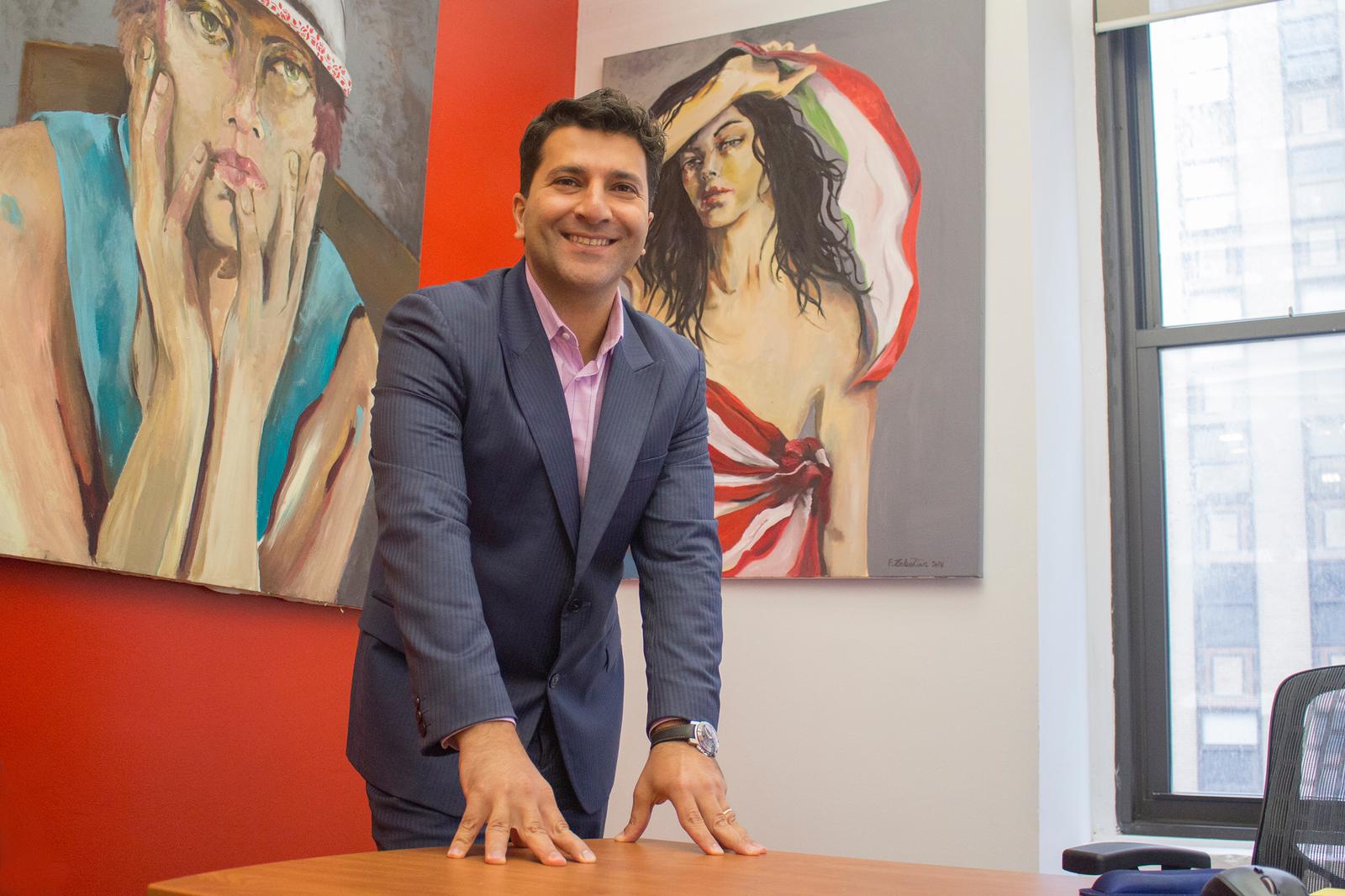
On a good day, several million minutes of conversation pass through Fardad Zabetian's software - board meetings, government sessions, town halls, product launches - and in most of them, someone in the room is hearing the words in a language other than the one being spoken. That is the whole point. KUDO, the company Zabetian founded and runs from a New York office on West 35th Street, exists so that language stops deciding who gets to take part.
Today KUDO is a cloud video platform with a deceptively simple feature: a dropdown menu of more than 200 languages, including sign languages, each one voiced by a live professional interpreter or, increasingly, by AI translation. A delegate clicks a flag and hears the meeting in their own tongue, in real time. Behind that dropdown sits an interpreter marketplace, custom glossaries, captioning, and the kind of low-latency audio engineering that most users never think about. The reason they never think about it is Zabetian's actual expertise. He spent two decades building the machinery of multilingual meetings before he ever moved it to the cloud.
The engineer under the diplomacy
Zabetian is Iranian by birth and an engineer by training. Before he turned 26 he was already building audiovisual and conference systems in Tehran and across Europe and the Middle East - the microphones, booths, and signal chains that let diplomats in a single hall speak dozens of languages at once. In 2000 he moved to the United States and finished graduate school in San Francisco, timing his arrival almost perfectly with the collapse of the dot-com bubble. A promised job at Sun Microsystems evaporated. So, in 2002, he started a company instead.
That company, Media Vision, sold conferencing hardware and language interpretation equipment to cities and institutions across the country. It grew fast. In 2007 he founded a second business, Conference Rental USA, leasing high-end interpretation gear. One early client set the tone for everything after: he supplied the interpreter infrastructure for the 2009 North American Leaders Summit, the meeting between Barack Obama, Canada's Stephen Harper, and Mexico's Felipe Calderon. A few years later he played a role in the 2012 redesign of the United Nations' meeting facilities, including the General Assembly Hall in New York - arguably the most famous multilingual room on earth.
KUDO by the numbers
Figures drawn from public company statements and press reports.
Turning cables into a dropdown
The pattern in Zabetian's career is a hardware man slowly realizing the hardware could disappear. In 2016 he co-founded AVAtronics, a Swiss company working on active noise-canceling technology for headphones, smart speakers, and conference systems. A year later, in 2017, he married what he knew about conference technology with the talent of highly skilled interpreters and launched KUDO, co-founded with chief language officer Ewandro Magalhaes - a partnership that, in Zabetian's telling, began with a chance encounter rather than a business plan.
KUDO's premise was that interpretation booths, receivers, and rented cables could all be replaced by a browser tab. For a few years it grew steadily and quietly. Then 2020 arrived, the world's meetings went remote overnight, and the quiet infrastructure company became essential. KUDO's usage jumped from roughly two million interpreted minutes a week to four million a day. The team went from ten people to a hundred in nine months. Two decades of unglamorous groundwork turned into an overnight success that was not overnight at all.
That distinction matters to him. Events are one-off spectacles; meetings are where organizations actually run - and where a language gap quietly excludes people every day. In 2021 the company raised a Series A round and launched KUDO Marketplace, described as the first platform-agnostic way to find, book, and pay professional interpreters, letting a customer schedule a human interpreter almost as casually as ordering a ride. Total funding for KUDO reached roughly $27 million.
Human, machine, or both
Zabetian is unusually clear-eyed for a founder in a field being reshaped by AI. He does not pretend machine translation is a fad, and he does not pretend it is finished. Simultaneous interpretation, he argues, is one of the hardest cognitive jobs there is - the interpreter has to hold legality, fidelity, and neutrality in their head while speaking and listening at the same time. KUDO's bet is not human interpreters versus AI, but a platform that can offer either, and often both, depending on what the moment requires.
“We are not naive,” he has said of the money pouring into AI. “We know that AI is being developed.” The company has leaned into speech-to-speech and AI-powered translation while keeping its marketplace of human professionals at the center. It is a pragmatic position from someone who has watched a physical industry go digital once already and knows the transition is never as clean as the pitch deck suggests.
The small details, and the big one
For all the summits and funding rounds, the anecdote Zabetian returns to is small. Early on, around 2003, his first customer was in Thornton, Colorado, and he could not reliably pronounce the town's name. Rather than risk fumbling it on a cold call, he spelled unfamiliar names out, letter by letter, until he had them cold. It is a tidy little emblem of how he works: an engineer's patience with detail, wrapped around a salesman's instinct for the human on the other end of the line.
He credits a lot of his outlook to staying present and filtering advice without chasing every piece of it. “It's important to listen,” he has said, “but it's also important not to get swayed or distracted.” One line that stuck with him came from, of all places, a spin-class instructor: the reminder that where you are today was once your dream. For a founder on his fifth company, gratitude is less a sentiment than a working tool.
Beyond KUDO, Zabetian sits on the Forbes Technology Council and puts his own money and time into the next wave: he is an angel investor in more than 20 startups and an active mentor to early-stage founders. Two of the companies he built earlier were named among the fastest-growing businesses in America. But the thread running through all of it is the one he keeps naming himself - the conviction that no one should be shut out of a conversation because of the language they happen to speak.
He has founded five companies - two of them before he turned 24.
He helped rewire the world's most famous diplomatic room: the UN General Assembly Hall.
His Swiss venture AVAtronics builds active noise-canceling tech for headphones and smart speakers.
KUDO's dropdown offers 200+ languages, including sign languages, voiced by live interpreters.