At 13, Dave Caputo was already finding fault with drywall. His best friend worked in the trade, following his father, and Caputo would hang around while the work got done. Years later, he could still remember suggesting that a leftover piece might fit above a door and being told it was not worth the trouble. An awkward material, a fiddly job, a piece going unused: the irritation stayed with him.
Plenty of people dislike home renovation. Few spend a career in networking technology, help take a company public on two exchanges, leave after its sale, and then return to an adolescent grievance with a manufacturing business. Caputo is now chief executive of Trusscore, which makes PVC wall and ceiling systems. His professional life has moved from the traffic inside the internet to the surfaces inside a room.
The change sounds abrupt until you look at how he gets started. His career contains a recurring interest in what people will need next, and in the people who can build it. Sometimes the prompt has been an investor’s phone call. Sometimes it has been a wall at an executive retreat. Drywall, meanwhile, has had decades to prepare its defence.
Twelve hours to change the plan
Before there was Sandvine, there was PixStream. Caputo joined the Waterloo video-networking business as vice-president of marketing in 1998, after work at Hewlett-Packard and a spell in Colorado. He brought a computer science degree from York University and an MBA from the University of Toronto. PixStream was working on a problem that broadband made increasingly interesting: moving video across networks.
Cisco bought the company in 2000 for a stock deal valued at C$554 million. Then the telecom market unravelled. In 2001, Cisco decided to close the operation. A transaction that had seemed to secure the team’s future had led, within months, to its dispersal. Caputo had to tell employees their jobs were going.
His immediate idea for what came next had the merit of simplicity. “We’re going to Disneyland,” he recalled telling investor Terry Matthews. Matthews had another itinerary in mind. The engineers knew how to build equipment for carriers. The managers knew how to solve customers’ problems. Why allow that combination to scatter?
Within 12 hours of the shutdown announcement, Caputo and colleagues had begun planning another company. The financing and launch took longer. Sandvine opened on August 31, 2001, with 40 employees and C$19.5 million in seed capital. The distinction matters: a decision can happen overnight; gathering a business around it still takes work.
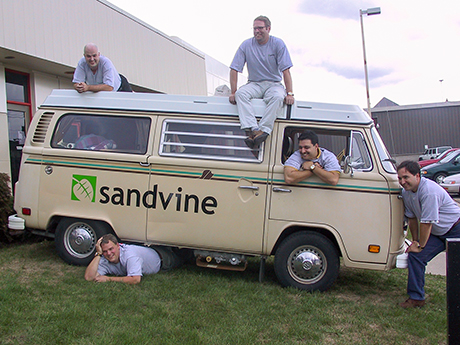
That first day produced a photograph of the founding executives with a Sandvine-branded Volkswagen van. Don Bowman and Tom Donnelly are up top; Caputo leans through the front window; Marc Morin and Brad Siim complete the group. It is a useful antidote to the solemn founding portrait. Here is a company that has acquired a name, some money, and a bus before acquiring the ceremonial stiffness of success.
The internet starts uploading
The commercial opening came from a change in behaviour. Cable networks had been designed to deliver television downstream. File-sharing services were turning internet customers into uploaders as well as downloaders. The available upstream capacity was much less generous. Sandvine developed network policy control technology to help operators manage that congestion and use their existing bandwidth more effectively.
It was a business built around something most subscribers noticed only when it failed them. An operator needed to understand what was travelling over its network before deciding how to handle it. Sandvine sold hardware and software for that job. Its early customer Cablevision gave the team a foothold while broadband was still replacing dial-up.
The geographical ambition was there early. In January 2003, Sandvine announced a UK subsidiary and an operation serving Europe, the Middle East and Africa. A company from Waterloo was addressing a problem that followed internet connections across borders. By May 2010, Ontario’s government described its customers as spanning more than 80 countries and serving over 300 million fixed and mobile subscribers.
August 2001
reported May 2010
of founding CEO
In 2006, Sandvine listed on London’s AIM market and then on the Toronto Stock Exchange. The following year, Canada’s Venture Capital and Private Equity Association named Caputo its Entrepreneur of the Year. Recognition made sense: an experienced group had survived the collapse of one employer and built a public company around another network problem.
There was friction, too. Sandvine’s traffic-management technology placed the business in the net-neutrality debate. Identifying traffic and controlling its treatment raised questions about the authority of internet providers. During the 2008 controversy, the company also suffered a sharp revenue decline. The story of its growth includes that difficult period, as well as the listings and awards.
A culture small enough to carry
Caputo’s answer to the problem of keeping a company together was unusually explicit. On Sandvine’s first day, he introduced an eight-point statement of values called the Sandvine Way. It later appeared on the backs of employee identification cards. A culture that fit on a badge could at least be found when someone needed it.
He treated the repetition as part of management. Companies could decide which behaviours they valued, write them down and keep reinforcing them. Customer success and doing the right thing were among the ideas the founders wanted to preserve. The point was to give employees something more dependable than a founder’s changing mood.
His own account of becoming a manager is refreshingly unpolished. He remembered micromanaging, supplying people with answers and trying to demonstrate how clever he was. That experience informed his concern with helping young engineers become useful managers. Technical confidence, he had discovered, did not automatically equip someone to lead a team.
“I slap together some PowerPoints and the team is the magic that makes it happen.”
Dave Caputo, on being Sandvine’s CEO
He also favoured initiative over a spotless decision record. He preferred four decisions with three correct to two decisions with both correct. It is a practical admission that a company can lose ground while congratulating itself on avoiding mistakes. For employees expected to exercise judgment, the permission has to survive the first occasion when their judgment is wrong.
In 2017, Sandvine was sold to Francisco Partners. Caputo moved on. The company he had helped lead for 16 years had given him experience in customers, capital and management. His next undertaking would require him to carry those lessons into a trade where his computer science degree could not explain every production problem.
A meeting with a wall in it
At an executive retreat on Prince Edward Island, Caputo met Joel Koops. A slat-like wall product at the venue started a conversation about Koops’s business. Koops and Steve Bosman ran MSW Plastics, whose manufacturing experience included extruded panels for agricultural buildings. Caputo saw a possible answer to the material that had annoyed him since childhood.
Koops and Bosman had already done the difficult work of establishing products, customers and manufacturing expertise. They wanted to grow into new markets. Caputo brought capital, ideas and experience building a business beyond its original customer base. The partnership put him in the CEO role, with Bosman responsible for manufacturing and Koops for corporate development and distribution.
Trusscore’s name refers to the internal truss structure in its products. Its Wall&CeilingBoard panels interlock, with fasteners hidden in the assembled system. SlatWall adds storage: hooks, shelves and baskets can attach to the wall. The attraction for Caputo is easy to understand. A finished surface can arrive as a product, rather than emerge from successive rounds of finishing work.
- PixStreamMove video over broadband networks.
- SandvineUnderstand and manage network traffic.
- TrusscoreRethink the interior wall system.
His ambitions extend beyond changing which panel a contractor buys. Trusscore has worked with the University of Waterloo’s Institute for Nanotechnology and established research and development activity in the region’s technology community. The proposition is that an established manufacturing process can become the base for continuing materials research.
The company’s Digital Paint project shows where that thinking leads. It is researching electrochromic materials that change colour when voltage is applied. Trusscore describes having changed the colour state of thin film on a small scale, with a longer-term ambition for a wider range of colours. A wall changing colour on command remains a development goal. The ordinary paint roller can keep its job for now.
Still close enough to see the work
Caputo has remained tied to Waterloo Region through business and philanthropy. He has served as Communitech’s board chair and helped start Social Venture Partners Waterloo Region, connecting donors with local organizations. In May 2023, he entered the Waterloo Region Entrepreneur Hall of Fame alongside his four Sandvine co-founders. The recognition put the group back together, two decades after the van photograph.
There are less ceremonial clues to his interests. His Trusscore author biography jokes about his confidence in his 12-foot basketball shot. On LinkedIn, he has celebrated a Trusscore-lined indoor court built for NBA player Desmond Bane and joked about having acquired an MBA instead of making the NBA. The education has served him reasonably well.
When Trusscore materials scientist Mitch Voralek needed to combine work with competitive rugby, the company arranged a flexible schedule. Caputo supported the arrangement as a way for an employee to pursue an ambition while remaining part of the business. It is a small example of what company culture requires once it leaves the identification card: somebody has to make the timetable work.
At a December 2025 gathering, Caputo explained the move into materials with a modestly phrased impulse: “I felt there was one more thing in me.” That next thing has a factory, research questions and customers who must be persuaded to change familiar habits. A career spent anticipating tomorrow’s internet has brought him back to a very old complaint. He is still working on the wall.