A private flight has an obvious main character: the aircraft. It photographs well, makes an entrance, and offers very little assistance with the hotel reservation. Dave Benjamin has made a business out of the work surrounding it. As co-founder and CEO of JetInsight, he deals in the quotes, schedules, and operational information that help charter operators arrange a trip. The passenger sees the departure. Benjamin’s software business sits closer to the decisions that make a departure possible.
That choice of subject gives his career its shape. He studied engineering, worked in software development and consulting, and went to business school. He then built a company for people running aircraft operations. Looking at that path, the interesting thread is the movement between technical systems and the businesses using them. His work asks a practical question: how can software make an operator’s complicated day easier to manage?
An engineer crosses into aviation
Benjamin’s public professional identity comes in two forms. JetInsight introduces its CEO as Dave; his LinkedIn and founder profiles use David. The background is consistent. Princeton electrical engineering, with 2010 as his graduation year. Software development at Microsoft. Consulting at Boston Consulting Group. Stanford’s Graduate School of Business, which he attended from 2013 to 2015.
Those are different ways of approaching a business. Engineering asks how a system behaves. Software development makes an answer usable. Consulting examines the organization paying for it. Taken together, they offer a useful way to read Benjamin’s eventual choice of company. Aircraft charter software has to work for a business whose daily responsibilities extend far beyond using software.
JetInsight’s own company listing dates its founding to 2014, during Benjamin’s Stanford years. He became its co-founder and CEO, with Lou Montulli as co-founder and CTO. The work would bring him into contact with operators whose customers expect an arranged journey, even when the arrangements themselves are complicated. A graduate education can provide frameworks. A customer with a trip to organize provides a deadline.
Growth, with a speed limit
In 2016, Benjamin described JetInsight as a technology platform and network for operators. Its aircraft offering ran from turboprops to heavy jets. The business concentrated primarily on the United States, while the aircraft could travel worldwide. This early picture puts the operator relationship near the center of the company’s ambitions.
Benjamin spoke about choosing operators with attention to safety and customer service. He also expressed the hope of growing as quickly as the business could handle. The qualification is worth pausing over. Growth is easy to admire from a distance. Handling it involves the people, systems, and service that must keep up with each addition.
“As fast as we can handle”
Dave Benjamin on JetInsight’s growth ambitions, 2016
Read as a business principle, his phrase leaves room for restraint. It ties expansion to the experience the company can deliver. The earlier network description and today’s operator software share that concern: someone has to make the practical side work. A booking promise becomes more credible when the business providing the aircraft has the information needed to fulfill it.
A partnership built around problems
Benjamin’s co-founder brings an unusual piece of internet history to the company. Montulli was a founding engineer at Netscape and invented the HTTP cookie. Long before JetInsight, he worked on the technologies through which browsers became more useful. At JetInsight, his responsibilities moved into the software behind aircraft charter operations.
There is a revealing early example of the engineering approach inside Benjamin’s company. Operators wanted access to a database of hotels and rental cars around airports. Montulli described how the team examined the request and found that the existing information went out of date and covered a limited area. They built an alternative using Google Maps, opening up a broader set of resources and information.
The anecdote matters because the team looked beyond the requested connection. A database could be connected successfully and still leave the operator with poor choices. Understanding the task changed the solution. Montulli also described engineers joining customer visits at onboarding and returning for later check-ins. This places the development work close to the person trying to use it.
For Benjamin, the partnership situates his business inside that practical engineering tradition. The hotel example is especially apt. An aircraft charter company has aircraft to manage, but the trip keeps extending into other people’s businesses. A useful product has to follow it there.
The luxury of fewer clicks
JetInsight describes a trip moving through a continuous lifecycle, from the initial quote to release, invoice, and reconciliation. It also describes sharing information between departments, so a change in aircraft status or a crew update reaches the people whose work depends on it. That is the operational setting Benjamin has chosen to serve.
The company makes a modestly sized claim about convenience: some tasks that previously required ten clicks now require one or two. It is a company claim about particular workflows, rather than a measurement of every operator’s day. Still, it gives the ambition a useful scale. A click is small enough for a customer to judge.
There is an appealing lack of ceremony in this sort of promise. The user can sit down, perform the task, and decide whether it helps. For a founder with Benjamin’s background, this is where the technical and commercial sides meet: a change to an interface must earn its place in someone else’s routine. A button has no interest in your résumé.
The work after the sale
Buying operational software creates another set of tasks. JetInsight describes a kickoff conversation about the customer’s goals and timing, followed by a customized implementation and training plan. The company gathers information to build the account and trains teams according to their needs. It also offers a knowledge base and monthly training webinars.
That service work adds substance to Benjamin’s role as CEO. The business he leads has to help customers move into the product and continue using it as their teams change. An aircraft operator cannot finish a software purchase, admire the receipt, and consider the transition complete.
JetInsight says each operation receives a dedicated Success Manager with context on its account. Its published support arrangements include year-round coverage and emergency support for critical problems that prevent dispatch. These are commitments made by the company, and they show the ongoing obligations behind its sales pitch.
Seen through this part of the business, Benjamin’s consulting experience feels relevant. The customer has a particular setup, goals, and difficulties. Software supplies capabilities; implementation helps fit those capabilities to the working operation. The relationship continues after the account is created. Its usefulness has to survive new employees, new questions, and the next complicated day.
A dinner beyond the departure board
A professional photograph offers a different setting: a restaurant table in San Francisco. Benjamin was named among the participants at a Dev.Pro CTO dinner alongside executives from companies including Autodesk, Sony, Ripple, and Trustly. The organizer described discussion ranging from wine and AI to technology consolidation and subscription renewals.
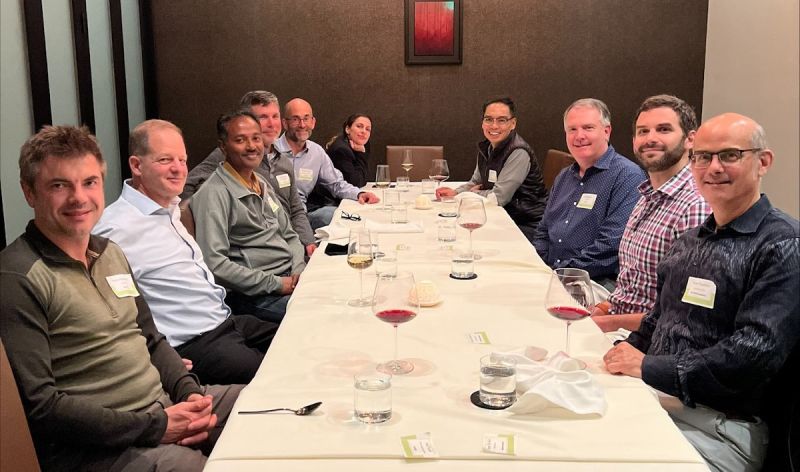
The gathering places him in a broader software community. The companies have different customers, yet questions about renewing subscriptions and connecting systems can cross industry boundaries. Even a business concerned with aircraft has conversations that sound familiar to other technology executives. The dinner account supplies a small, human setting for that overlap: a table, a group of peers, and rather more subjects than a departure board allows.
Nine thousand services later
In October 2024, JetInsight and FlightBridge announced an integration in beta. FlightBridge handles crew travel and passenger services. The planned connection put bookings and vendor status updates inside JetInsight, linking those arrangements more closely to the flight schedule. Benjamin described the goal in terms of saving time and making the trip experience seamless.
The specific problem has a recognizable shape. A schedule changes; the arrangements attached to it need attention. The announced capabilities included updates, alerts around schedule changes, and notifications to the people involved. This is the same territory as the early hotel-database problem, approached through a deeper connection between two businesses.
On March 6, 2025, the integration became available to all mutual customers. The companies reported a beta involving more than 20 JetInsight-powered operations and over 9,000 services booked and synced. Those are activity counts from the test, not a forecast or a claim about the entire market. They give this chapter of Benjamin’s story a concrete working scale.
Benjamin called the feedback “wildly positive.” The released connection allowed customers to book FlightBridge services within JetInsight and brought booking updates into the same environment. Crew could also book through the JetInsight iPhone and iPad app when their operation enabled that option.
The result returns the story to its opening subject. Benjamin’s company works among the details around a flight, including those handled by other providers. A hotel booking is ordinary work. Keeping it connected to the changing trip is useful work. His public career leads into that space, where a software business earns its relevance by helping an operator get the next arrangement right.