He builds the part of education most people never see - the version that has to survive a prison firewall, a warden's veto, and a network with no internet.
Most edtech founders worry about churn and click-through. Noah Freedman worries about whether his software can run on a tablet that can never, under any circumstances, phone home. That single constraint defines his company. Nucleos, the public benefit firm he co-founded and runs, builds secure, tablet-powered education for people held in U.S. jails and prisons - a place where roughly 95% of ordinary e-learning is simply unusable, because the same features that make modern software convenient also make it a security risk behind bars.
His answer is a platform called Achieve DXP - a digital experience platform that strips out anything that could enable prohibited contact with the outside world, then delivers what's left: courses, e-books, library media, credential tracking, and a record a person can carry toward a job on release. Nucleos handles the security so the facility doesn't have to. It tracks what someone completes so reentry isn't a cold start. And, notably, it's free for the correctional agencies and incarcerated learners who use it, funded instead through grants and investment on what Freedman calls a "reentry-as-a-service" model.
The pitch is not utopian. Freedman is careful to say that technology is the supporting cast, not the star. "Educators and in-person stakeholders" should lead, he argues, with software as infrastructure rather than a replacement for human teaching. It is a strikingly modest claim from someone running a tech company - and it's exactly why people inside the corrections-education world take him seriously.
By late 2023, the company had raised about $3 million in a round that brought in iT1, Western Governors University Labs, the ScaleGood Fund, and angel investor Sanjay Srivastava, on top of public support including San Francisco's "People Over Profits" program. Around the same time, Nucleos formally reclassified itself as a public benefit corporation - a legal commitment that the mission outranks the margin.
The product surface is deliberately broad. Nucleos acts as a single connector between tablets, content libraries, and the facility itself, then layers on the credential tracking that turns a string of completed courses into something a person can actually show a parole board or an employer. The roadmap reaches past coursework toward video calls and messaging - the ordinary digital connections most people never think about, rebuilt carefully enough to satisfy a corrections officer. Each feature has to clear the same bar: useful enough to matter, locked down enough to be allowed.
What makes the company unusual isn't the technology so much as the business shape around it. Charging the customer is the obvious move, and Freedman declined it. Free-to-facility removes the budget argument that kills most prison-reform pilots before they start, and it puts the financial weight on grants and mission-aligned investors who measure returns in recidivism curves rather than seat licenses. It's a harder company to run. It's also a much harder company to say no to.
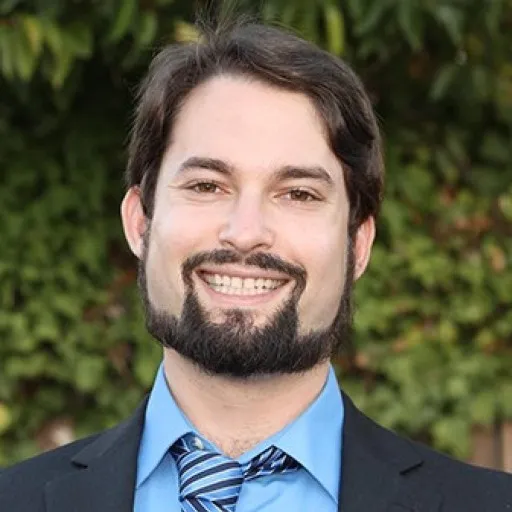
“ Without a solution like Nucleos, almost 95% of digital e-learning and training material can't be used in prisons or jails due to security reasons.Noah Freedman - on the gap his company exists to close
The case for prison education isn't sentimental - it's statistical. The problem is that almost nobody inside is reached by it.
Freedman's first venture wasn't about prisons at all. With co-founder Camila Vega and Stanford professor David Katzenstein, he built PortableCloud - micro-server technology that aggregated the best offline educational content for under-resourced schools with no reliable internet. The first deployments landed in India, Zimbabwe, and Kenya. The whole design philosophy was offline-first: assume no connection, and make learning work anyway.
Then a colleague was incarcerated. Through that relationship, Freedman saw that the digital divide he'd been fighting in rural classrooms existed, just as starkly, inside American corrections - the same walled-off, disconnected environment, the same locked-out learners. The constraint he'd already solved for, no internet and tight security, turned out to be the exact shape of the prison problem. So the company pivoted, and Nucleos debuted in Santa Cruz in 2017.
It's worth sitting with how rare that pivot is. Plenty of founders chase whichever market is hot. Freedman did the opposite - he took technology built for one of education's most overlooked populations and aimed it at an even more overlooked one. The skills carried over almost perfectly: the offline architecture, the obsession with security, the patience to work with institutions that move slowly and trust outsiders even more slowly. The corrections sector is not a place you stumble into for the valuation. You go there because you decided the people inside count.
Graduates from Princeton's Woodrow Wilson School with a degree in public policy.
Runs software development for global e-learning and micro-server projects at the Stanford Graduate School of Education.
Co-founds PortableCloud with Camila Vega and Stanford's David Katzenstein - offline education content for schools in India, Zimbabwe, and Kenya.
Nucleos debuts in Santa Cruz, redirecting the technology toward U.S. correctional education.
Raises ~$3M, reclassifies Nucleos as a public benefit corporation, and launches the Achieve DXP platform.
Speaks at the ASU+GSV Summit and the "Back to School" Summit on the prison-to-college pipeline as Pell Grants are reinstated for incarcerated students.
Freedman came up through Princeton's public policy program, not a computer science lab. But by the time he left Stanford's education school he had spent years running software for e-learning products - a rare combination of someone who can argue the policy case for second chances and then go build the system that delivers them.
Trace his career and it's almost suspiciously consistent: affordable computers for schools in India and Zimbabwe, offline content for the disconnected, then a secure learning platform for the most disconnected population in the country. The setting keeps changing. The conviction doesn't.
For a software CEO, he's unusually willing to put technology in the supporting role. His blended model insists that teachers and on-site staff lead - a position that earns trust in a field justifiably wary of Silicon Valley promising to fix everything with an app.
Nucleos is a public benefit corporation whose LinkedIn handle is, fittingly, "nucleos-second-chances." Making it free for facilities isn't a marketing gimmick - it's the operating model, with grants and mission-aligned investors footing the bill.
"Without a solution like Nucleos, almost 95% of digital e-learning and training material can't be used in prisons or jails due to security reasons."
"Educators and in-person stakeholders should lead - with technology as supporting infrastructure, not a replacement."
Nucleos is free for the prisons and learners who use it - the bill is covered by grants and investors, not the customer.
The company's legal LinkedIn handle is literally "nucleos-second-chances."
Its offline-first DNA came from rural schools with no internet - the same constraint that later fit prison networks perfectly.
HQ sits on Soquel Avenue in Santa Cruz; Freedman himself is based up the coast in San Francisco.
When Pell Grants returned for incarcerated students in 2023, Freedman was already on the conference stage talking pipeline.
Freedman's wager is simple to state and hard to win: make real education and workforce training a normal part of incarceration and reentry across the U.S. justice system, so that people leave with credentials and a path to a job instead of just a release date. The roadmap points past coursework - toward video calls, messaging, and a fuller digital life for people the rest of the internet forgot. It's unglamorous infrastructure for one of the country's least glamorous problems. Which is, more or less, the whole point.
The timing helps. In 2023, Pell Grant eligibility returned for incarcerated students, reopening a funding door that had been shut for decades and suddenly making the prison-to-college pipeline a live policy question rather than a theoretical one. Freedman was already on the conference circuit when it happened, taking the stage at the ASU+GSV Summit and the "Back to School" Summit to argue that the demand was real and the infrastructure was the missing piece. He had spent years building for a moment the policy world was only just catching up to.
There's a version of this story told in soaring language about redemption and technology. Freedman doesn't really tell it that way. He talks about security constraints, blended models, and who should lead the classroom. The restraint is the tell. He's not selling a miracle; he's shipping a system, one facility and one credential at a time, on the unshowy belief that education shouldn't stop at a prison gate. For a problem this big, that patience may be the most radical thing about him.