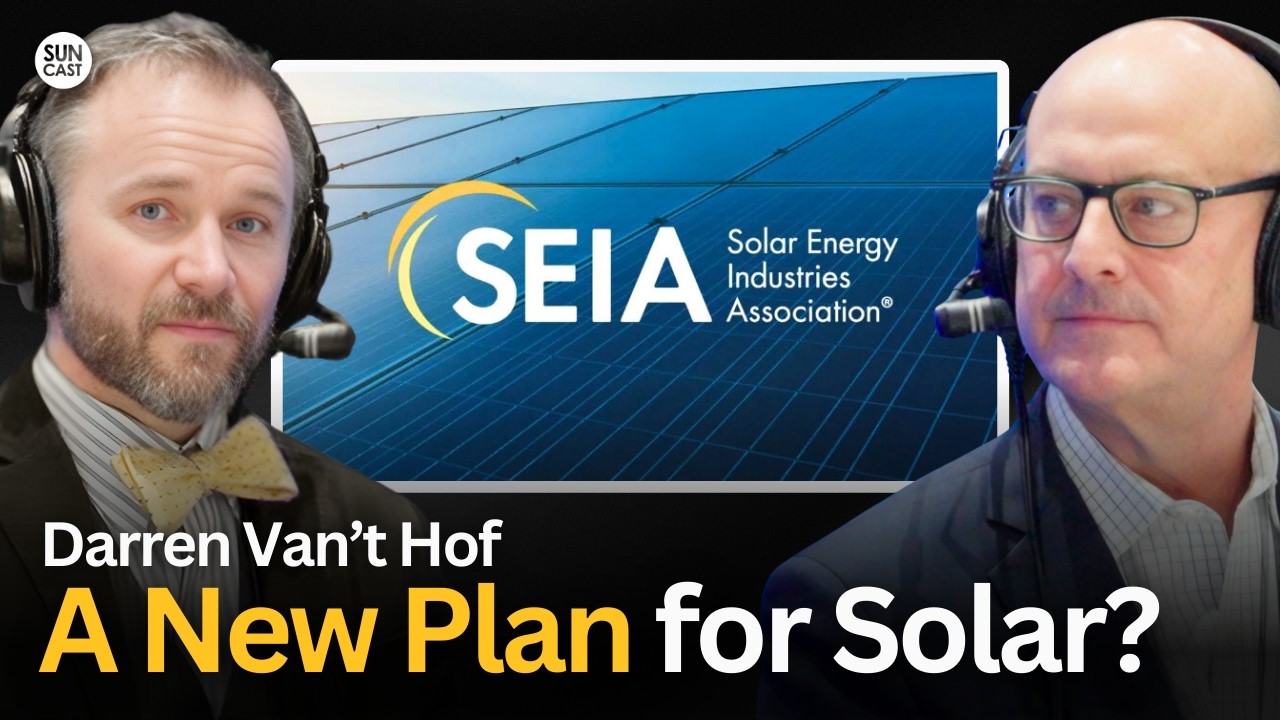
On January 20, 2026, Darren Van’t Hof changed seats. For 15 years he had watched the Solar Energy Industries Association from its boardroom, eventually becoming chair. The view was strategic: policy, priorities, budgets, leadership. Then the association asked him to become its interim president and chief executive. Overnight, the agenda stopped being a board packet and became a working day.
He described the early sensation with unusual candor. SEIA was tracking every federal regulation, every state standard and every mention of solar and storage in the media. Research, events, state programs, web projects and videos arrived almost daily. It was inspiring, he wrote, “if not a bit overwhelming.” This was not false modesty from a newcomer. Van’t Hof knew the institution intimately. He was simply discovering the difference between knowing the map and directing traffic.
His appointment placed a finance specialist at the center of an argument usually narrated as a contest between technology and politics. Van’t Hof’s career suggests a third plot: capital. Panels do not appear because a forecast is attractive. Storage projects do not materialize because a chart bends upward. Someone has to translate tax rules, contracts, counterparties and construction risk into an investment that can survive scrutiny. For more than two decades, that translation was his trade.
The education of a solar banker
Van’t Hof studied political science at the University of Missouri-St. Louis. It is a fitting beginning for someone whose working life would sit on the seam between government intent and market response. He joined U.S. Bank and moved through real estate development, asset management and structured finance before leading renewable-energy investment work. By 2010 he was publicly representing the bank as a director of renewable energy investments. Solar was then a smaller, stranger proposition for mainstream finance, and tax equity was the bridge between a public incentive and a private project.
The bridge had engineering of its own. A bank with taxable income could invest in a renewable project and use the associated credits. The developer gained capital; the investor gained a return shaped partly by tax benefits. None of it was simple. Project quality, developer experience, power contracts, construction schedules and shifting federal rules all had to line up. Van’t Hof’s team developed a reputation for assembling portfolios and working with residential and utility-scale businesses while the market grew around them.
The numbers got larger, but the lesson remained stubbornly human: certainty attracts money. In 2011, U.S. Bancorp’s renewable tax-equity commitments had passed $400 million. Later biographies credited initiatives led by Van’t Hof’s team with more than $5 billion in renewable investment. In 2022, he helped introduce a solar debt product alongside a tax-equity investment for a $200 million project in Maine. The craft was expanding from one useful instrument into a broader toolbox.
Builds experience in real estate development, asset management and structured finance inside U.S. Bank’s community-development business.
Begins a 15-year stretch on SEIA’s board while leading renewable-energy investments at U.S. Bank.
Chairs SEIA’s Federal Policy Committee, bringing an investor’s eye to the association’s policy work.
Serves as board chair, then joins Oakland Capital Solutions to advise companies in a changing energy market.
Steps down as chair and into day-to-day responsibility as SEIA’s interim president and CEO.
His finance work also carried him into the less photogenic rooms where industries are shaped. In 2023, Van’t Hof joined solar developers, investors and SEIA policy staff in a meeting with the Federal Reserve, Federal Deposit Insurance Corporation and Office of the Comptroller of the Currency. The subject was a proposed banking rule and its treatment of tax-equity investments. A change deep in a regulatory framework could alter the appetite for renewable projects far beyond Washington. This is the sort of hinge Van’t Hof notices.
Fifteen years of institutional memory
While his day job was moving capital, Van’t Hof was steadily accumulating another asset: institutional memory. His SEIA board tenure spanned solar’s passage from an insurgent corner of the power market to a leading source of new generating capacity. He served as federal policy chair before becoming board chair. He watched the association manage trade disputes, tax-credit battles, supply constraints and the recurring tension between rapid deployment and domestic manufacturing.
That long apprenticeship made him a logical steward when Abigail Ross Hopper prepared to leave after nine years as CEO. Hopper described him publicly as empathetic, committed and deeply invested in equity. More importantly for the handoff, the two had already worked together through policy crises, financial challenges and personnel questions. Continuity can be a dull word. During a leadership transition in a volatile industry, dull can be quite attractive.
Van’t Hof did not arrive promising reinvention. His first message praised the staff, the membership and the foundation he inherited. Then he ended with four clean words: “Now, let’s get to work.” The economy of the line suits him. Finance teaches a suspicion of ornamental confidence. The model must close even when the presentation is over.
After cost comes permission
In conversation, Van’t Hof returns to a striking refrain: “Every year there’s a crisis. Every year there’s something that’s going to be the death knell of the industry.” It is not bravado. It is pattern recognition earned during two turbulent decades. Solar has repeatedly faced expiring incentives, trade cases, recessions, supply shocks and political reversals. The crises were real. So was the growth that followed them.
His 2026 thesis is that solar has already won the cost contest. The pressing constraints are now time and certainty. A project can be economically compelling and still sit idle while a permit stalls, an interconnection queue lengthens or a rule changes between planning and construction. Those delays do more than irritate developers. They freeze capital. They postpone supply in a country where power demand is rising. They make a financial problem out of an administrative one.
The argument has three audiences
Capital needs certainty. Communities need affordable, reliable power. Policymakers need proof that projects create jobs and arrive on time. Van’t Hof’s task is to keep all three in the same conversation.
Storage sharpens the case. In the first quarter of 2026, the United States added 9.7 gigawatt-hours, then a record for that quarter. Van’t Hof framed batteries in the language of household economics and national resilience: protection from fuel-price shocks, lower costs and a stronger grid. When data centers need large blocks of power quickly, he argues, solar paired with storage is among the fastest resources available. Speed has become a policy position.
This is also why his rhetoric ranges beyond climate. He talks about American manufacturing, energy security, electricity bills and the 280,000 people working across solar and storage. The choice is deliberate. A trade association cannot depend on one argument or one party. Van’t Hof wants solar to pass through several political doors at once: cheap power, domestic industry, local employment, reliability and cleaner generation.
The translator’s job
There is a neat symmetry to Van’t Hof’s new role. Early in his career, he translated public policy into investable transactions. Now he must translate industry mechanics into public meaning. The audiences have multiplied: lawmakers, regulators, manufacturers, developers, financiers, utilities, workers and customers. Each arrives with a different definition of urgency.
He has some unusual tools for the assignment. A political science education supplies the architecture of institutions. Structured finance supplies respect for consequences. Board service supplies the long view, including a memory of which crises disappeared and which changed the market. And his brief stop at Oakland Capital Solutions reinforced the advisory instinct: listen closely, identify the gap, find the capital or expertise that can fill it.
None of this makes the politics easy. Permitting reform can unite people in principle and divide them in detail. Domestic manufacturing can strengthen supply chains while raising questions about cost and timing. Rising demand creates an opening for solar and storage, but also a scramble among every energy source to claim importance. Van’t Hof’s answer is characteristically practical: emphasize what can be financed, built and delivered.
The interim title gives his tenure an unavoidable provisional quality. Yet the work is not provisional. Projects are waiting in queues. Investors are pricing uncertainty. States are setting standards. SEIA’s members still need a voice when the rules change. Van’t Hof may be keeping a seat warm, but he is doing so in a room where the thermostat controls billions of dollars.
His career has not followed the glamorous solar story, the one told in aerial footage of gleaming arrays. It has followed the paperwork underneath: the investment committee, the tax rule, the regulatory filing, the board vote. That paperwork is where ambition acquires a closing date. Van’t Hof spent 20 years learning how to make the numbers support the hardware. His task now is larger and more public: make the country understand why the hardware should be allowed to arrive.