The detail Daria Shevchenko carried home from a technology conference was not a product demo, a slogan or a business card. It was a pair of boots. Light blue cowboy boots, to be precise, decorated with spikes and rhinestones and worn by a Forbes journalist who approached the Snov.io team at Collision. Years later, he was still the person she remembered.
For a chief marketing officer, this is more than a good party story. It is a working theory of attention. Clothes can open a small window in a crowded room, but Shevchenko’s conclusion went beyond costume: “The whole personality is important, don’t forget it at home.” The line is compact, mischievous and surprisingly demanding. It says that being seen is merely the beginning. A person still has to be worth meeting.
That idea sits neatly beside the business she has helped build. Snov.io makes software for finding potential customers and contacting them through email and LinkedIn. The machinery is designed for scale. Shevchenko’s public advice keeps returning to the opposite unit of measure: one relevant person, properly understood.
“The whole personality is important, don’t forget it at home.”Daria Shevchenko, on being memorable at conferences
A marketer in a city that ships software
Shevchenko is based in Chernihiv, in northern Ukraine, where Snov.io assembled its early team. Public company materials identify Oleksii Kratko as founder and CEO and Shevchenko as CMO. She was publicly named in that role by 2018, coordinating marketing specialists and web designers. Her remit today still joins those two disciplines: marketing strategy, design and the work of turning attention into sales growth.
Her own professional summary describes seven years spent driving growth “from the ground up.” The phrase matters. Snov.io’s public history is not arranged around a parade of financing rounds. The company is bootstrapped, and its chronology is made of things customers could use. In 2017 came Email Finder. Drip Campaigns followed in 2018. An email-tracking extension arrived in 2019. Sales CRM came in 2021, email warm-up in 2022, and deliverability and AI features in 2023. The current chapter adds LinkedIn automation to the mix.
From single tool to connected workflow
This kind of progression gives a marketing leader a peculiar assignment. Every new tool expands what the company can promise, but too many promises can turn a product into a junk drawer. The job is to make separate utilities feel like one coherent answer: find the right prospect, learn enough to be relevant, begin a conversation, follow up and keep the work organized.
It also places design close to the commercial argument. A feature can be technically sound and still feel impossible if the interface makes its logic obscure. A campaign can be persuasive and still disappoint if the product behind it feels assembled from unrelated parts. Shevchenko’s combined oversight of marketing and design gives her responsibility for both halves of that encounter: what the company says before someone signs in, and what the product communicates after they arrive. In software, those are not separate stories for long. The landing page makes a promise; the workflow either keeps it or sends the customer looking for the exit.
Snov.io says its products now reach more than three million users in more than 175 countries. The numbers are large, but the company’s path to them was incremental. It expanded into China, Brazil and Spanish-speaking markets. It grew to a distributed team of 100 people by 2022. Each move required language, design, positioning and local judgment - the quiet infrastructure of marketing that rarely gets a launch video of its own.
The homework comes before the handshake
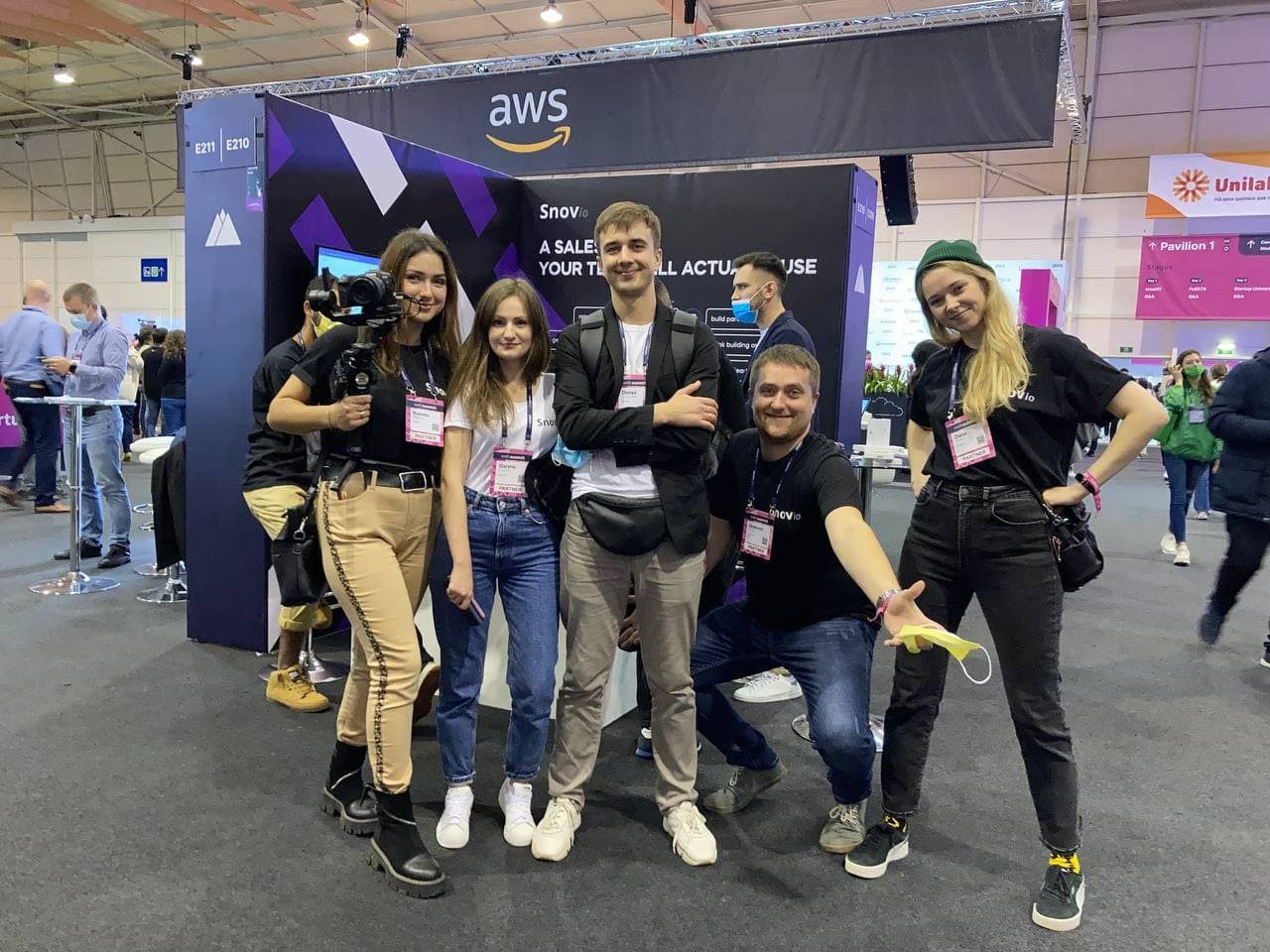
Shevchenko’s most revealing writing is practical. Her checklist for Web Summit begins long before anyone stands under the exhibition lights. Arrange the travel early. Choose the people who can explain the product. Prepare a short demonstration. Above all, “Research big leads.” A prospect appreciates a conversation that begins with some knowledge of who they are, what they do and what they might actually need.
This sounds obvious only because good advice often does after somebody has said it. Conference floors encourage the wrong instincts: scan the badge, deliver the script, collect the contact, move along. Research reverses the order. It makes curiosity the first sales action. The demonstration then becomes less like theatre and more like a useful reply.
In 2019, Shevchenko published a conversation recorded at Web Summit with Martin and Jose Marcos Rodriguez, the founders of Melior.AI. The questions were not ceremonial. Where should a young company spend its money? How did the founders win a first client when they had only an idea? What advice had survived contact with reality? The answers ranged across validation, research and development, competition and the danger of assuming nobody else had considered the same problem.
There is a useful continuity between interviewer and executive here. Shevchenko’s work asks how companies begin conversations with strangers. Her questions to founders probed what happens before a company has earned the right to be noticed at all. Both are problems of relevance. Both punish vanity.
Research the person. Shape the message around a real need. Measure the response. Remove what is not working. Repeat without pretending that scale excuses irrelevance.
Automation with its shoes on the ground
The phrase “sales automation” can summon a miserable picture: a thousand identical notes arriving with the wrong first name. Shevchenko’s published comments argue for another version. In one email test, she said personalization increased open rates by 15 percent. The figure is modest enough to be believable and useful enough to change behavior. Relevance was not a decorative flourish. It altered the result.
Her guidance on list maintenance is similarly unsentimental. People who repeatedly ignore a company’s emails should not be treated as an invitation to send more. Segment the audience. Protect sender reputation. Concentrate on the subscribers who show interest. Good outreach has an exit as well as an entrance.
This is the operator’s distinction between volume and leverage. Volume asks how many messages the system can send. Leverage asks what the system can learn, preserve and improve. The second question is harder because it reaches beyond software. Data can locate a person; only judgment can decide whether the approach respects their time.
“Research big leads.”Shevchenko’s shortest conference instruction, and perhaps her broadest
Growth without the drumroll
In 2022, Snov.io publicly explained that its head office and much of its team were in Chernihiv, then one of the dangerous centers of Russia’s full-scale invasion. The company said many employees had changed location while the business continued to operate, support Ukraine and develop its products. It also stopped service and payments from Russian users.
The corporate statement belongs to the team, not to Shevchenko alone. Still, it gives necessary weight to the otherwise smooth language of growth charts. A product timeline can make expansion look inevitable. It never is. Behind every neat arrow are people improvising under conditions the diagram politely omits.
Snov.io kept adding markets and tools. It crossed one million users in 2021 and later reported more than three million. Its story moved from a collection of lead-generation utilities toward a platform joining prospect data, campaigns, CRM, deliverability and multichannel engagement. A colleague recently described the company as a working horse: useful, steady and built around the real tasks outreach requires. The image suits Shevchenko’s public persona better than a unicorn ever could.
She appears less interested in manufacturing mystique than in arranging the conditions for a productive exchange. Know the room. Know the prospect. Explain the product clearly. Wear something memorable if the spirit moves you, but bring a personality to match. Marketing, in this telling, is hospitality with a spreadsheet nearby.
The reason to answer
There is an irony in spending a career making cold outreach software warmer. The tools become faster while the standard for a worthwhile message rises. Every improvement in automation makes lazy communication easier, and therefore easier to ignore. Shevchenko’s answer is not to retreat from scale. It is to insist on thought before scale begins.
That is why the boots survive as more than comic relief. They are proof of what attention feels like from the receiving end. Out of a hall full of names, logos, screens and practiced openings, one sharply observed person remained. A brand wants the same privilege, but it cannot demand it. It must earn memory by being distinctive, prepared and useful at once.
Shevchenko’s career at Snov.io is a study in that patient accumulation. One product became several. Several tools became a workflow. A company built in Chernihiv learned to speak to users across the world. The growth is visible in the numbers. The craft is visible in the smaller choices: a researched lead, a cleaner list, a more relevant demonstration, a line worth remembering.
The software can find the address. The marketer still has to supply the reason to answer.