In October 2016, Daniel Whitenack entered a programming-language argument with an inconvenient question. Data scientists were debating Python and R. He wanted to talk about Go. His case concerned the unglamorous journey from an interesting result on somebody’s laptop to software that colleagues could deploy, inspect, and support. A model could be clever and still be a dreadful coworker.
The argument has aged into a useful introduction to Whitenack. Today he leads Prediction Guard and co-hosts Practical AI with Chris Benson. One job involves building controls around AI systems; the other involves asking people how those systems work. Across both, he keeps returning to what happens after the demonstration, when an organization has to live with the result.
His route there passes through theoretical physics, patent work, open-source software, and language research. Read as a list of occupations, it looks restless. Follow the work itself and a more consistent concern appears: how to make complicated computation understandable enough for other people to use. His projects repeatedly address reproducibility, access, and control.
A physicist takes the long way to production
Whitenack studied engineering physics at Colorado School of Mines before completing a physics doctorate at Purdue University. His dissertation explored density functional resonance theory for unbound electronic systems. The subject deals with calculating properties of systems that do not remain neatly bound together. It is a rather specialized preparation for a career explaining why software should behave itself.
The research had its own demanding questions about what a calculation represents. Working with Adam Wasserman, Whitenack investigated complex density functions, resonance energies, and lifetimes. Purdue lists him among its 2012-13 Bilsland Dissertation Fellowship recipients. These were years of formal research, before his public work became associated with teaching developers or interviewing AI founders.
After Purdue, he worked in intellectual property. An archived professional biography identifies him as a patent agent at Marshall, Gerstein & Borun, helping prosecute patents involving electrical and software engineering. It also records a high-performance computing internship at the National Center for Atmospheric Research. The transition put scientific training alongside the practical task of describing what someone had invented.
That early chapter matters because his later career can otherwise seem to begin at a microphone. By the time listeners encountered Data Dan, he had already worked in settings where technical explanations had consequences beyond the person doing the calculation. Research, patent applications, and deployed software each demand a different kind of precision. His subsequent teaching would bring those concerns into a more conversational register.
The laptop is only the beginning
By 2017, Whitenack was working at Pachyderm, discussing versioned data and reproducible pipelines. In an early Data Engineering Podcast interview, the topic was how to track changes in data alongside the code that processes it. The appeal was practical: a result should come with a recoverable account of the ingredients and steps that produced it.
His 2016 essay “Data science gophers” described another part of the same problem. Experimental code could be difficult to move into a working service. Errors could appear without a useful explanation. Data science could become awkwardly detached from the engineering organization expected to keep it running. Go appealed to him for explicit error handling, deployment, and readable code.
He did not claim that one language should handle every task. The argument was about producing something useful that its makers could support. Anyone who has inherited a mysterious spreadsheet will recognize the social dimension of that ambition. An unexplained answer gives the next person a number and a new problem. A reproducible process gives them somewhere to begin.
Whitenack also took the teaching seriously enough to publish it. His book Machine Learning With Go appeared in 2017, covering regression, classification, clustering, time-series models, and neural networks. He spoke about Go for data science at GopherCon and maintained the Go kernel for Jupyter. His public repositories include a neural network written from scratch and workshop materials for putting AI applications into containers.
These are useful clues to the character of his public work. He repeatedly provides something a learner can examine: code, a workshop, a worked explanation. The nickname Data Dan is informal; the material underneath it often asks readers to do fairly exacting work. Friendly packaging need not imply an easy syllabus.
- 2012PhysicsPurdue doctoral research
- 2017ReproducibilityPachyderm and a Go book
- 2018ConversationPractical AI launches
- 2025Private AIPrediction Guard seed round
A show grows out of a conversation
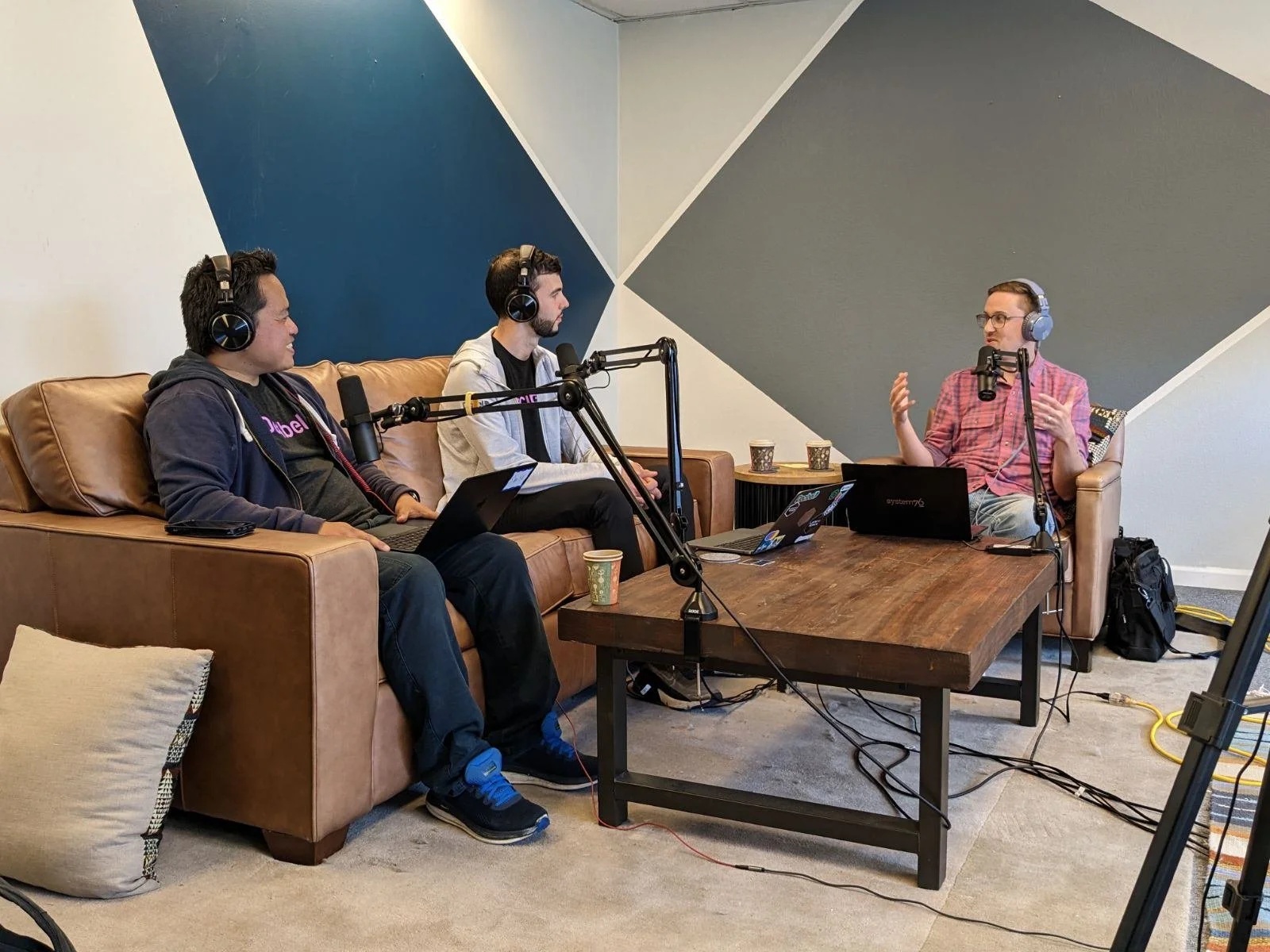
Practical AI began with connections in the Go community. Adam Stacoviak had met Whitenack at GopherCon, and discussions about a data-science podcast followed. The inaugural episode was recorded in April 2018 and published on July 2. Stacoviak and Jerod Santo introduced Whitenack and Benson in a conversation lasting about 35 minutes.
There is a pleasingly ordinary detail in that origin. The show emerged from people talking about something they wanted to make, returning to the idea, and finding collaborators. Whitenack described different iterations of what it might become. For a program concerned with making AI practical, its own beginnings involved the familiar work of arranging a project with other humans.
The partnership has lasted through considerable changes in the subject. Practical AI now describes its purpose as making artificial intelligence practical, productive, and accessible. Its audience includes technology professionals, businesspeople, students, and enthusiasts. Holding a conversation for that range of listeners requires room for explanation as well as room for technical disagreement.
By October 2026, the show had reached episode 377. Recent discussions ranged from narrative intelligence and education to physical AI and security research. The breadth suits a host whose own work crosses research, teaching, and enterprise deployment. He can spend the working week building a company and then enter a conversation where someone else supplies the expertise.
“Creating real world value with state-of-the-art AI.”
Daniel Whitenack’s stated focus on Data Dan
When the language changes, the problem changes
At SIL International, Whitenack worked on AI for languages with fewer digital resources. His research interests there included spoken-language identification, multilingual dialogue, machine translation, and estimating translation quality. The work changes the usual picture of AI adoption: the challenge includes whether a language has the data and tools needed to participate at all.
He contributed to the collaborative Masakhane research effort on African-language machine translation. A 2020 paper in that work argued for participatory research, involving people across the translation-development process. The collaboration produced benchmarks for more than 30 languages. Whitenack was one member of a substantial author group, an important distinction in a project built around shared participation.
A later paper, co-authored with Jonathan Janetzki, Gerard De Melo, and Joshua Nemecek, addressed semantic-domain dictionaries for low-resource languages. Published in 2024, GUIDE used a graph neural network to help create and populate those dictionaries. The continuity is concrete: language access remained part of his research record even as his public business identity shifted toward Prediction Guard.
His account of managing research at SIL adds another revealing detail. He wrote that he had started as the organization’s only data scientist; by October 2021, its growing AI and NLP teams included more than ten data scientists or computational linguists. Coordinating their work meant tracking experiments and sharing computing resources across locations. The old question about reproducibility had acquired colleagues, languages, and time zones.
One researcher starts an experiment. Another needs to repeat it, change it, and understand what happened. Data, code, and results must travel together.
A conceptual illustration of the research workflow Whitenack described at SIL.The answer needs somewhere safe to run
As large language models became a wider business concern, Whitenack continued writing explanations aimed at people choosing tools. His June 2023 guide organized the model landscape around five characteristics: access, licensing, size, context length, and language or domain. The list moves attention away from a single impressive output and toward the conditions under which a developer can use a model.
Those conditions connect directly to Prediction Guard. The company offers a self-hosted AI control plane for enterprises, with an emphasis on operating AI within an organization’s own infrastructure. Its current work includes controls over agents, their access, and their actions. Practical AI is the podcast he co-created; Prediction Guard is the separate company he founded and leads.
An Intel case study described the earlier deployment challenge in tangible terms: organizations wanted useful language-model applications while handling private data and unreliable outputs. It discussed prompt injections, inaccurate answers, and the computing capacity required to run safeguards. Whitenack’s business sits among those operational details. The entertaining answer on a screen is only one part of the system an enterprise must manage.
In May 2025, Prediction Guard announced a $3.7 million seed round led by Sovereign’s Capital. The stated plans included sales and marketing hires and further development for private deployment across on-premises, air-gapped, and cloud environments. Funding gave the project resources to expand; it also made the practical ambition more explicit. Customers would need something they could deploy and govern.
Whitenack framed the aspiration in terms of restoring institutional trust through private, secure intelligence. That is a larger promise than selling access to a model. Whether it succeeds will depend on the systems and their use. For now, it explains why his company spends time on the permissions, safeguards, and operating conditions that rarely receive the applause at a demo.
Still taking questions
Whitenack remains based in the Lafayette, Indiana, area, with Purdue recurring in his career as both the place of his doctorate and somewhere he occasionally teaches. The international conference circuit and the podcast give that locally rooted work a wider audience. The result is an unusual professional rhythm: build, teach, ask, then return to building with more questions.
On October 22, 2026, Practical AI published its discussion of exploit development, agentic vulnerability discovery, and fake proofs of concept. Eight years after its debut, the show was still examining what emerging capabilities mean in practice. Whitenack’s career offers a reason to keep listening: he has spent a long time caring about the work that begins once an answer appears.
Follow the work
Explore Data Dan, his writing, GitHub projects, LinkedIn, and X. Listen to Practical AI’s first episode or find recent conversations.
Watch Go for Data Science at GopherCon 2016 and the Practical AI video channel. Read the Prediction Guard funding announcement, the Purdue dissertation abstract, and his language-research publications.