A package can travel the last mile beautifully and still have a miserable journey. Daniel Sokolovsky’s career has come to revolve around that inconvenience. After building AxleHire, the delivery company now called Jitsu, he turned his attention to the stretch of road before the local driver takes over. Somewhere upstream, a business has a few pallets to move, a destination to reach, and too little freight to fill a truck. The doorstep promise depends on solving that less photogenic problem.
It is an oddly consistent path for an entrepreneur whose companies have changed names and whose shipments have changed size. Food orders became batched parcels. Parcels led him toward freight moving between facilities. The recurring interest is the arrangement: how to put goods, vehicles, people, and information together so the next movement becomes possible. A truck is expensive scenery when the load does not fit the plan.
A student, a delivery service, and a letter to Washington
Sokolovsky grew up around a family-run courier business in Southern California. Delivery was part of the family’s working life, with manually planned routes and paper tracking among the practices he encountered. Later, at the University of California, Berkeley, he studied applied mathematics and joined the SkyDeck startup incubator. His early on-demand food delivery venture proved difficult to scale profitably. The experience pushed him toward batching deliveries, an approach that would underpin AxleHire.
Before that shift had become a company history, there was Berkeley Delivers. In September 2014, Sokolovsky wrote to SEC chair Mary Jo White about equity crowdfunding. He described himself as a Berkeley student with a startup and wanted rules clear enough to let him raise capital from peers who were not accredited investors. His ambitions were concrete: student work through a delivery training program and two more software engineers to improve the database.
There is something pleasingly unpolished about this early artifact. A student delivery founder was addressing Washington because a financing mechanism might help him employ people and build software. The letter placed the administrative problem alongside the operating one. Deliveries needed organizing. A database needed work. Capital needed a route into the business. Even the money, it seems, required better directions.
Dinner taught the lesson
AxleHire was founded in 2015, with Peter Wysinski as Sokolovsky’s fellow founder. Meal-kit deliveries became an early proving ground. A box of dinner ingredients gives a carrier a fairly direct examination: the arrival matters, the contents matter, and the customer intends to eat. The company developed its software and operations around those demanding deliveries. Its founding approach combined the economics of batched routes with more responsive matching of drivers and packages.
Sokolovsky’s applied-math background fits the work without turning the biography into a neat equation. Routes are sequences of decisions, and each choice has consequences for the rest. The intellectual appeal is easy to see. So is the practical test. The best-looking plan still has to survive a driver’s day. Delivery offers a frequent and rather unforgiving grading system.
“A lot of the technology is actually in the back end and invisible to anybody’s eyes.”
Daniel Sokolovsky, discussing AxleHire
By the time AxleHire was expanding on the East Coast in 2021, Sokolovsky was describing its underlying software as a “digital skeleton.” It handled order intake, address verification, routing, and fleet decisions. The value was in making those functions work across facilities. The company could extend a change through its network rather than treat every location as an entirely separate operation.
That explanation reveals where his attention goes. The visible act is a person leaving a box. Behind it sits a series of decisions about which person, which vehicle, which route, and which address. Customers might never inspect the machinery that makes those choices. They experience its consequences when the delivery arrives.
SEC letter
founded
founded
Jitsu
The connections around AxleHire also carried forward. Adam Bryant met Sokolovsky while investing at Eclipse Ventures and developed a close working relationship with the founding team. Bryant joined as chief operating officer in March 2020 and later became Jitsu’s CEO. The company changed its name in April 2024. Its tenth-anniversary account thanked Sokolovsky as its founder and described its partnership with his newer company, Warp.
Those details give the career a useful continuity. Jitsu and Warp occupy different portions of a shipment’s journey, while the people involved retain relationships built around the earlier business. A founder can move to another problem without the first company disappearing from the picture.
The four-pallet problem
Warp began in 2021. Sokolovsky founded it with Troy Lester, whose previous business, Covet Shipping, had become an AxleHire company. When Warp emerged from stealth in February 2022, it announced $2.4 million in seed funding led by Bee Partners. The target was less-than-truckload freight, usually abbreviated LTL: shipments that occupy only part of a truck.
Sokolovsky described the awkward cases that interested him. A business might consistently ship four pallets. Another shipment might need five destinations. A full truck was easier to arrange than those smaller, distributed movements. Warp connected trucking operators and cross-docking facilities through software so different vehicles and handoffs could be coordinated within one network.
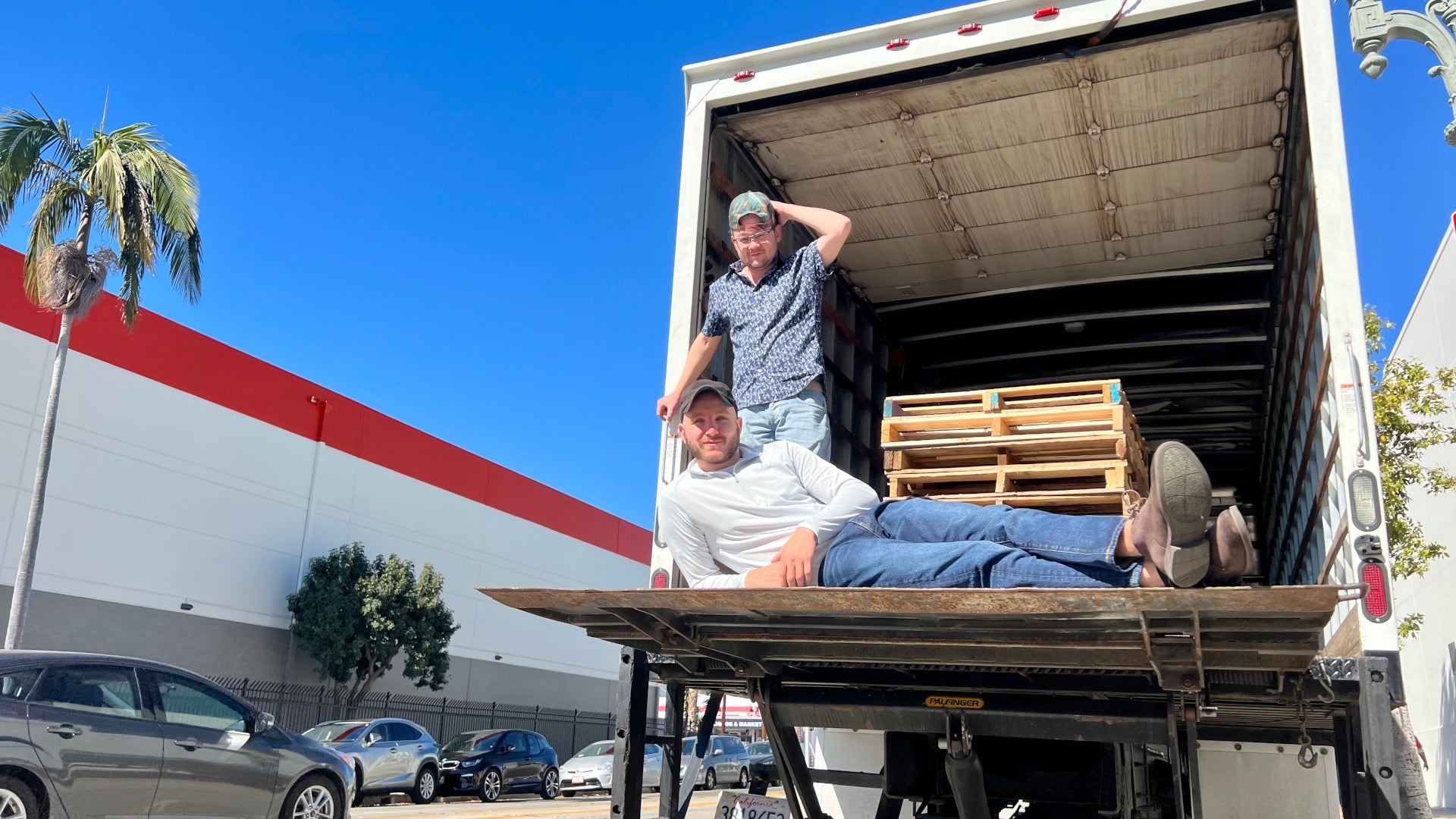
The idea grew from a limitation Sokolovsky had encountered in last-mile delivery. A local network can serve a destination city, yet remain difficult for a distant, lower-volume shipper to use. Getting inventory into that city can erase the economic advantage. In his account of Warp’s development, the upstream leg was the piece that prevented some shippers from choosing a regional delivery provider.
That observation changes the way his move looks. He followed a customer’s difficulty into an adjacent part of the journey. The service at the destination could be attractive while the trip to reach it remained expensive. Looking backward from the doorstep exposed the dependency.
The machinery in Warp’s model has several owners and several jobs. Cross-docks provide places to transfer and consolidate freight. Carriers provide the movement. Software helps coordinate the network and track shipments at pallet level. In his conversations about the business, Sokolovsky returns to the possibility of fitting different shipment needs into a shared system.
Warp also joined the University of Washington’s Urban Freight Lab in 2022. Sokolovsky already knew its work from an AxleHire last-mile pilot in Seattle the previous year. The connection is another small sign of continuity: the research relationship followed him from one portion of delivery to another.
Backstage at the mall
His recent writing takes the same concern into an environment where the customer sees almost none of the freight operation. In March 2026, Sokolovsky examined mall supply chains: controlled access, narrow delivery windows, limited backroom space, and store teams whose schedules revolve around shoppers. A retail store may serve customers, process returns, and fulfill online orders while also needing room for arriving inventory.
His prescription emphasizes predictable replenishment, consolidation before freight reaches the store, and visibility into arrivals. The practical point is that transportation decisions become decisions about space and staff time. A delivery that interrupts the sales floor creates work beyond the act of unloading. The loading dock has a vote in the customer experience, however modest its décor.
Warp had announced Concourse in February 2026, a service built around scheduled replenishment for mall retailers. The launch brings his argument into a specific operating setting. Store teams can plan around delivery windows, rather than rearrange the day every time goods appear. For a founder who started in food delivery, the unit of attention has become the store’s working rhythm.
Later in March, Sokolovsky published a checklist for evaluating transportation resilience. He asked whether providers could reroute freight quickly, shift movement between facilities, identify available capacity, and offer useful network visibility. His argument places flexibility inside the network’s design. Preparation means having alternatives that can be used when the original plan stops working.
The next handoff
Automation has become part of the next chapter. In June 2025, Warp announced a $10 million Series A led by Up.Partners and Blue Bear Capital, with plans to fund AI systems and a fully robotic cross-dock. The proposed facility would automate receiving, dimensioning, sorting, and dispatch. These were announced plans, a description of where the company intended to invest.
New funding announced for AI systems and a robotic cross-dock.
“It is about multiplying output,” Sokolovsky said of the round. The statement fits the recurring problem in his career: how to make a set of people, equipment, and facilities accomplish more through coordination. At Berkeley, the database needed improving. At AxleHire, the software selected routes and fleets. At Warp, the ambition extends into the place where freight changes hands.
There is an appealingly ordinary destination for all this engineering. A meal arrives. A package reaches the house. A store receives stock while its staff can use it. Sokolovsky has kept moving backward through the journey to find the decisions that make those moments possible. The last mile remains in view. He has simply given the miles before it more of his attention.