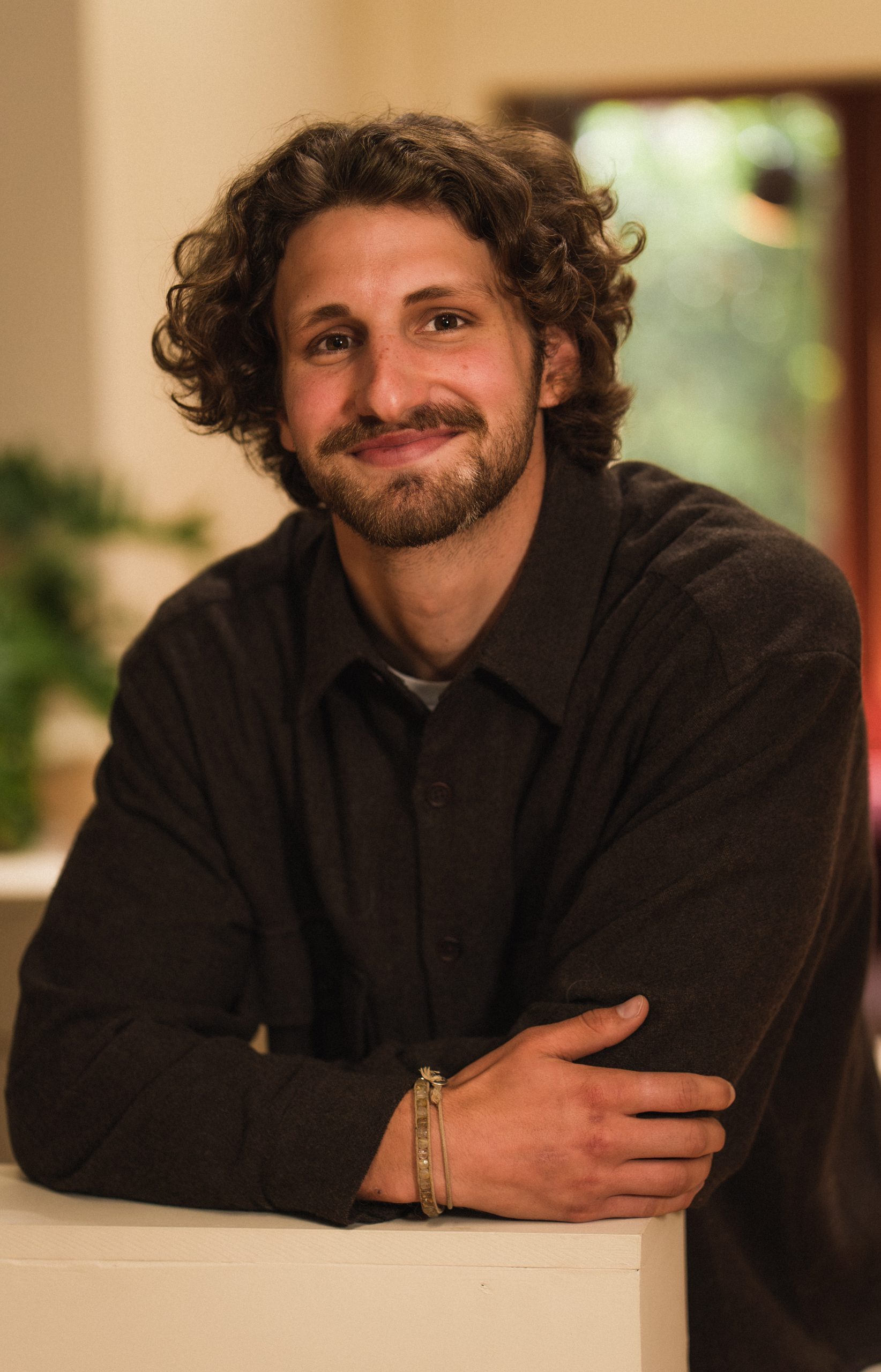
The investor who finds you first
There's a specific kind of investor who gets called "contrarian." Usually it just means wrong early and lucky later. Daniel Museles at NFX is something different - he's the kind of contrarian who can articulate exactly why the consensus is off before the price moves. He backed space data centers in 2024 when the phrase alone made most people blink. Starcloud - then called Lumen Orbit - just raised a $170M Series A at a $1.1 billion valuation. The window Museles wrote about had barely opened.
He's the Principal at NFX, the $450M San Francisco venture firm built on the theory that network effects are the only durable moat. That thesis runs deep at NFX. James Currier, Gigi Levy-Weiss, Pete Flint, Morgan Beller, Omri Drory - the partners built NFX Signal as much as they built the fund. Museles inherited that DNA and ran with it: 414 investor connections on Signal, active across crypto, AI, and space, checking sizes from $500K to $4M with a sweet spot at $2.5M. He shows up at the seed round, before the category is named.
He joined in September 2022, responding to what Morgan Beller described openly as a "wacky job listing." That framing wasn't accidental. NFX wanted someone who saw the wacky listing as a feature, not a warning sign - someone with enough intellectual range to take space data centers seriously in 2024 and AI-powered in-person dating seriously in 2025. Before the investing seat, Museles had already been in the room: he worked at an NFX portfolio company as an operator, learning what a term sheet actually means from the side that has to cash it.
The path there was precise. Sidwell Friends in Washington, DC - the same institution that educated Chelsea Clinton and Sasha and Malia Obama - then Cornell's School of Industrial and Labor Relations. His focus at ILR: micro-organizational behavior, the academic discipline that asks why individuals make the specific decisions they do under specific conditions. It's a strange background for a VC, until you realize that venture capital is almost entirely the practice of making fast, asymmetric bets on individual decision-makers. Understanding why founders decide what they decide, when they decide it, under which pressures - that's not a soft skill. That's the job.
After Cornell, Boston Consulting Group, where he ran private equity due diligence. BCG is good training for pattern recognition across industries, worse training for tolerating slow decisions. He moved on.
"Every era has its 'uninvestable' categories. Then a team comes along and makes you feel stupid for ever believing that."- Daniel Museles, on backing Known (AI dating app)
The investment in Starcloud is the cleanest proof of thesis. When NFX made its seed-stage bet on the company then called Lumen Orbit, the premise was that reusable rockets had triggered a cost collapse in orbital access - the same kind of structural disruption that containerization did for global shipping, that railroads did for continental commerce. Museles co-wrote the thesis with Morgan Beller in February 2026: "Ports, Rails, Roads, and Orbits." The argument is that SpaceX has already achieved a 20-36x cost reduction versus the Space Shuttle, with a potential 500x improvement still ahead. On-orbit compute follows from that logic. If getting to space gets cheap enough, you put data centers up there.
Most of the venture community was still calling it science fiction. By the time the paper published, Starcloud had a $1.1B Series A with In-Q-Tel, a16z and Sequoia scout funds, and Y Combinator all following in. The position NFX held from seed had already repriced dramatically. "Once you see it, you can't unsee it," Museles wrote. That's not a quote designed to impress - it's the actual experience of conviction before consensus.
The investment in Known works the same way, from the opposite direction. Known is an AI dating app that uses voice to get people onto in-person dates. The category - consumer social, dating apps, apps trying to pull people offline - has been declared dead multiple times. Museles backed it anyway with NFX leading, alongside Forerunner, Pear VC, and Coelius Capital in a $9.7M raise. His tweet at launch didn't pitch the product, it addressed the category skepticism directly: "Every era has its 'uninvestable' categories. Then a team comes along and makes you feel stupid for ever believing that."
He also leads NFX's crypto practice. The timing of that seat, 2022 onward through the crypto winter and back out, required a specific combination of conviction and patience. NFX's broader investment philosophy - network effects, not token mechanics - gives Museles a filter that most crypto-native investors don't apply: which of these protocols actually has a structural moat? Which ones become more valuable as they scale? The ILR background in individual decision-making turns out to be relevant here too. Crypto networks live or die by the coordination problems they solve for individuals at scale.
In September 2024, as NFX was restructuring - four employees from the software and engineering side were let go while the investment team expanded simultaneously - Museles was promoted to Principal. Morgan Beller announced it, called him the firm's "best partner-in-crime," and sent an explicit signal to founders: if you're working on something early and unconventional, reach out to Daniel directly. That kind of public endorsement from a GP doesn't happen accidentally. It's the firm saying: this person's judgment has been tested and it's good.
"Back when NFX invested in Starcloud, the idea of data centers in space was borderline insane to the uninitiated. Now, Starcloud is a frontrunner in a very real race to create the systems needed to unlock on-orbit compute."- Daniel Museles, Twitter/X, on Starcloud's trajectory
There's a detail about his personal life that fits almost too neatly: his dog is a Newfoundland named Cayuga - after the lake at Cornell. Newfoundlands are enormous, deliberate animals that were bred to rescue people in difficult water. They're not impulsive. They're built for situations where panic is the wrong response. It's either a coincidence or a tell.
His Twitter handle, @_dmuus_, has been active since February 2013. He was 14 or 15. That's a long time to be watching the internet develop from the inside - long enough to understand what networks actually do to information and attention, not just in theory but in lived experience. His personal site is built with WebAssembly, which is a technical choice no one would make for a simple personal page unless they were interested in the architecture for its own sake.
When Morgan Beller calls him the investor who "will probably find you first," that's not a sales line. It's a description of how Museles actually operates. He's not waiting at a desk for a warm intro. He's already in the corners of the internet where the weird ideas are forming - reading, posting, building conviction. By the time a founder is ready to raise, Museles has often already mapped the category. The first conversation isn't a pitch. It's a continuation.
The arc from Sidwell Friends lacrosse midfielder to NFX Principal is, in retrospect, coherent. He grew up at an institution that trained the children of powerful people to think seriously and act with some sense of consequence. He studied the science of individual decision-making. He went to a firm that taught rigor without removing intuition. He worked inside a startup before he started writing checks. And then he found his seat at a firm that has a genuine theory of value - network effects - and started backing the founders who most people were calling too early, too strange, too far out.
The space paper ends with a warning: "U.S. early advantages in space aren't permanent without sustained institutional moats." That's a geopolitical sentence in a venture essay. It suggests Museles is not thinking about returns alone - he's thinking about which technologies become infrastructure, and who owns them. That's the mind of someone who plays a longer game than the standard 10-year fund cycle.
The door is open. Email d@nfx.com. Just make sure what you're building is strange enough to be interesting.
The portfolio bets before consensus
On-orbit data centers deployed via very-low-Earth-orbit satellites. NFX invested at seed before the category had a name. Co-investors on the $170M Series A include In-Q-Tel, a16z scouts, Sequoia scouts, and Y Combinator.
Voice-AI dating app designed to push users toward real, in-person dates. Founded by Celeste Amadon and Asher Allen. NFX led with Forerunner, Pear VC, and Coelius Capital co-investing.