The first bottling run at Harpoon Brewery had barely begun when Dan Kenary's friends stopped the line. This was 1987, when a craft brewery in Boston sounded less like a business plan than a dare with stainless steel. Kenary was about to get married. His friends pinned him down, stripped off his clothes, put him in a jumpsuit with an Elvis wig and glasses, drove him to Logan Airport and handed him a ticket to Memphis.
A photograph from that detour still made him laugh decades later. It also captured the reason he had walked away from banking to make beer. The point was never only the liquid. Beer was the excuse for people to gather around a table, at a ball game, on a river, or apparently on an airplane dressed as the King. Several men in the photograph became Harpoon investors. The gang kept reuniting. A prank became corporate archaeology.
That origin matters because Harpoon's most consequential choices have followed the same plot: bring people in, give them a reason to stay, then build the business around the bond. The company's famous product is an IPA. Its deeper product is belonging.
The permit with a very small number
Kenary, Rich Doyle and George Ligeti had been college friends before they became brewery founders. Travel in Europe exposed them to something missing back home: varied, fresh beer that belonged to a place. In 1986, they acted on the absence. Harpoon received Massachusetts brewing permit No. 001, the first issued by the Commonwealth in more than 15 years.
Permit No. 001 looks glorious in hindsight. In real time, it meant almost nobody had prepared the customer for what came next. Kenary had left his job in banking. The founders needed to brew consistently, persuade bars to make room, and explain why beer that was amber or hazy had not spoiled. The first years, he has said, were survival mode. Local beer required local education.
There was a useful tension in Kenary's preparation. He had studied American history at Harvard, writing a thesis on Kenneth O'Donnell, an adviser to President John F. Kennedy. He later earned an MBA from the University of Chicago while working at the First National Bank of Chicago. One education taught him to read institutions backward. The other taught him to run numbers forward.
Kenary has written that history in his childhood home was a lively argument, never quite settled. At Harvard, he learned to enjoy re-examining old questions. Brewing suited that disposition. It gave him ancient techniques, centuries-old companies, recipes wrapped in legend, and late-night conversation. He calls it, with a historian's wink, the world's second-oldest profession.
“The beauty of studying history is that one is never finished.”Dan Kenary, reflecting on his Harvard education
The meeting where the buyer was already in the room
By 2014, Harpoon had something the young founders could scarcely picture: scale, a recognized flagship, a second brewery in Windsor, Vermont, and hundreds of employees. Then Doyle decided to leave. A familiar path was available. A strategic buyer or private-equity firm could purchase the stake. Kenary did not want a distant owner flattening the company into somebody else's system or moving its beer elsewhere.
So he convened roughly 200 employees in the Boston beer hall. The taps were nearby, but the room was strangely quiet. Some visitors wore suits, always suspicious brewery attire. People feared Harpoon was about to join the long list of independent breweries sold to a larger corporation.
Kenary invited everyone to look at the person on the left and the person on the right. Those colleagues, he announced, were the new owners of 48 percent of Harpoon. Employees cheered. Some cried. The transaction created an employee stock ownership plan, or ESOP, funded with debt and designed to allocate shares over time.
The decision has acquired the clean glow of a case study, but Kenary talks about its complications, too. Debt adds pressure. Ownership does not magically produce engagement. An ESOP, he says, is not for every business. It can be powerful when a company already has an engaged culture and turns engaged employees into engaged owners. The sequence matters: ownership amplified the culture; it did not substitute for one.
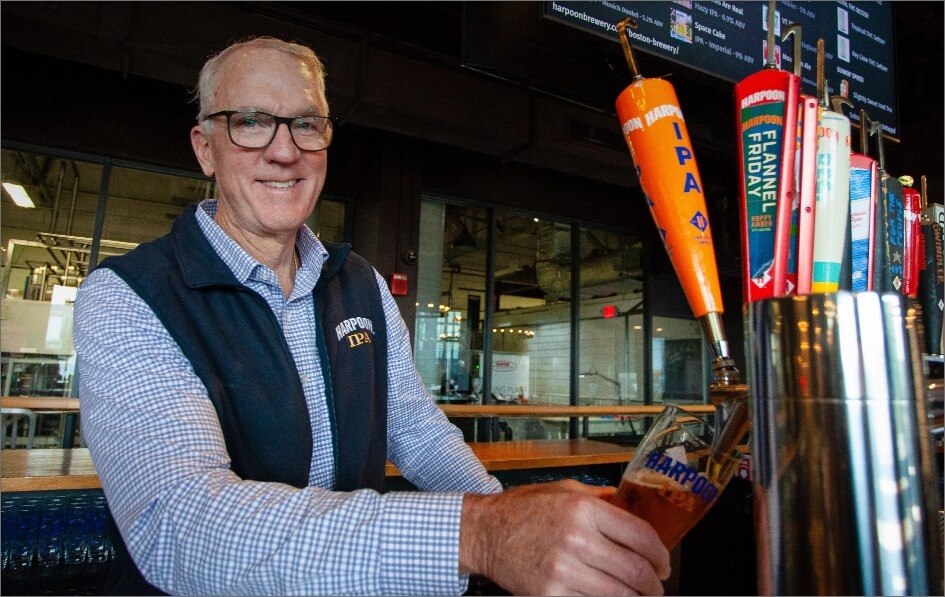
His language around leadership is disarmingly domestic. “Honey is more effective than vinegar,” he has said. He prizes people who combine decency with drive, ambition and competitiveness. Nice is not a euphemism for sleepy. Harpoon's ideal resembles a good team: people who enjoy one another and still want to win.
That culture shows itself in modest acts. In one story, a customer complained about a beer. Before the problem could climb an approval ladder, Harpoon's head of quality drove a replacement 12-pack to the customer's home. The recipient later served Harpoon at their wedding. No loyalty program could improve the ending.
A collective, not a collection of labels
Harpoon expanded partly by building and partly by welcoming other beer businesses. It acquired the Windsor brewery in 2000. Clown Shoes joined in 2017. Long Trail followed in 2022. Kenary's stated approach to acquired brands was unusually restrained: the point was not to make Clown Shoes more like Harpoon. It was to help Clown Shoes become more fully itself.
That instinct faced a larger test at the end of 2024, when Harpoon parent Mass. Bay Brewing and Smuttynose parent Finestkind Brewing announced their combination. The new Barrel One Collective began 2025 with 14 brands and brewery or retail operations across Massachusetts, New Hampshire, New York and Vermont. Greater Good Imperial Brewing joined that June.
Consolidation is an unromantic word, especially in craft beer. It suggests identical cans moving efficiently through a beige warehouse. “Collective” makes a more demanding promise. Distinct brands must share capacity without surrendering character. The economic logic is evident: production assets, distribution routes and administrative systems can travel farther together. The cultural logic has to be earned one brewery at a time.
In July 2025, the founder made another institution-minded move. Kenary shifted from chief executive to co-founder and president of Barrel One. Nathaniel Davis became CEO. After almost 40 years, the transition was a practical version of Kenary's repeated ambition: leave the place prepared for greater success than it had achieved under him.
“There aren't a lot of hundred-year breweries in the United States. That's our goal.”Dan Kenary on Harpoon's horizon
Boston is not a backdrop
A local brewery eventually has to decide what “local” means. For Harpoon, it has meant manufacturing jobs, festivals, road races, environmental and business groups, and a beer hall on the Boston waterfront. Kenary served as founding president of the Massachusetts Brewers Guild, as a leader at Save the Harbor/Save the Bay, and as chair of Associated Industries of Massachusetts.
In October 2025, Governor Maura Healey appointed him and business leader Mark Nunnelly to co-chair a new advisory council on Massachusetts competitiveness. Its brief includes taxation, workforce development, regulation, innovation, education, housing, transportation and the effects of federal policy. It is a very long way from persuading a bartender to try an unfamiliar amber beer, yet the operator's concerns remain recognizable: costs, talent, logistics, rules, and whether a good idea can survive in this place.
Meanwhile, Harpoon's Boston home entered its fifth decade with a 2026 reintroduction as Harpoon Seaport. The plan broadened the food, outdoor and live-event experience. The brewery that once had to invent a local beer audience is now tending a local gathering place.
Kenary's career offers no tidy recipe. He is candid that the early years were frightening and the ESOP can be stressful. His own advice to his younger self is modest: relax, have more confidence, and hire for character rather than a narrow résumé label. He identifies himself as the risk taker next to finance colleagues who supply useful resistance. Even the honey needs a balance sheet.
But one pattern is clear. The friends in the Elvis photograph became investors. Customers became regulars. Workers became owners. Acquired breweries were asked to retain their identities. A founder became a civic adviser and then made room for a new chief executive. Again and again, the next stage widened the circle.
That is how a 100-year ambition begins to sound less grandiose. A company lasts when enough people can recognize themselves inside it. Kenary started Harpoon because Boston lacked the beer culture he had enjoyed elsewhere. His more interesting accomplishment is the culture that now has a chance to continue without requiring him at its center. The pint gets emptied. The table remains.