Consider the wing flap. From a passenger seat, it looks like a piece of metal doing something reassuringly mechanical. Somewhere inside the aircraft, however, a sensor has to report where that flap actually is. The distinction between where something should be and where it is can matter enormously. Curtiss-Wright makes components for precisely this sort of distinction. Its name evokes the beginning of flight. Its present business asks a more practical question: what has to work inside the machine?
- It sells specialist hardware and services to aircraft makers, defense contractors, power operators and industry.
- The jet age displaced its old aviation business. Components became a route into other machines.
- Today, nuclear simulation and aircraft computing sit beside pumps, valves and surface treatments.
When the airplane business moved on
Start with the name. The corporation formed in 1929 from businesses descended from Glenn Curtiss and the Wright brothers. Those pioneers were its ancestors, rather than three men gathering to launch a new venture together. By the Second World War, Curtiss-Wright was making aircraft, engines and propellers in enormous numbers. The P-40 fighter became one of its recognizable products. It was a business organized around the machinery of an aviation era.
Then the machinery changed. The company’s own history describes how commercial jets, including the Boeing 707 and Douglas DC-8, eroded the place of reciprocating engines and propellers. Curtiss-Wright withdrew from military airplane competition; its Airplane Division closed in 1951. The historical lesson begins with an uncomfortable fact: being skilled at an important product does not ensure that the product will remain important.
Its response unfolded over decades. Curtiss-Wright moved engineering knowledge into electronics, simulation, metal treatment and equipment for nuclear applications. The continuity was the ability to solve difficult physical problems. The customers and products could change. That distinction helps explain why a company carrying the Wright name now has something useful to sell to a reactor developer.
The business of staying inside
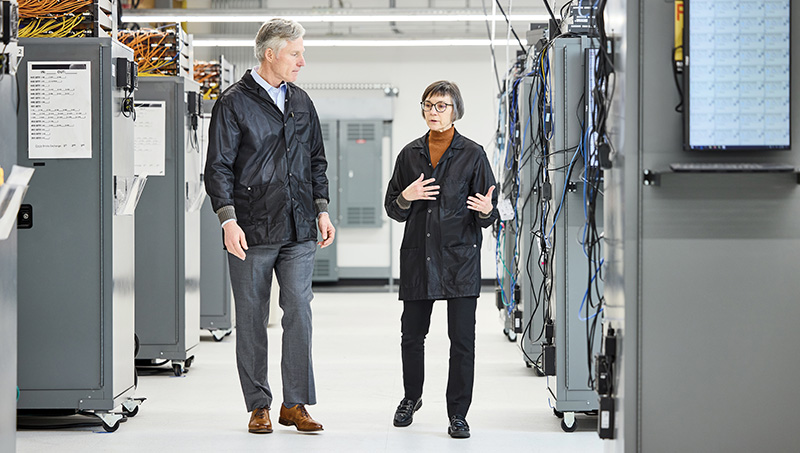
Today’s catalogue can initially look like several companies accidentally sharing a website. Sensors and actuators sit beside rugged computers, tactical networking, nuclear pumps and surface treatments. The organizing principle becomes clearer when you look at the working conditions. These products belong in places where heat, vibration, wear, pressure or an interruption in service makes an ordinary component inadequate.
Aerospace & Industrial supplies sensing, motion control and treatments such as shot peening and laser peening. Defense Electronics supplies computing, communications and instrumentation. Naval & Power supplies equipment for ships, nuclear plants and demanding process applications. A manufacturer can buy a component, an integrated system or specialist work on an existing part. The relationship can continue through support, replacement and upgrades.
Three routes into demanding machinery. Reported segment sales; rounding applies.
Take the C-17 transport aircraft. In February 2026, Boeing selected Curtiss-Wright mission computers for a flight-deck modernization program. Curtiss-Wright put the estimated lifetime contract value above $400 million. That figure is an estimate across a program’s life, rather than cash already collected. The immediate customer is Boeing; the aircraft serves the U.S. Air Force and allied operators.
The computers follow a Modular Open Systems Approach. The practical attraction is the ability to insert new technology as requirements change. A long-lived aircraft needs computing that can evolve. Curtiss-Wright’s proposition combines that modularity with equipment built for demanding service. Its PacStar business addresses a related problem on the ground: taking computing and communications into rugged, remote locations.
The aircraft can keep flying while the technology inside it changes.
An observation on the C-17 modernization brief
Buy the skill. Build the capacity.
The nuclear business shows how the portfolio grows. In April 2024, Curtiss-Wright bought WSC, a power-plant simulation company, for approximately $34 million. In December, it completed the roughly $200 million Ultra Energy acquisition, adding reactor protection, monitoring and specialized sensors. One purchase helped model the plant and train its operators. The other added equipment for measuring conditions and protecting operation.
By October 2026, the connection was concrete. Curtiss-Wright had installed a Stage 1 training simulator at TerraPower’s Natrium site in Kemmerer, Wyoming. Built on its 3KEYMASTER platform, the simulator reproduces plant equipment and operating conditions to support training and licensing. Under other contracts, Curtiss-Wright is also developing the plant’s distributed control and reactor protection systems. Several distinct capabilities now meet one customer’s project.
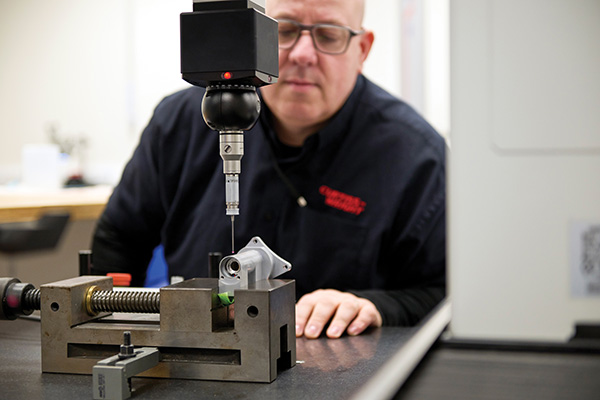
Engineering ambition also needs floor space. In July 2026, the company announced an $80 million, multi-year expansion at Cheswick, Pennsylvania, combining internal investment with state support and maritime industrial-base funding. Two new buildings are intended to increase manufacturing and testing capacity. The announced plan anticipates about 150 additional jobs. Buying capability and making room to deliver it are separate expenses.
A factory lesson with conditions attached
There is a useful idea here for anyone running a specialist business: identify the knowledge customers still need when the original product loses ground. Then find adjacent work where that knowledge matters. Curtiss-Wright’s history suggests the approach; it does not make it inexpensive or quick. Nuclear equipment and defense systems demand technical credibility, qualification work and patience with programs that can move slowly.
The competition also changes with the component. Moog has identified Curtiss-Wright as an aircraft-controls competitor. A buyer choosing a sensor faces a different shortlist from one selecting a reactor system. This makes broad claims of superiority unhelpful. The meaningful question is whether a particular product satisfies a particular specification, budget and delivery schedule. Reduced government spending, postponed projects or customers bringing work inside can all weaken the model.
The company reported $3.498 billion in 2025 sales. In September 2026, it announced that Kevin Rayment would succeed Lynn Bamford as CEO on January 1, 2027, with Bamford becoming Executive Chair. The next leader inherits a business whose aviation ancestry is unusually famous, but whose daily work is mostly hidden. Somewhere, a flap moves. A sensor reports its position. That is where this company earns its place.