The first Crewdible warehouse was not really a warehouse. It was an escape hatch. Dhana Galindra had built an online retail business, found products that sold and then discovered the unglamorous tax on every successful order: somebody still had to find the stock, wrap the parcel and carry it into the shipping system. By 2016, that somebody was too often him.
His first workaround was wonderfully informal. He asked people who worked around courier services to hold products and dispatch them when orders arrived, paying roughly Rp5,000 per transaction. Other sellers wanted in. The nuisance was common enough to be a market, and in 2017 Galindra and co-founder Sony Gultom turned the arrangement into Crewdible.
The Tangerang company now sits in an easily misunderstood part of commerce. It is a third-party logistics provider, but not merely a warehouse landlord. It is a marketplace for spare capacity, but parcels do not move on introductions alone. It is a software company, but every line of code eventually confronts a physical object, a cutoff time and a roll of tape. Crewdible's product is the coordination of all three.
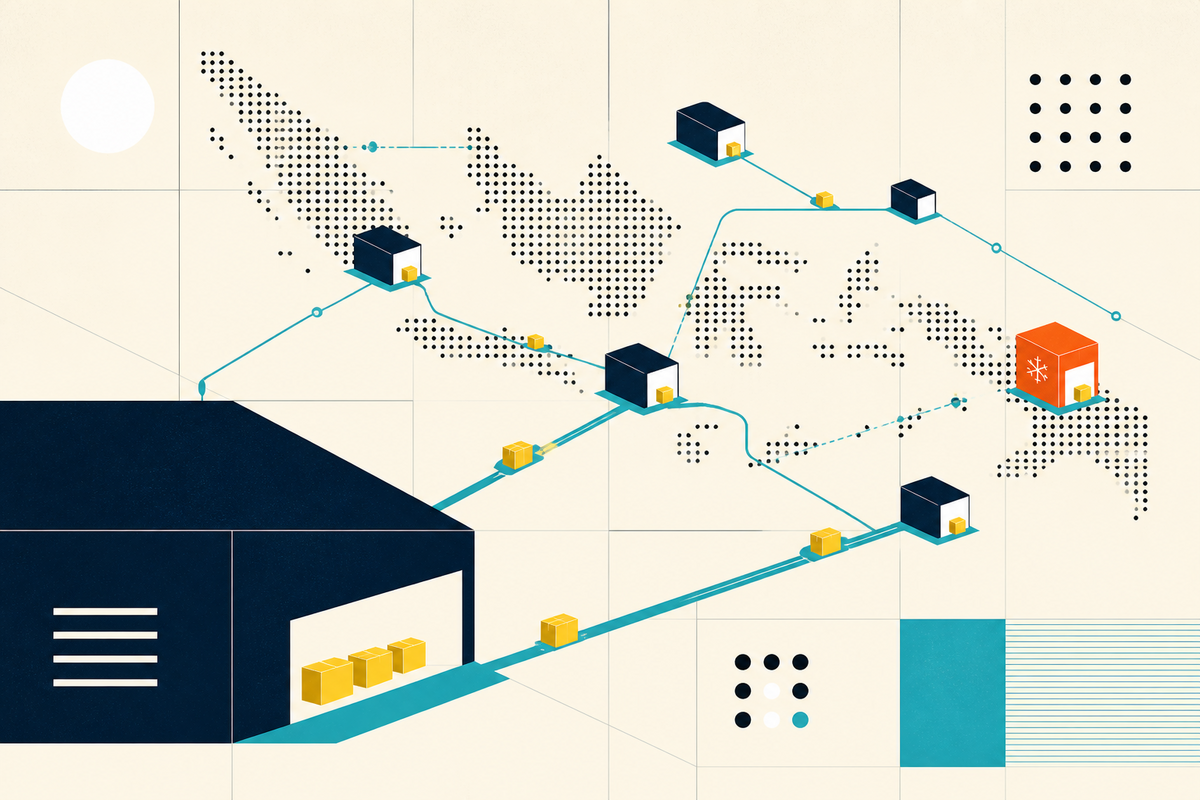
A warehouse made from other people's walls
Traditional warehousing grows through leases, concrete and long commitments. Crewdible built its supply from what already existed: homes, garages, shop-houses, offices and conventional warehouses with room to spare. Property owners can contribute space; operators can run a node without owning the building; one partner can do both. Crewdible verifies the site, trains the operator, monitors performance and brings seller demand.
That makes the network comparatively light on property, but not light on responsibility. A seller does not care that a warehouse is crowdsourced when the wrong lipstick shade lands in a customer's box. Every node needs the same inventory logic, order discipline and service standards. Crewdible's Warehouse Management System records stock and transactions, routes incoming orders and gives sellers a real-time view. The software is the common language spoken by buildings that were never designed as one fleet.
For merchants, the bargain is freedom from fixed operations. They can store stock, connect marketplace orders, choose warehouse capacity, and outsource picking, packing and courier coordination. They do not need to hire a warehouse crew before they know whether next month's volume will justify it. For a property owner, a quiet room becomes earning capacity. Crewdible takes fees around storage and handling, while the partner model divides the economics among the platform, the operator and the owner.
This arrangement also explains the company's stated culture. Crewdible lists continuous learning, intense user orientation, extreme ownership and collaboration as its four values. They are tidy phrases on an About page, but each maps to a network risk. Operators must learn unfamiliar categories. Product teams must notice where sellers lose time. Someone must own a stock discrepancy instead of passing it between warehouse, platform and courier. Independent partners must behave like one organization at the moment an order arrives.
“We are here because e-commerce is growing, and we follow behind it.”Dhana Galindra, founder and CEO
Everything before the doorbell
Delivery apps trained shoppers to stare at the last mile. Crewdible operates in the long prelude before a driver rings the bell. A product arrives inbound, is counted and placed. A marketplace order enters the system. A worker finds the correct SKU, packs it to the seller's specification and stages it before the courier cutoff. Stock changes must flow back to the merchant before a second channel sells an item that has already left the shelf.
The catalog makes this more complicated than cardboard boxes suggest. Fashion means many similar SKUs. Packaged food requires first-expired, first-out rotation. Beauty and health products may need controlled conditions. Fresh and frozen inventory needs speed and temperature discipline. High-value goods demand cameras, vetted handlers and insurance. Homewares can mean anything from a spoon to a sofa. Crewdible markets micro and macro warehouses, cold storage, custom packaging and dedicated enterprise arrangements because no single shelf plan covers that range.
This is where Crewdible's expertise lives: less in moving a box than in designing the rules around it. Which warehouse should receive the stock? How late can an order arrive and still leave today? Which lot expires first? What happens when an item breaks, disappears or returns? The company has described insurance coverage for losses and publishes formal claim and service-level procedures. Those details are mundane until a merchant's working capital is sitting on somebody else's shelf.
Its advertised fulfillment packages have included integrations with Bukalapak, Tokopedia, Shopee, Lazada and TikTok Shop, alongside API connections. Some plans have used a transaction percentage with stated caps, while larger customers receive prices based on their requirements. The business model is therefore a blend: service fees for the physical work, storage economics for capacity, and software that makes both repeatable.
One network, two kinds of customer
Crewdible solves two idle-resource problems at once. Sellers have inventory but too little time, staff or local reach. Property owners have space but too little demand or operating know-how. The platform stands between them. Its differentiation is not simply cheaper storage; Galindra has argued that existing space lowers rent and software speeds operations. The more consequential distinction is flexibility: multiple smaller nodes can put goods nearer customers without forcing a merchant to build a national warehouse estate.
Seller side
Trade leases, payroll and packing queues for variable fulfillment capacity, stock visibility and local reach.
Partner side
Trade idle floorspace for trained operations, warehouse software, courier pickup and seller demand.
There is a second distribution layer too. Crewdible's Dropshipper Network lets brands expose selected inventory to resellers, who can market products without holding the stock themselves. A Dropshipper Management System lets suppliers register SKUs and manage the network. Instant Fulfillment handles routine online orders; Enterprise Solution bundles more customized storage, transport and logistics. Together they move Crewdible from outsourced back room toward commerce operating system.
Customers named on the company's site reveal its practical constituency: Carpetshop Indonesia, skincare seller Mokkaskin, home-and-living brand Normal Estate and the Lapakgamis88 dropshipper. These are businesses for which one missed pickup or one fuzzy stock count is not an abstract supply-chain metric. It is a delayed customer message, a poor marketplace rating or cash trapped in the wrong city.
The company has also framed its expansion as local economic infrastructure. A warehouse partner can make unused property productive and hire nearby operators; a merchant can reach another city without opening a branch. The claim is practical rather than sentimental. Indonesia's thousands of islands make distance expensive, and the country's smaller cities do not all justify a conventional fulfillment center on day one. A distributed network lets capacity arrive in smaller increments, provided demand and quality can be matched.
Capital for the coordination problem
Investors arrived as the workaround became infrastructure. Friends, family and angels supplied early money in 2018. Global Founders Capital led a US$1.5 million pre-Series A in 2019, when Crewdible said it would expand into major Indonesian cities and strengthen technology for heavier, more varied traffic. The pandemic then pushed more commerce online. The company describes 2020 as a period of hyperscale, though Galindra noted that growth was uneven: home goods and gaming rose while vulnerable sellers struggled.
Network build-out
Selected public milestonesCompany-reported warehouse counts are snapshots, not a continuous series.
In October 2022, Bukalapak led a US$3.2 million Series A, joined by 500 Southeast Asia, Ondine Capital, former GoPay chief Aldi Haryopratomo and other angels. The fit was legible: Bukalapak knew merchant demand; Crewdible had fulfillment supply and operating software. Bukalapak's audited 2023 accounts later disclosed a 9.09 percent interest in Crewdible Holding, describing its subsidiary business as a warehouse and fulfillment aggregator in Indonesia. Across the disclosed 2019 and 2022 rounds, Crewdible raised US$4.7 million.
Money cannot eliminate the hard part. Crowdsourced capacity produces variation. A home-based micro-warehouse and an enterprise facility do not begin with identical loading bays, staff or throughput. Crewdible's terms spell out service levels, claims, fees and responsibilities because a network needs both code and consequences. Training and monitoring are not support functions here; they are part of the product.
Where Crewdible fits
Indonesia already has warehouse and fulfillment alternatives, including Shipper, Waresix, AllSome Fulfillment, Goodang and iStore iSend, as well as fulfillment programs operated by marketplaces. Crewdible occupies the intersection of a 3PL, a capacity marketplace and logistics SaaS. Its partner network is the economic wedge. Its warehouse and dropshipper systems are the mechanism. Its focus on SMEs gives it a vast but operationally demanding customer base.
The appeal is clearest for a seller graduating from the kitchen table but not ready to become a logistics company. Crewdible can provide an operations department in pieces: one shelf now, another city later, cold capacity when the catalog changes, custom workflows when volume warrants them. Larger enterprises can buy dedicated and tailored arrangements, but the founding insight still hangs over the business. Growth creates chores before it creates infrastructure.
Crewdible's wager is that those chores can be standardized across places that look nothing alike. The green mark on its website is cheerful; the machinery underneath is sober. Every parcel must reconcile software with a shelf, a person and a clock. If the system works, the seller barely notices any of it. That invisibility is the service.