The New York company that took creatine - the gym's worst-kept secret - and made it taste like sour cherry.
Somewhere in a Target between the protein bars and the multivitamins, a shopper who has never set foot in a powerlifting gym picks up a pouch of orange gummies and reads the back. One and a half grams of creatine. Vegan. NSF Certified for Sport. No scoop, no shaker, no chalky aftertaste. She buys it on the way to checkout, next to the toothpaste.
That small, unremarkable transaction is the entire point of Create Wellness. The company didn't invent creatine - one of the most studied compounds in sports science has been around for decades. It invented a version of creatine that a normal person would actually agree to take every day. And then it convinced the supplement aisle, one retailer at a time, that the stuff belonged next to the toothpaste.
Creatine has a public relations issue, which is impressive for a molecule. The science is overwhelming - hundreds of peer-reviewed studies, tens of thousands of participants, consistent findings on strength, recovery, and increasingly on cognition and healthy aging. On paper, it should be as routine as a daily vitamin.
In practice, it was trapped. Creatine lived in giant tubs of unflavored powder, marketed almost exclusively to men who refer to leg day as a personality. It clumped. It floated. It demanded a shaker bottle and a tolerance for grit. For everyone outside that narrow audience - which is to say, most people - the message was clear: this is not for you.
The irony was hard to miss. The most evidence-backed supplement on the shelf was also the one most people had quietly written off. The science said "everybody." The packaging said "meatheads only."
Dan McCormick had taken creatine for more than ten years and, by his own admission, hated the experience. He believed the science completely and dreaded the ritual - the messy powder, the daily friction, the routine that kept breaking. He had spent his career building consumer brands at Away, Parade, and Not Boring. His wife, Sienna McCormick, had spent six years at Goldman Sachs. In 2022 they made a bet that the problem with creatine was never the molecule. It was the delivery.
The fix sounded simple and turned out to be anything but. They wanted a gummy. More than twenty manufacturers told them a real creatine monohydrate gummy could not be made - creatine is famously unstable in the wrong conditions, and a candy-like format seemed to break every rule. After months of reformulation, they found one partner willing to build it from scratch.
The result was the world's first creatine monohydrate gummy. The McCormicks deliberately built the brand for men and women alike, dragging the category out of the weight room and toward anyone curious about strength, recovery, and staying sharp.
Dan and Sienna McCormick launch Create Wellness and introduce the world's first creatine monohydrate gummy.
Unilever Ventures leads a $5M round, bringing total funding to roughly $7.3M and validating the gummy thesis.
Core flavors roll out across Target stores after explosive year-over-year growth - the brand's biggest retail leap yet.
Alliance Consumer Growth and Impact Capital lead a $20M round, with Unilever Ventures returning, to fund retail, education, and new formats.
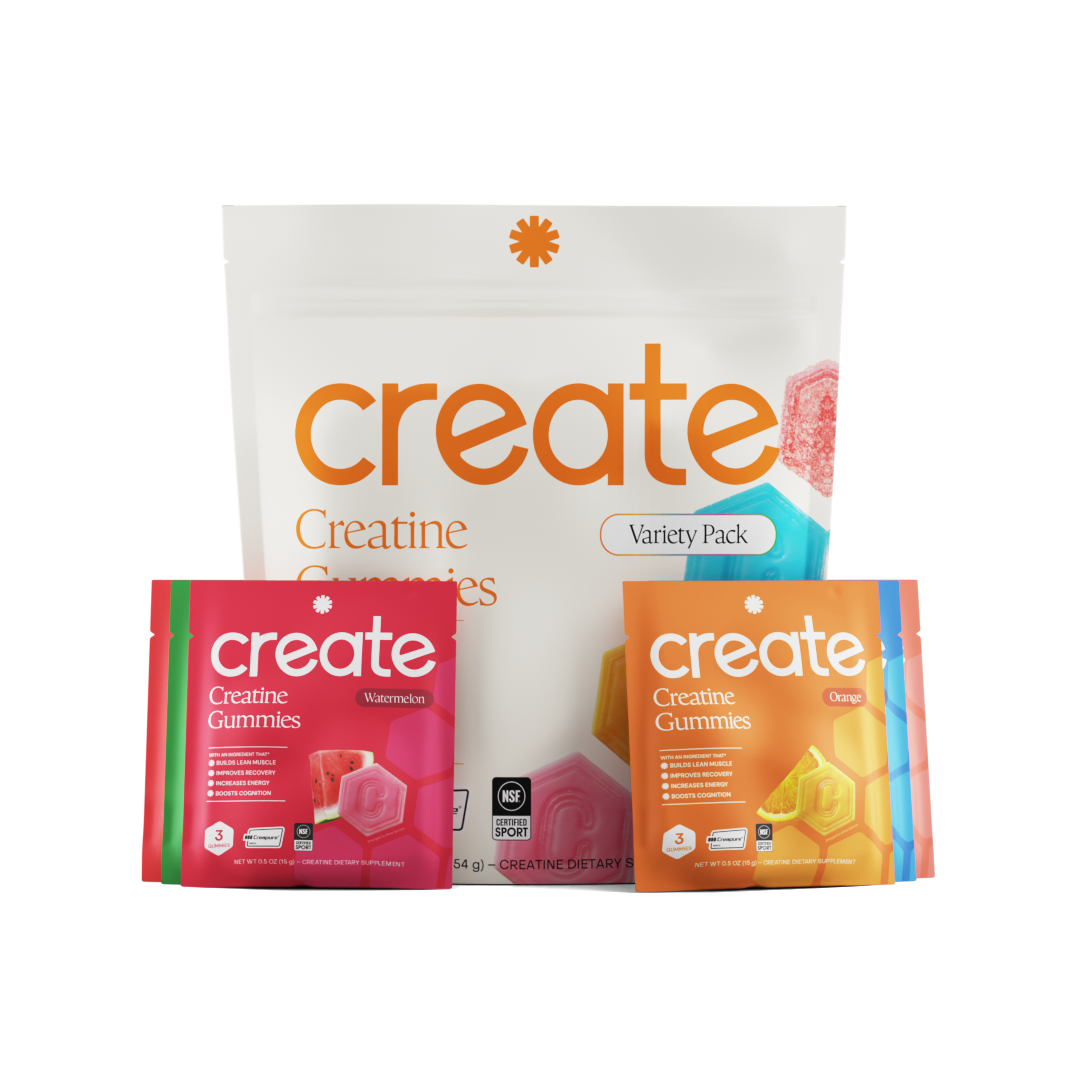
The flagship is the gummy: 1.5 grams of creatine monohydrate per piece, low sugar, built on a vegan pectin base, NSF Certified for Sport and third-party tested. It comes in flavors that sound like a candy aisle - Orange, Blue Raspberry, Sour Green Apple, Watermelon, Sour Cherry, Sour Peach - which is rather the point.
For people who want hydration too, there are Creatine + Electrolytes stick packs. For purists who never minded the powder, there's unflavored 99.9% pure creatine monohydrate. And for the perpetually packing, variety travel pouches. The format changes; the molecule doesn't.
A good story is not a business. Create's case rests on harder evidence: gummies sold, shelves won, and investors who write checks for a living.
The retail proof is just as concrete. The gummies now sit on shelves at Target, GNC, The Vitamin Shoppe, Sprouts, and Wegmans - a distribution footprint that powder-tub brands spent decades assembling. The Series B was led by Alliance Consumer Growth and Impact Capital, the family office of Mike Repole, the operator who co-founded vitaminwater and BODYARMOR. People who have done this before are betting it happens again.
Strip away the flavors and the funding and Create's mission is a single statistic. When the McCormicks started, roughly 2% of people took creatine. The whole company is an argument that the other 98% were simply never given a reasonable way in.
That reframes everything. Create isn't really competing with other supplement brands for a slice of the existing creatine market - it's trying to grow the market itself, mostly by reaching women and non-athletes who were politely ignored for years. Education does as much work as flavor. The brand spends real effort explaining what creatine is, what the research actually says, and why "bodybuilder supplement" was always a marketing accident rather than a fact.
If the research on creatine and cognition and healthy aging keeps holding up, the audience stops being "people who lift" and starts being "people who get older," which is everyone. That's the prize the Series B is chasing: new formats, more shelves, and a slow rewrite of what the word creatine means to a casual shopper.
So return to that Target aisle. The shopper who grabbed the orange gummies on her way to the register has no idea she's part of a thesis. She didn't research a molecule or read a single clinical trial. She just found something easy to take that happened to be backed by decades of science - which is exactly the gap Create Wellness was built to close.
Creatine spent decades waiting for permission to be normal. Create handed it a gummy and pointed it toward the checkout.