In 2018, a relatively small venture fund produced a very large number. CRCM Opportunity Fund had started with $37.5 million. By May, partner Toby Zhang said it had distributed more than $1 billion. Among the investments behind ChinaRock Capital Management’s venture success were Youku and Musical.ly, the video app acquired by ByteDance. The arithmetic was enough to make an investor put down a coffee.
- Capital for institutions and families; early backing for technology founders.
- A venture history shaped by connections across the US and China.
- Big outcomes depend on surviving very ordinary expenses.
But a payout tells you where a journey ended. It tells you considerably less about the waiting, the wrong turns, or the bills paid along the way. CRCM becomes more interesting when you put that result beside another portfolio company: Sandbox VR, whose American operating subsidiary entered Chapter 11 in 2020. Both belong in the picture.
Two audiences. One pool of patience.
Today, CRCM L.P. describes itself as an investment adviser managing discretionary capital for institutions and families, with bases in San Francisco and Las Vegas. Its April 2026 regulatory filing reported approximately $746.7 million in regulatory assets under management across 19 accounts. That measures capital under advice, rather than annual sales or cash returned to investors.
The venture operation adds a second audience: founders seeking money before their businesses become obvious. Historically, CRCM concentrated on seed and Series A opportunities. Capital providers entrust money to the manager; portfolio companies receive investment capital. Keeping those roles straight helps explain the business. A founder needs room to build. An institution needs someone who can judge whether the building is worth financing.
Founder Chun Ding brought an asset manager’s background to that problem. Before CRCM, he worked at Farallon Capital Management and became a managing member there. The resulting firm has a public-market heritage alongside its venture activity. Its product is investment management, with individual funds serving as investment vehicles.
The bridge had a destination
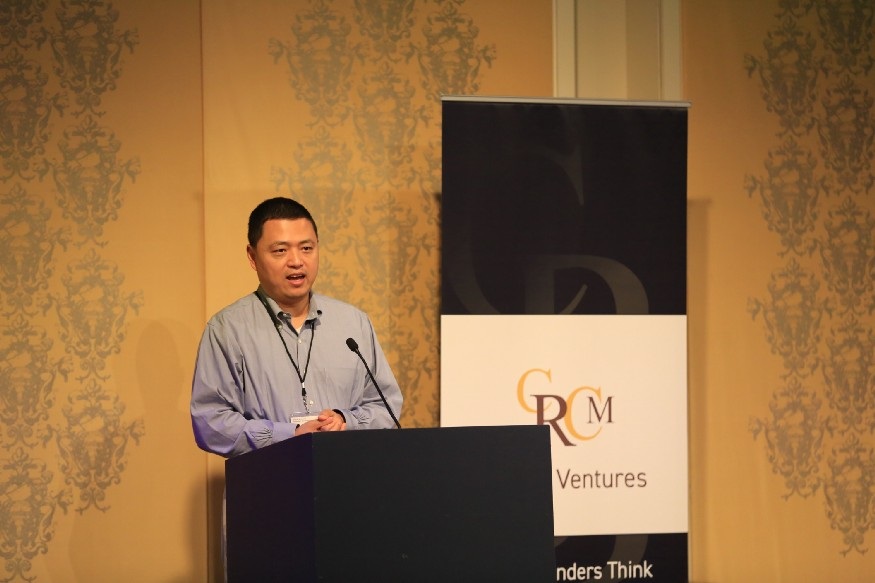
In a 2016 interview in Sydney, Zhang described a progression from Chinese internet investments toward early companies in the United States, Israel and Australia. The attraction for entrepreneurs was specific: familiarity with China and the US West Coast could help them enter overseas markets. This was a network with a proposed use, rather than a collection of impressive business cards.
Zhang said the team spent over half its time understanding entrepreneurs. It also sought businesses capable of changing direction and technology that could establish competitive barriers early. Musical.ly illustrated the founder emphasis: CRCM already knew the entrepreneurs from earlier work. The practical lesson is to investigate the people and their ability to adjust before falling in love with a market forecast.
CRCM’s advantage over a purely domestic seed investor was that international perspective. Compared with a specialist investor, it also ranged widely across healthcare, financial technology, media and frontier technologies. Breadth makes sense when expertise and relationships travel with the investment; it becomes less useful when a company’s problems demand knowledge the investor cannot supply.
A $150 million ambition meets a smaller close
The Youku Global Media Fund made the approach tangible: combine an investment manager with a media partner and pursue emerging technology. A public limited partner’s disclosure described an original target of $150 million. By July 31, 2018, confirmed commitments were about $65.9 million, and the fund closed.
The same disclosure recorded a change in Youku’s investment platform from special limited partner to limited partner, and a new name: CRCM Frontier Technology Fund I. Those changes matter. A target is a fundraising ambition; commitments are what investors agree to supply. The public record documents the revised structure without establishing why every participant changed course.
Later vehicles continued the venture activity. Opportunity Fund IV disclosed $66.45 million sold to 36 investors in its April 2022 Form D. Those were fund interests sold by that filing date, rather than corporate funding for CRCM itself. A reader comparing funds should keep targets, subscriptions and asset values in separate columns.
Then the doors stayed shut
Sandbox VR gave the portfolio’s futuristic ambitions a physical address. Friends entered a room, wore equipment and shared a virtual adventure. In 2020, that room became the problem. Pandemic closures removed the ability to trade. The American subsidiary, Glostation USA, filed for Chapter 11 in August and emerged after a court-approved reorganization later that year.
The restructuring involved roughly $13.6 million of secured debt. Here was a technology investment negotiating with the decidedly familiar world of lenders and landlords. CRCM was among Sandbox’s backers; that fact alone does not establish its role in the rescue or its eventual financial outcome.
The episode offers a useful question for any ambitious product: what has to remain available for customers to pay? For location-based entertainment, the answer includes premises, permission to open and people willing to gather. Technical quality cannot substitute for those conditions. Runway calculations need to include the commitments that keep running when revenue stops.
willing to gatherPremises
able to openRunway
able to last
Lose access to the room, and the revenue model changes.
The quieter bets explain the range
By 2023, the venture record included less theatrical problems. CRCM participated in Venteur’s $7.6 million seed round, led by GSR Ventures. Venteur helps employers fund individual health insurance choices through ICHRA arrangements, giving employees a way to select coverage. The product addresses a purchasing and benefits problem that employers encounter repeatedly.
That March, CRCM also joined an $8 million Series A for ClearBlue Markets, led by Royal Bank of Canada. ClearBlue identified CRCM as an existing investor. Its work combined carbon-market advice with technology for businesses navigating compliance and voluntary emissions goals. These are services sold by portfolio companies; CRCM finances the businesses behind them.
Pick the pond. Keep watching the water.
Zhang’s later reflections add a useful correction to the mythology of perfect foresight. In March 2025, he wrote that he had left CRCM the previous month. Looking back, he credited the early mobile and social wave with making investors look clever. His compact verdict: “Market cycles matter.” He also stressed changing direction when circumstances demand it.
For founders considering CRCM, the useful exercise is to connect the company’s needs to that record: early capital, international context and tolerance for emerging markets. For readers elsewhere, the transferable habit is more basic. Identify what would make demand disappear, which expenses would survive, and what evidence would justify another commitment. The future can take years to arrive. Rent has a date.
“Market cycles matter.”
Toby Zhang · March 2025