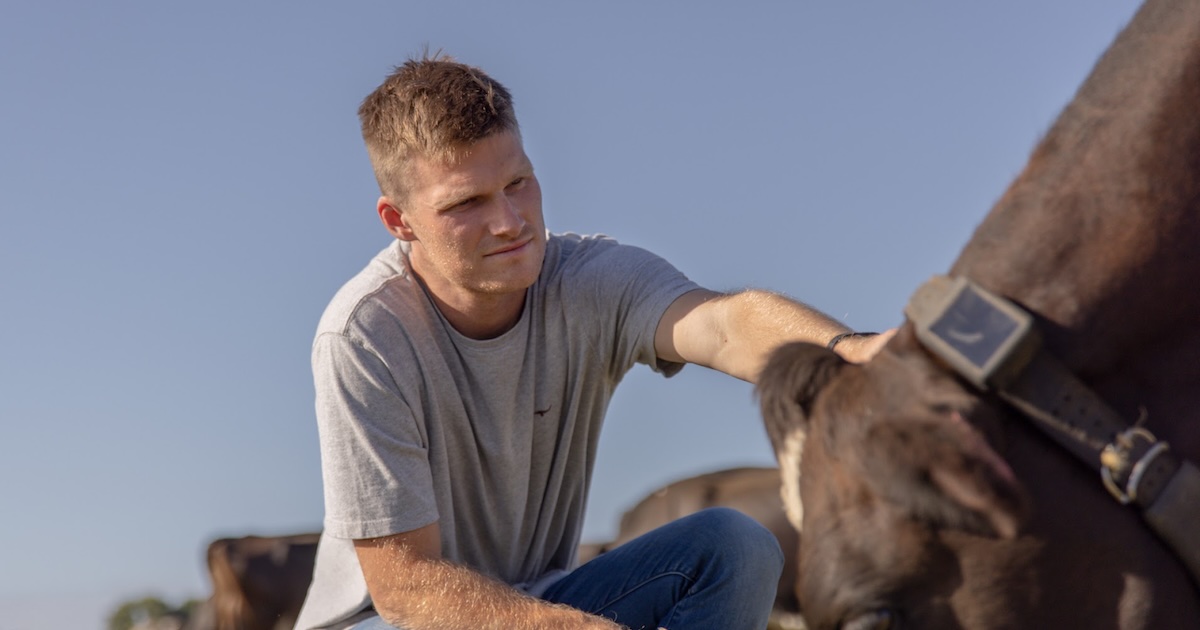
Craig Piggott left a job building rockets to persuade cows to take instructions from a collar. Put like that, the career move sounds like a difficult conversation with a parent. His parents, however, were dairy farmers in New Zealand’s Waikato. They understood exactly how much work there was in getting a cow from one place to another. Piggott had grown up doing it.
Years later, his company Halter would sell a million collars and raise US$220 million in a single funding round. Those numbers invite a familiar account of a young engineer spotting an opportunity. The more revealing story concerns the thing he already knew: a farm’s timetable has remarkably little interest in the farmer’s plans. Cattle need moving. Grass needs managing. The work arrives again tomorrow.
Halter grew out of his wish to change that arrangement. Its premise was wonderfully awkward. Instead of asking a farmer to walk out and move a fence, could software move the boundary? Could the animals learn to follow it? A cow would have to become a willing participant in an engineering experiment. The cow had other appointments, mostly involving grass.
Four points through the gate
Piggott’s beginnings offer little support for the idea that a founder’s future announces itself on a school report. He boarded at St Peter’s in Cambridge and described himself as an average student. Business interested him, but engineering offered a route into the technical work he wanted to do. He entered the University of Auckland with a score of 254 against a required 250.
His first test returned zero out of ten. He responded by working harder, found his rhythm and joined Formula SAE, the student engineering competition. By the time he finished his mechanical engineering degree, he had first-class honours. The progression matters more than the opening mark: the student who had barely crossed the entrance threshold found work that engaged him enough to change his performance.
The university would name him its Young Alumnus of the Year in 2025. There is a pleasing circularity in that recognition. An institution that admitted him by four points eventually invited him back as an example. An admissions score can open a gate; it is a less reliable guide to everything someone might do after walking through it.
Nine months of rocket school
The next opening came after a university entrepreneurship event. Rocket Lab founder Peter Beck had been speaking. Piggott approached him afterwards and discussed a project he was working on. That conversation led to a job during his final university year. He also took part in the Velocity Ideas Challenge in 2016; his recollection of the prize money’s likely destination was pizza and beer.
At Rocket Lab, he encountered a business trying to establish an industry in New Zealand. He saw the intensity of a technical team attempting something difficult, and the willingness to raise money before the outcome was certain. His stay lasted about nine months. It gave him a practical view of how large ambitions became daily work, with demanding colleagues and problems that needed solving.
Beck’s influence continued after Piggott decided to leave. He backed Halter and joined its board. The relationship became a bridge between two very different kinds of engineering: one concerned with leaving the ground, the other with making better use of it. Piggott had found an early supporter who already knew how he worked.
In their later conversations about Halter, Piggott and Beck also discussed company culture and radical honesty. Technical uncertainty gives that subject some weight. If a device is failing in a paddock, optimism alone cannot repair it. A team needs to be able to say what happened, hear an unwelcome answer and try again while there is still time to learn from the attempt.
A cow joins the investor meeting
Piggott co-founded Halter with Max Olson in 2016. The family farm became a testing ground. Before a Series A raise, the team prepared a demonstration involving a cow named Big Bird: Piggott would send an instruction from San Francisco, and she would respond back in New Zealand. The time difference made the local performance a four-in-the-morning affair. Big Bird walked towards the gate.
There is something bracing about a pitch whose success depends on livestock. A presentation can describe what ought to happen. A cow provides an immediate verdict on whether it does. The demonstration compressed the whole proposition into a visible movement: an instruction travelled across the world and an animal followed a cue. For a farmer, the interesting distance was the walk someone no longer needed to make.
Other parts of development were less photogenic. Piggott has described an early year when little worked. His initial solar calculations even suggested a panel the size of a bath mat. The team had to learn how to make hardware that could survive on an animal, outdoors, while supplying the power the system needed. The elegance of the eventual app conceals a considerable amount of stubborn physical work.
“It took us more than four years and millions of dollars before we even had a product we knew would work.”
Craig Piggott
That admission puts useful distance between the clean idea and the finished equipment. The first question was whether the concept could work at all. Commercial use added more questions about reliability, repeatability and the effort required from a farmer. A convincing demonstration could earn another conversation. A useful product had to earn its place in the routine.
The real subject is grass
To understand Piggott’s thinking, start below the animal. “Dairy farmers are really grass farmers,” he says. A pasture-based operation depends on deciding where cattle graze, how much feed they receive and when a patch of land gets a rest. The fence is one of the tools that turns those decisions into action. Making that tool easier to change gives the farmer more choices.
Halter pairs solar-powered collars with an app. Trained cattle respond to sound and vibration cues, allowing farmers to set virtual boundaries and guide movement. The farmer can alter grazing areas without putting a new internal wire across the paddock. It is a direct connection between a decision on a phone and the distribution of cattle on the ground.
● ● ●
● ●
Draw in the app → collar cues → cattle move
Conceptual illustration of virtual grazing allocation.That flexibility has a human consequence as well as an agricultural one. A job that requires someone to be physically present at a particular moment fixes the shape of their day. Remote herd movement loosens one of those ties. Piggott talks about customers gaining hours for their families. The value is easy to grasp without knowing anything about the electronics: somebody gets to be somewhere else.
He also keeps returning to the farmer’s knowledge. Different land and weather require different decisions. The ambition is to give experienced people a more responsive way to carry those decisions out. Software earns its usefulness in the paddock, where an attractive interface has to answer a much less forgiving question: does this make the job easier?
A longer fence line
Recognition followed adoption. Piggott appeared on Forbes’ 2021 Asia 30 Under 30 list in Industry, Manufacturing & Energy. In 2024 he won EY New Zealand’s Technology and Emerging Industries entrepreneur category. Halter topped that year’s Deloitte Fast 50 with 1,539 percent revenue growth. In March 2026 he received the New Zealand Innovator of the Year award.
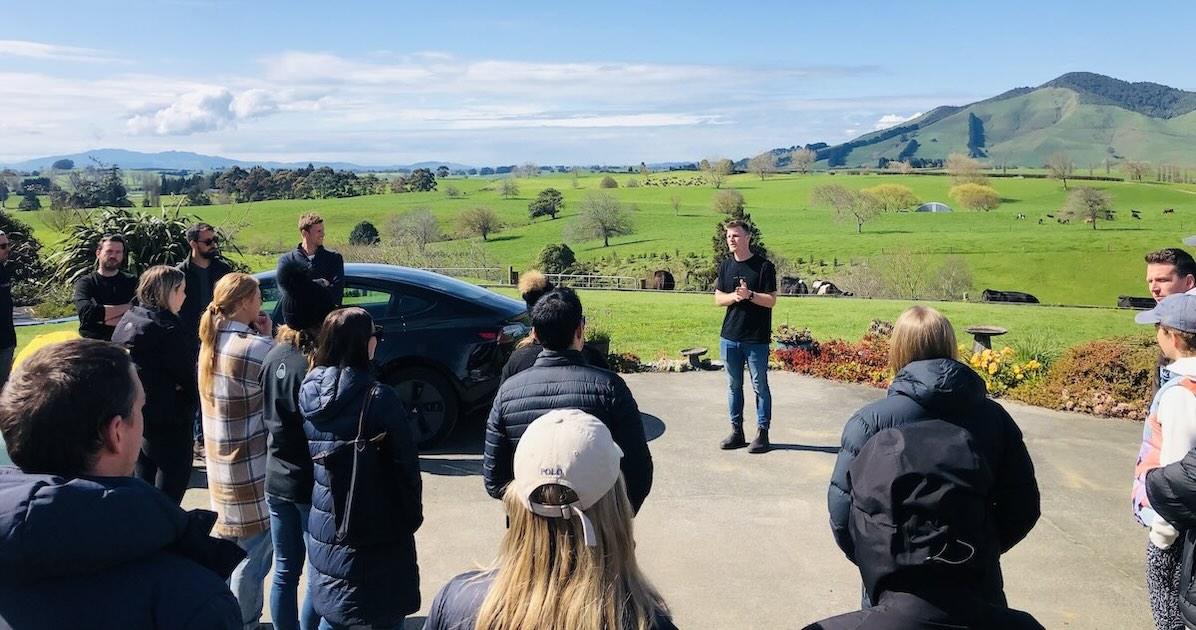
Expansion brought a fresh set of practical demands. Halter launched in the United States in 2024, taking a product developed around New Zealand farming to beef ranches with different terrain, scale and routines. Piggott has emphasised listening to those ranchers and adapting the product. International growth required the team to keep learning what a useful day’s work looked like in another place.
The Series E, led by Founders Fund, supplied capital for further expansion and product development. The company announced plans for Ireland and the United Kingdom, alongside growth in its existing markets. By then, American customers had drawn 60,000 miles of virtual fencing. The recurring act of drawing a boundary had become a substantial business, one grazing decision at a time.
His interests away from the collar include kitesurfing, making things by hand and table tennis, where he has cheerfully described wanting to beat everyone on the team. He once wanted to become a mechanic. Systems engineering became a broader expression of that curiosity: understanding how parts work together, then finding a way to make the whole arrangement better. The competitive streak appears to extend indoors.
Back to satellites, by way of a cow
In April 2026, Halter announced direct-to-satellite connectivity for beef cattle collars. Its earlier system relied on proprietary radio towers. The new version removed that on-farm infrastructure requirement, opening a route to remote properties where connectivity had limited deployment. In New Zealand, the service arrived through One NZ Satellite, powered by Starlink.
For someone whose earlier career took him to Rocket Lab, the connection offers a satisfying turn. Space technology now serves the farm work that drew him away from aerospace. Yet the purpose remains recognisably ordinary: help someone manage cattle across difficult country. The satellite is useful because of what happens at the other end, on land a farmer knows.
Piggott’s account of progress often comes back to the immediate task. “You just wake up every morning and move the ball forward,” he has said. The line fits a career built through repeated attempts: an engineering student finding his footing, a founder testing collars, a team adapting its product to another kind of farm. Somewhere, after all that work, a cow walks towards a gate and a farmer gets some time back.
More from the paddock
Watch Halter: A Farming Story, or hear Piggott on The Dom Harvey Podcast and Agtech - So What?