In 2010, Craig Barnett wrote a letter about somebody else’s retirement. David Holmes was leaving Gazal after more than half a century, and the chief operating officer wanted the occasion marked properly. His tribute covered shirts, workwear, changing currencies and the kind of counsel that becomes part of a company’s furniture. Then came a small admission: it was intimidating to work alongside someone who had been making clothes at Gazal before Barnett was born.
It is a useful place to begin with Barnett. Long before his own farewell, he had put into writing what deserved remembering about a colleague. There were commercial results, certainly. He noted that Van Heusen had more than doubled under Holmes over seven years. But patience, generosity and friendship received room on the page too. The balance was revealing.
Sixteen years later, Barnett’s turn arrived. In May 2026, he retired as CEO and president of PVH Australia and New Zealand, ending 25 years across Gazal and PVH. An apparel career spanning roughly four decades had brought him from Australian manufacturing into the regional leadership of Calvin Klein and Tommy Hilfiger. Now the person writing the farewell was the person leaving.
Before the labels, there were 865 machinists
Barnett began in Brisbane in the early 1980s, in a division of Bradmill whose factory employed 865 machinists, mainly making men’s shorts and trousers. It is a rather different opening image from the polished shopfronts associated with his later job: hundreds of people engaged in making the thing that would eventually hang beneath a brand name.
His route continued through Sara Lee’s branded apparel business, where he worked in sales and marketing, and then into the chief operating officer’s position at Gazal. Production, selling and running an organisation appear in that sequence. They are different views of the same garment, each with its own awkward questions about cost, demand and delivery.
By the time he reached regional brand leadership, the business around him had changed its shape. The career connects a local factory setting with an international brand owner and a distribution network serving two countries. A shirt can remain recognisably a shirt while practically everything about the business behind it changes. Barnett’s working life crossed that divide.
The price of keeping the lights on
In 2010, while at Gazal, Barnett joined a public argument over Australian retail costs and overseas online shopping. Local businesses were challenging the tax treatment of low-value imports. A customer could compare the number on a screen with the number on a shop label; the retailer had to account for everything that sat behind the second number.
Barnett’s contribution was practical. Manufacturing costs, he argued, were broadly similar. Exchange rates, duties and the expense of operating a full-service Australian retailer created the differences. His defence of the local shop rested on the services and operating costs attached to it.
The episode catches an operator at work. Fashion supplies the attractive surface; someone still has to explain the arithmetic. Rent, staffing and service do not disappear because the competing offer fits neatly into a browser tab. Barnett was addressing that tension well before the closing chapters of his PVH career. It gives his later involvement in fulfilment and automation a longer commercial context.
A partnership acquires a different shape
PVH Brands Australia began operations on 3 February 2014 as a joint venture between PVH and Gazal. It brought Calvin Klein Underwear and Calvin Klein Jeans together in Australia and New Zealand. Gazal’s 2014 account of the venture described restructuring, new outlets and preparation for additional product categories. The work involved aligning businesses that had previously operated separately.
The scope widened in February 2015, when Tommy Hilfiger and the heritage brand businesses, including Van Heusen and Nancy Ganz, joined the venture. Wholesale, company-operated retail and e-commerce formed part of its distribution network. Barnett’s CEO chapter belonged to this growing collection of brands, channels and operating responsibilities.
These dates matter because a joint venture and an acquisition are distinct events. PVH completed its purchase of the Gazal shares it did not already own on 31 May 2019. The global parent said the transaction would give it full control of its brands in Australia. A long relationship had progressed into a new ownership arrangement.
The 2019 transaction also made continuity explicit. Four key managers entered employment agreements and were expected to remain for at least two years. The scheme documents identified Barnett as PVH Brands Australia’s CEO, alongside Michael Gazal, Patrick Robinson and Guy Griffiths in the senior team. Corporate control was changing while experienced people remained involved in running the business.
For a profile of Barnett, that distinction is useful. His story runs through successive versions of an organisation, rather than a string of unrelated executive appointments. The businesses around him were combined, expanded and acquired. His career stayed connected to the work of making those arrangements function in the Australian and New Zealand market.
- 2014Joint venture begins with Calvin Klein businesses.
- 2015Tommy Hilfiger and heritage businesses join.
- 2019PVH completes its Gazal acquisition.
The less glamorous end of a fashion label
One of the later projects associated with Barnett’s tenure was a new fulfilment operation with Toll at Kemps Creek in western Sydney. Toll’s May 2026 announcement described a three-year transition from multiple sites using highly manual processes to a single automated operating model. Calvin Klein, Tommy Hilfiger and Van Heusen were the brands it would support.
The system combined goods-to-person technology, automated packing and e-commerce fulfilment. Each term describes work that customers rarely see. A purchase has to be found, packed and sent through the right process before it can become the uncomplicated arrival the buyer expects.
“This is a complete transformation,” Barnett said of the project. He credited persistence, resilience and partnership. The choice of words suits the setting: a warehouse transformation requires people and organisations to keep working together through a long period of change. There is no shop-window shortcut.
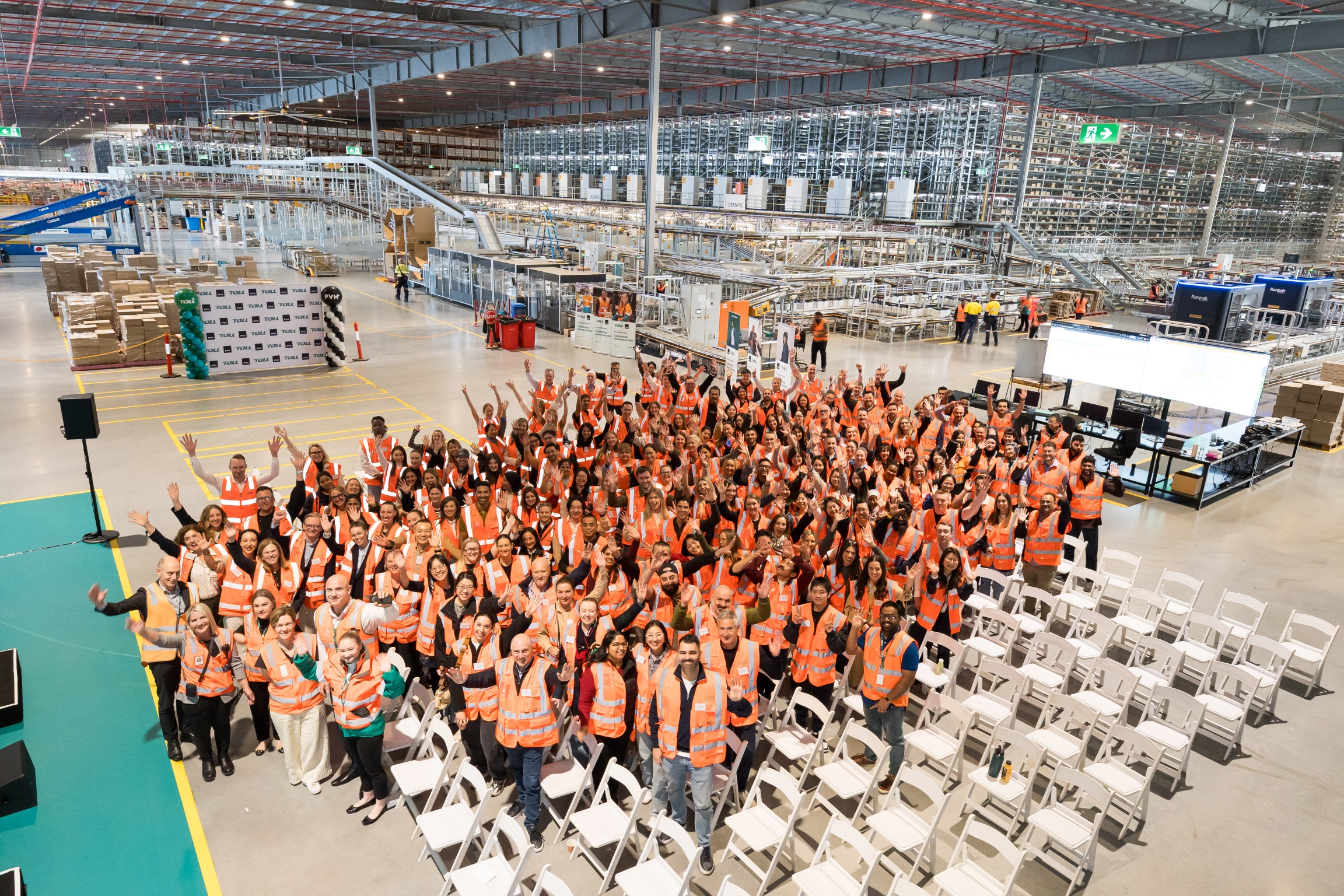
The celebration photograph makes its own contribution to this story. People in bright safety vests fill the foreground; the machinery stretches behind them. Even in an operation built around automation, the group picture remains a group picture. The clothes may carry famous names, but getting them to customers remains collective work.
Who gets to belong inside the business?
Barnett’s public responsibilities also included being an executive sponsor of PVH’s Business Resource Groups. These associate-led groups bring colleagues together around a shared background, interest or purpose. PVH described his sponsorship in terms of involvement and stronger connections across the organisation. It is a less visible aspect of an executive role than opening a store, but it concerns the people who have to work inside the business every day.
His introduction to PVH Australia’s Reconciliation Action Plan addressed another relationship: that between the company’s Australian operations and First Nations peoples. He endorsed a formal commitment to reconciliation, acknowledged the traditional lands on which the business traded and thanked its reconciliation committee. The language recognised that the work was at an early stage.
The document placed colleagues, consumers and communities within the same commitment. Its ambitions included deeper understanding and enduring partnerships with Aboriginal and Torres Strait Islander peoples. Those are stated commitments, with the continuing work still ahead of them. They belong in Barnett’s record as part of what he publicly supported while leading the Australian business.
Clothes with somewhere else to go
Another thread runs through PVH’s relationship with Thread Together, which redistributes new clothing to people facing hardship. In a public account of a Fashion for Good panel, Barnett described the company’s longstanding support through donated inventory and volunteering. The event brought the organisation’s work into the workplace through a conversation with its CEO, Anthony Chesler, and guests Tetiana and Zoe.
Here, clothing had a destination beyond the normal sale. The inventory was still useful; the partnership gave it another route to people who needed it. That is a concrete connection for an apparel company to make, rooted in the product it already handles.
On PVH’s retirement announcement, Chesler thanked Barnett for his support and described warmth and humility alongside his professional contribution. It was a partner’s assessment, and a personal one. Beside the corporate farewell, it adds a view from outside the organisation: a relationship built through work that extended beyond the shop floor and the balance sheet.
“Change is at our core.”Craig Barnett, reflecting on the apparel industry in May 2026
A farewell with room for laughter
Barnett’s own departure message returned to the quality of working relationships. He remembered the laughter and camaraderie, and said that creating a supportive, happier workplace had mattered alongside delivering financial goals. It was his assessment of the years he had spent with the team, offered at the point when he was stepping away from it.
Simon Mc Chesney-Clark succeeded him. Having joined PVH ANZ in 2021 to lead direct-to-consumer operations, he brought responsibility for retail, wholesale, sales, property, visual merchandising and e-commerce into the top role. The appointment kept the succession within the existing leadership group.
Barnett said his immediate plans centred on rest and family. He was doubtful about taking on another CEO role with the same intensity, while remaining open to an interesting project or challenge. After decades of managing a business that kept changing, he had left himself some latitude about what came next.
The old letter about David Holmes now reads differently. In 2010, Barnett had taken the trouble to record the value of somebody’s patience, friendship and accumulated knowledge. In 2026, his own farewell made space for much the same things. Across those two departures sits a career in clothes, and a consistent interest in the people who make a company worth spending years with.