At Old Navy, the binders were part of the problem. Stefan Larsson recalled senior leaders carrying thick collections of evidence that their departments were doing the right things. Each had a defense. The business, meanwhile, needed help. He gathered six leaders and asked them to put the binders on the floor, agree on where they stood and choose three priorities. A fashion turnaround had reached the point where the first useful accessory was an empty pair of hands.
He followed that conversation with weekly learning sessions. The question became what the team could discover and execute together. It is an appealing episode because the obstacle is so recognizable: people can become expert at explaining their own performance while losing sight of the result everyone shares.
“I map out all the facts,” Larsson said of entering a new role. He has had several opportunities to practice. His route runs through H&M, Old Navy and Ralph Lauren to PVH, where he became chief executive in February 2021. Along the way, there have been growth records, a public disagreement and plans whose ambition has exceeded the results. The binders belong on the floor in those conversations, too.
A wardrobe education, from the inside out
Larsson’s preparation happened across the machinery of clothing retail. He joined H&M in 1998. Early responsibilities included merchandising, assortment development, planning and production. These are decisions about what exists before anyone decides how to advertise it: which garments to make, how many, and how to get them into a shop.
Then his work widened. He helped launch H&M on the American West Coast, took on global expansion responsibilities and eventually became head of global sales. By the time Gap announced his appointment to Old Navy in 2012, that last role covered about 2,300 stores. Product presentation, inventory, customer service and store operations sat within the same field of responsibility.
During his nearly 15 years there, H&M’s revenues increased from roughly $3 billion to $17 billion, while its operating footprint expanded from 12 countries to 44. Those were the achievements of a growing organization, with Larsson on the team. The distinction matters. Retail involves rather too many deliveries, fitting rooms and purchase orders for a one-person explanation.
The experience gave him an education in scale without allowing scale to remain an abstraction. A global expansion strategy eventually becomes a particular shop, with a particular assortment, facing customers who can walk elsewhere. His subsequent career would keep returning to that encounter.
H&M’s expansion years; company-wide figures, not results attributable to one executive.
Three years in an American family wardrobe
Old Navy offered a different setting for those skills. Gap named Larsson its first global brand president in April 2012; he started that October. The chain was preparing to open in Japan, its first market outside North America. It already had more than a thousand North American stores and a proposition built around fashion, value and families.
That is a demanding combination. A customer buying for a household has several sizes, tastes and budgets to reconcile. The clothes must appeal, the price must work and the store must make the errand manageable. An executive can admire the brand’s potential all afternoon; the shopper may have twenty minutes.
Larsson’s Old Navy tenure produced a record that has followed him into later biographies: 12 consecutive quarters of profitable growth. It made him a plausible candidate for a more unexpected assignment. In 2015, he was chosen to succeed Ralph Lauren as CEO of the company Lauren had founded.
The move connected two very different expressions of American clothing. At Old Navy, family value was central. At Ralph Lauren, the founder’s particular vision of a life was inseparable from the name on the label. Operational experience traveled with Larsson. Agreement about what the brand should become would have to be built afresh.
The appointment that did not become a long chapter
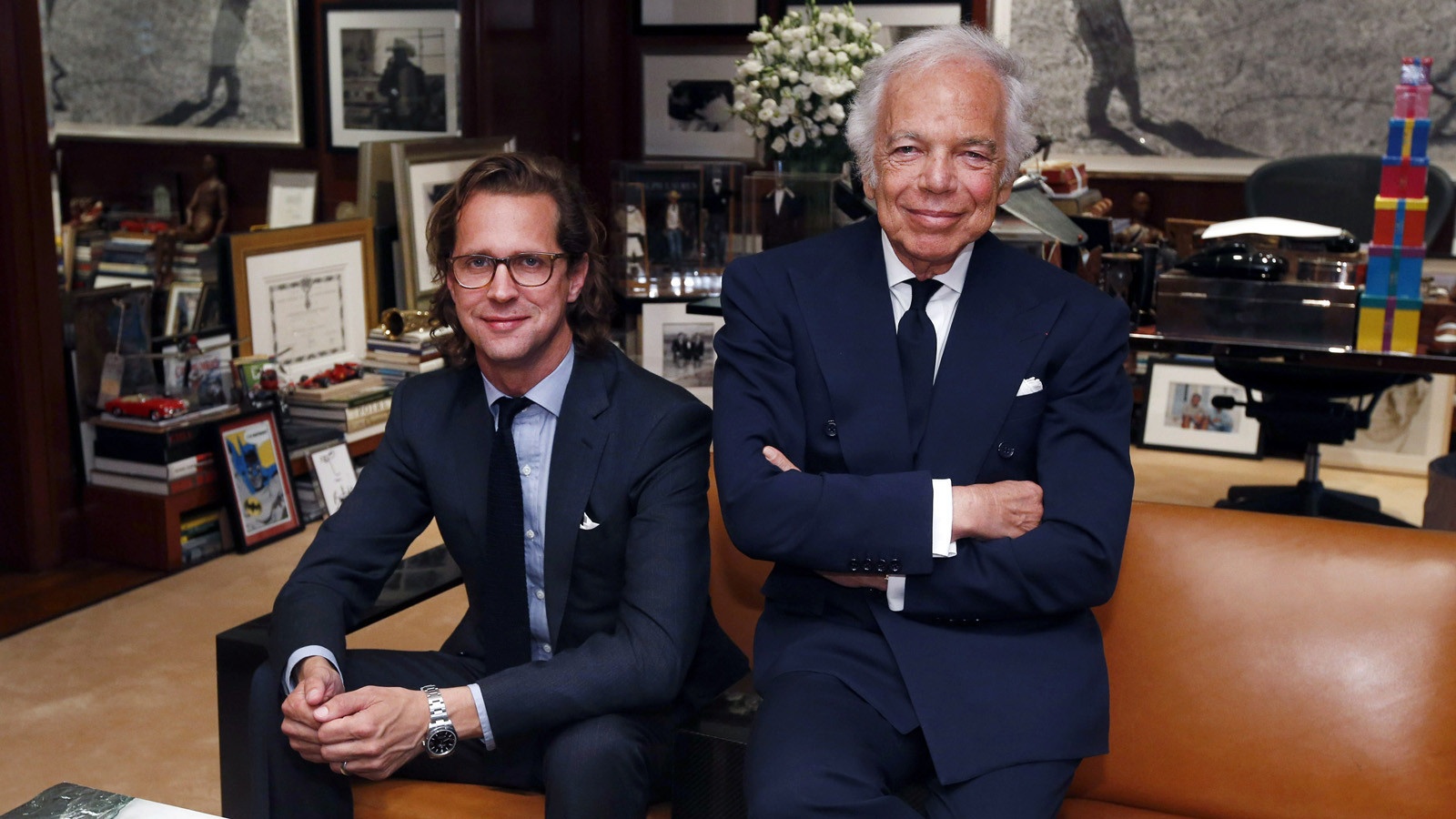
Larsson became Ralph Lauren’s president and chief executive in November 2015. Lauren remained executive chairman and chief creative officer. The arrangement placed a professional operator beside a founder whose creative identity was also the company’s commercial identity. Both roles carried authority; their relationship required a workable understanding of where that authority met.
By February 2017, the company announced that they had mutually agreed to part ways. Lauren publicly described different views about evolving the creative and consumer-facing business. Larsson’s departure took effect on May 1. The company said its Way Forward restructuring plan would continue, with finance chief Jane Nielsen leading its execution while a CEO search proceeded.
The episode gives the career its necessary complication. A method can help colleagues establish a common starting point. It cannot settle every question about authorship, aesthetics or the future of a founder’s company. The public explanation identifies the disagreement without providing a license to invent a backstage drama.
For Larsson, the next major appointment came in June 2019, when he joined PVH as president. There he would have time alongside the incumbent CEO, Manny Chirico, before taking the top job. The succession put him inside another collection of American fashion names, this time at the parent-company level.
Two names, many moving parts
Larsson became PVH’s CEO and a director on February 1, 2021. His remit included Calvin Klein and Tommy Hilfiger, brands whose familiarity can make the work behind them seem deceptively simple. Recognition is valuable. Turning recognition into a purchase requires a sequence of decisions that a logo alone cannot make.
In April 2022, he introduced the PVH+ Plan. Its five drivers connected product, consumer engagement, the digital marketplace, demand-led operations and efficiency. Taken together, they describe an effort to make the company’s creative and commercial decisions reinforce one another, across regions with different customers and expectations.
Consider the ordinary journey from an advertisement to an order. A campaign attracts attention. The product has to justify it. Distribution has to put it within reach. Inventory has to be available in the right place. Money spent on one link can be wasted when another fails. This is why an apparel CEO spends so much time on matters that would make an unpromising runway show.
PVH’s emphasis on recognizable product categories and direct relationships with consumers fits Larsson’s earlier experience. The practical task is to make the route to purchase work repeatedly, while keeping each brand distinctive. There is little value in operating two familiar names as though their customers had bought the same idea.
- 01 Product
- 02 Consumer engagement
- 03 Digital marketplace
- 04 Demand & data
- 05 Efficiency & investment
Five priorities that have to work together, across both brands and their regional businesses.
The numbers get a vote
The original PVH+ presentation included a revenue objective of approximately $12.5 billion for 2025. PVH reported $8.95 billion for that year. The gap is substantial, and belongs beside any account of the plan. An ambition remains an ambition even when the presentation is beautifully prepared.
Larsson’s May 2026 letter to shareholders described a return to annual revenue growth and an 8.8% non-GAAP operating margin for 2025. It also described cost savings and supply-chain improvements. Those are operating developments within a continuing effort, rather than evidence that every original objective had been achieved.
The target was announced in April 2022. These are nominal revenue figures; the chart is not adjusted for portfolio or currency changes.
The September 2026 second-quarter report supplied a mixed picture: revenue of $2.097 billion, down 3% year over year, while reported e-commerce sales rose 4%. PVH reaffirmed its full-year outlook. Larsson’s task continues in the space between stronger elements of the business and the performance of the whole.
The people around him are part of that effort. In July, PVH announced that Alexis Rollier would join as CFO in early September, bringing experience from Sephora. Earlier 2026 appointments also addressed regional leadership, licensing and consumer strategy. A plan becomes concrete partly through who is given responsibility for carrying it out.
A professor’s influence, still in circulation
There is a quieter continuity in Larsson’s career. As a student, he contacted Hanken professor Christian Grönroos to ask about taking a course. Their relationship continued over the years. When Larsson returned to Hanken in February 2024, he credited the professor’s encouragement to develop a vision simple enough for others to understand.
His academic background spans Hanken in Finland and Jönköping International Business School in Sweden, where he jointly earned a Master of Science in Business Administration. The later connection with Grönroos suggests that the education continued after the qualification. Having someone with whom to test an idea can remain useful long after one acquires a boardroom.
“I want to make new mistakes every day!”
Stefan Larsson, speaking at Hanken, February 2024
At that visit, Larsson announced a scholarship offering mentoring and time shadowing work at PVH’s New York headquarters. Hanken later documented recipients gaining access to the company and to Calvin Klein’s fashion-show world. The relationship had acquired another generation.
The sentiment about mistakes sounds cheerful until it becomes a management obligation. Learning requires someone to admit that an expectation failed. A leader who asks for candor has to make room for it when the news concerns his own strategy. Larsson’s career provides enough successes and interruptions to give that principle a practical test.
Back at Old Navy, the binders had offered a comforting version of events. Putting them down made a different conversation possible. Years later, with Calvin Klein and Tommy Hilfiger in his charge, the question remains usefully awkward: what do the facts require the team to learn next?