Before an idea becomes a room, a photograph, or a brand, it tends to become a pile. A saved Instagram post. A screenshot. A chair glimpsed on a website whose name has already escaped you. The pile grows; its usefulness does not necessarily follow. Cosmos begins with this ordinary embarrassment: having excellent references and a very poor idea of where they are.
- Save images, videos, links, notes, and products in one visual library.
- Find references by keyword, color, or a similar image.
- Use free collecting; pay for collaboration and extra controls.
- Choose whether likely AI imagery is shown, blurred, or hidden.
Andy McCune and Luca Marra started Cosmos as a side project in 2021. McCune had previously built Unfold, the storytelling app acquired by Squarespace. The new problem was closer to home: creative work needed references from across the internet, gathered somewhere they could be found again. Friends in design recognized the predicament. A personal filing problem had an audience.
01 / The folder came too early
The revealing decision arrived in January 2026. Previously, saving an image required putting it in a cluster. That sounds sensible. Libraries have shelves. Offices have drawers. But a person encountering a compelling photograph may know that it matters without knowing where it belongs. Compulsory organization made a small act of curiosity into a small administrative appointment.
Cosmos changed the sequence. Users could save immediately to their profiles and organize afterward. Clusters remained; the obligation disappeared. This is the company’s useful lesson for anyone building creative software: capture and classification happen at different speeds. A system can respect both by refusing to make the slower one a condition of the faster.
That change also moved Cosmos toward social discovery. A profile becomes legible through what someone keeps. The following feed supplies another route to inspiration: look at the people whose choices interest you. The resulting appeal is quite specific. You can encounter an image through a person’s sensibility rather than starting every expedition with a search term.
02 / A memory needs more than a thumbnail
Cosmos calls a saved item an element. An element can be a photograph, video, GIF, note, link, or product. Upload your own material or collect it with a browser extension. One element can connect to several collections, allowing the same reference to serve different projects without pretending it has only one possible meaning.
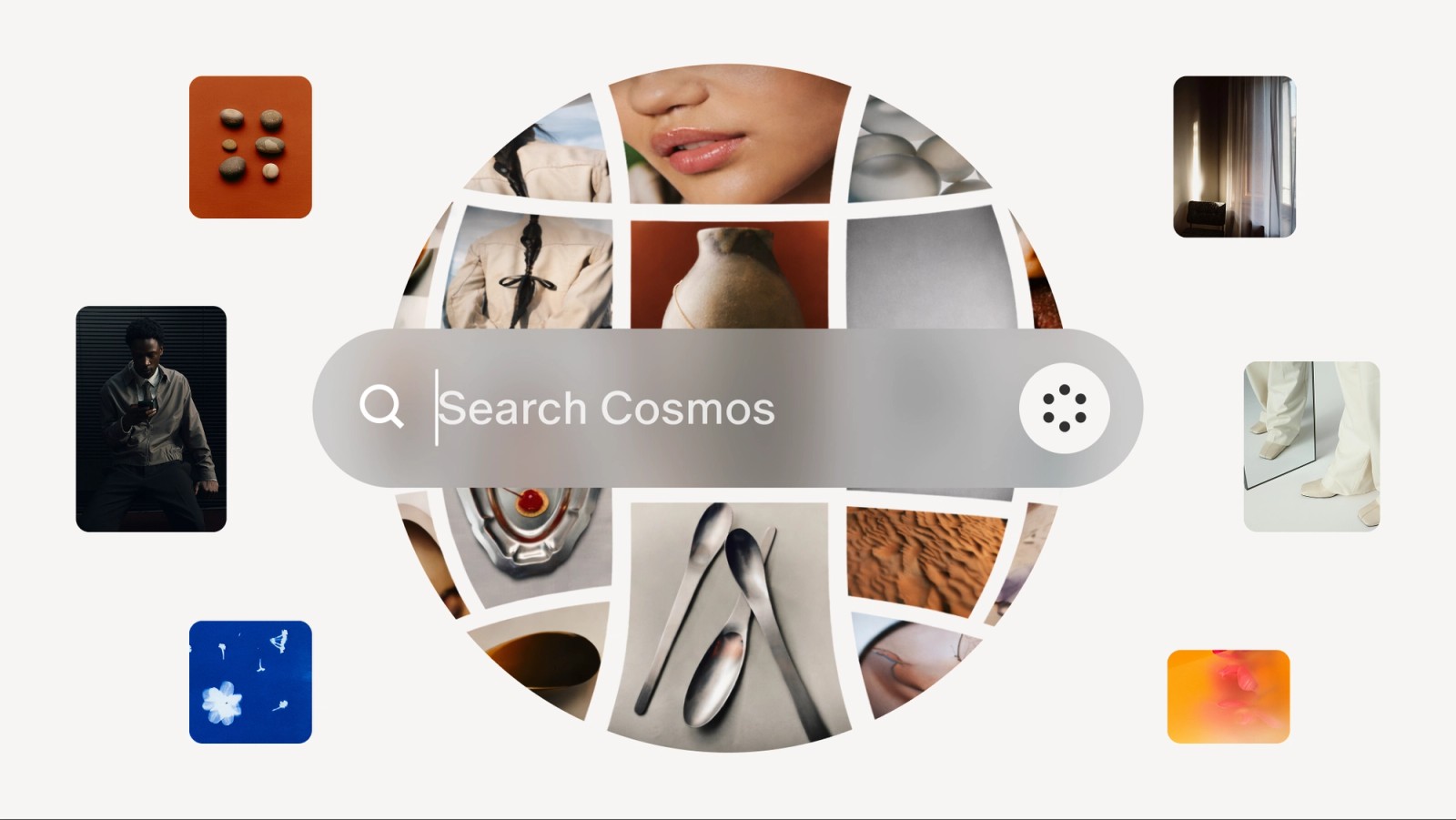
Search makes the archive usable. Enter words, choose a color, or supply an image on desktop to find visual matches. Combine filters when a broad search produces too much: an object plus a palette, for instance. Search can cover the platform, your saved material, or people you follow; it can also stay inside a particular collection.
Consider a designer preparing a restaurant concept. This is an illustrative workflow: gather lighting, menus, interiors, and materials; separate them into collections; search a saved palette when the conversation turns to upholstery. The practical benefit is continuity. The reference that started the discussion remains available when the discussion becomes a decision.
03 / Your taste is training the feed
The For You feed starts with five topics chosen during signup. Then behavior takes over. Cosmos’s documentation says that after more than 50 connected elements, those original topics no longer influence recommendations. Saving and organizing become signals about what the person actually wants to see.
After this point, the initial signup topics stop shaping the For You feed.
For a new user, that suggests a sensible experiment: collect around one real project, connect the references you value, and mark unhelpful recommendations as Not Interested. A feed cannot infer a considered preference from an account you never use. Nor does a good recommendation guarantee a useful outcome; eventually somebody still has to design the restaurant.
Pinterest is the obvious comparison. Instagram saves and screenshot folders are the familiar habits Cosmos is trying to replace. Its particular combination is a visual library with searchable references, human collecting, and image context. Public reporting describes millions of users and company-reported adoption by creative teams at Nike, Apple, and Amazon. That indicates professional use, without establishing company-wide purchasing contracts.
04 / The machine can help identify the picture
Cosmos researches images to surface their creator, source, and story. That is a meaningful use of automation in a medium where reposting strips away names. Attribution gives a reference somewhere to lead: toward the photographer, architect, publication, or original work that makes it more interesting.
The company also lets users control likely AI imagery. Fast Company reported in January that 10 percent of users had chosen to block it. An earlier default blur had exposed synthetic pictures people had unknowingly saved, provoking frustration. The episode illustrates a difficult product problem: identifying an image changes how somebody feels about it.
“Taste shouldn’t feel like status. It’s a practice.”Andy McCune, June 2026
A caption is useful context, but permission is a separate matter. Cosmos’s FAQ says material remains subject to its creator’s rights. A reference library helps with inspiration; it does not automatically supply publishable assets. For commissioned work, check the original source and arrange the rights you need before moving an image into a deliverable.
05 / A quiet place with bills to pay
The service is free to use. Premium supplies collaboration, bulk image exports, grid customization, early feature access, and reserved usernames. The US App Store lists $8 monthly or $72 yearly. For a team, the paid value lies in working together; for an individual, the decision depends on whether those controls improve a recurring habit.
A $15 million Series A, co-led by Shine Capital and Matrix in January 2026, funded further development. The summer release added Cosmos Shop, with over a million products, alongside iPad support, a rebuilt Android app, and Canvas Mode. Purchases happen with retailers. Commerce gives a saved aesthetic a route into actual objects, while raising an editorial question about how shopping will shape discovery.

McCune’s early office doubled as a vintage furniture gallery; designers and architects wandered past the monitors. The detail fits. Cosmos sells the usefulness of choosing, arranging, and returning. The reader can copy that practice without copying anyone’s taste: gather with a purpose, preserve context, revisit the collection, then make something that deserves a place in somebody else’s pile.