A photograph of a finished hairstyle answers one question beautifully: what did it look like? It says less about how the tools were prepared, how the client was consulted, or whether the person doing the work could repeat it tomorrow. Beauty has a visible result and a largely invisible process. COSMETOLOGIST’s stated business proposition occupies the space between them. It describes qualifications intended to make professional salon skills easier for someone else to recognize.
- The offer: salon-focused qualifications, professional referrals and a jobs board, as described by the company.
- The audience: practitioners and the employers assessing them.
- The useful distinction: a qualification’s value depends on what it measures and who accepts it.
A brush, a certificate, a hiring decision
COSMETOLOGIST describes its role as providing an “industry benchmark” for practitioners and prospective employers. That phrase contains two customers. One wants evidence of ability. The other wants a way to interpret that evidence without starting every hiring conversation from scratch. The company also describes working with cosmetics firms and fashion stylists, placing its proposition near the practical business of finding people for beauty work.
Its emphasis is on application techniques for professional salons. Hygiene and client care appear alongside application in the description. The combination matters. A beautiful result might attract attention; a useful professional standard also addresses the process that produced it. The proposition is that these abilities can be made explicit enough to travel from practitioner to employer.
Consider the employer’s problem as a thought experiment. Two applicants bring attractive portfolios. One can explain the assessment behind a credential, including the techniques and working practices it covered. That gives the employer another basis for questions. It does not settle the hiring decision, but it can make the conversation more precise. That is the practical appeal of the model COSMETOLOGIST describes.
A qualification is useful when the person reading it understands what was tested.
THE CENTRAL QUESTION
The introduction after the assessment
The company’s description adds a second service: referrals. Qualified practitioners can agree to a contact link so potential employers can reach them, and the description mentions a jobs board. In the proposed arrangement, assessment and discovery sit next to each other. A practitioner needs a way to demonstrate ability and a way for an interested employer to make contact.
It is an economical idea. The referral supplies an introduction; the qualification supplies a subject for the conversation. As a business proposition, that places COSMETOLOGIST between professional education and recruitment. The value would come from helping each side understand the other. More names in a directory would be useful only if employers could interpret the evidence attached to those names.
There is a lesson here for other service businesses. Describe the work precisely, explain the standard applied to it, and put the evidence where a buyer or employer can use it. That is an editorial reading of COSMETOLOGIST’s pitch, rather than a claim about its commercial results. The distinction keeps an appealing idea from becoming an invented success story.
The small print does the heavy lifting
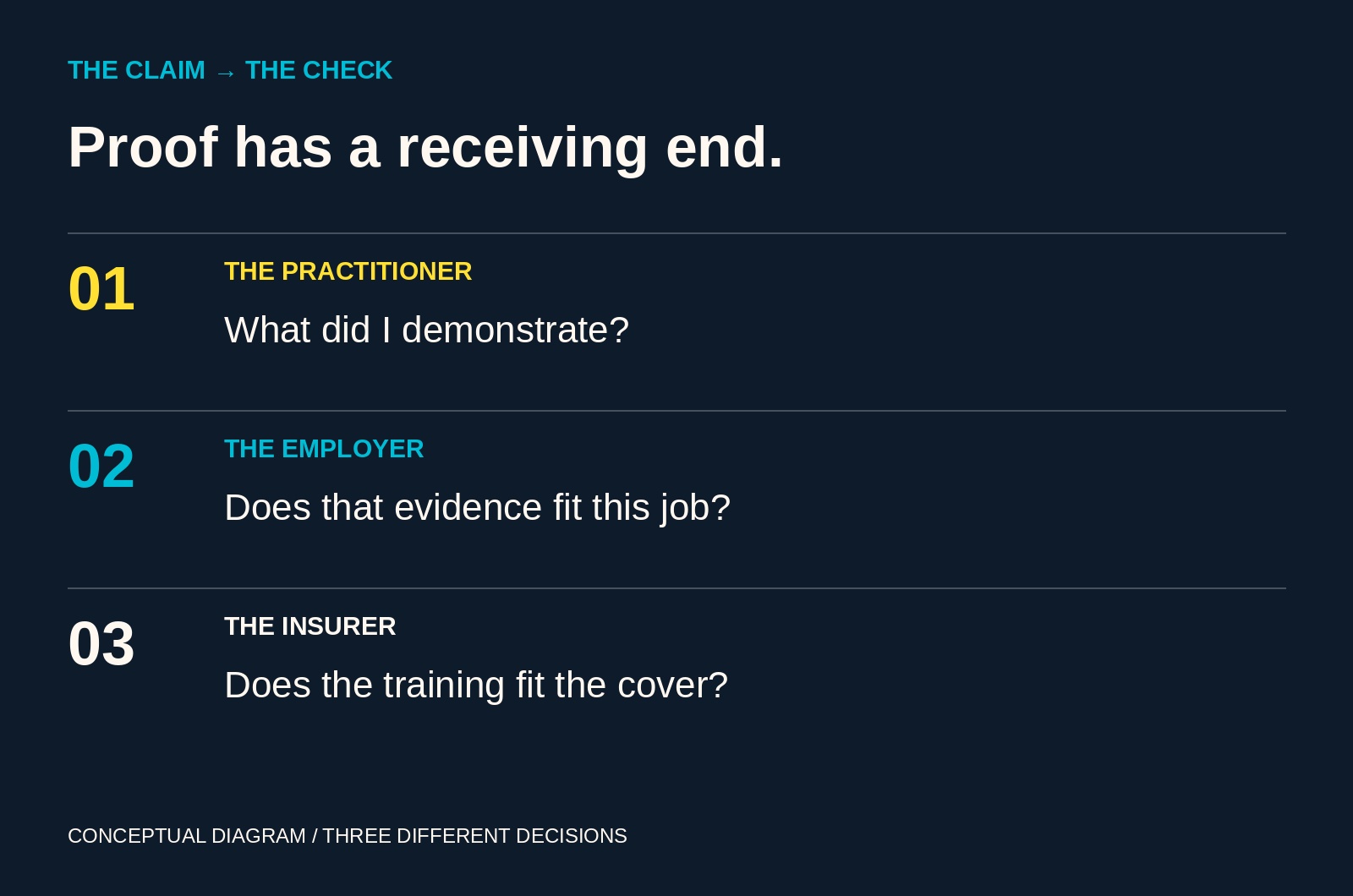
COSMETOLOGIST’s description mentions BABTAC in connection with professional insurance. That reference makes the distinction between a company’s description and an insurer’s decision especially important. BABTAC publishes its own qualification standards and treatment prerequisites. A mention of the organization does not itself establish a partnership or acceptance of a particular certificate.
BABTAC distinguishes qualifications issued by awarding organizations from accredited short courses, which it generally describes as professional development or an introduction to techniques. Its insurance guidance also ties cover to relevant qualifications and working procedures. For a practitioner, the sensible question is therefore specific: does this exact training support the exact treatment and cover being sought?
That question explains the limit of any broad promise of recognition. An employer, insurer and awarding body perform different jobs. Agreement from one does not automatically answer the others. A certificate becomes more useful when its scope is clear enough for the intended reader to make a decision. The administrative detail is part of the product’s practical value.
Specialist is a starting point
The surrounding market supplies useful comparisons. The International Make-up Association focuses on make-up education and examinations. CIBTAC offers a broader range of beauty, complementary and spa qualifications. These are contextual alternatives, rather than established COSMETOLOGIST partners. Their published approaches show that a specialist claim belongs in a market where assessment and recognition already have concrete meanings.
CIBTAC’s beauty-therapy diploma specification, for example, describes theory and practical assessment, including external examination. That level of detail lets a prospective learner ask better questions about any offer: which competencies are covered, how are they examined, and what does completing the assessment demonstrate? Specialization becomes meaningful through those answers.
COSMETOLOGIST’s stated focus on salon application is best understood against that background. Its proposed expertise concerns professional technique and the employer’s ability to recognize it. The offer is most relevant when a practitioner’s intended work matches the qualification’s scope and the intended employer accepts the evidence. Those conditions determine usefulness more directly than a broad category such as beauty.
Follow the link. Read the name.
There is another detail worth noticing. COSMETOLOGIST’s LinkedIn profile lists cosmonelle.com as its website. The domain currently presents COSMONELLE and promotes beauty financing, including loans and installment plans. That is a different public message from the qualifications-and-referrals description. A shared website link alone does not establish how the two propositions relate.
For the reader, the practical move is to keep the names and offers distinct. Anyone considering a service should identify the provider, the deliverable and the terms attached to it. In this case, that means distinguishing the company profile’s qualification proposition from the financing presented on its listed domain.
The interesting idea in COSMETOLOGIST’s description remains straightforward: skill becomes easier to discuss when there is a clear account of what someone has demonstrated. For the practitioner, that can guide the next question. For the employer, it can sharpen the interview. Begin with the work, then examine the proof.
Explore the public profiles
Continue with COSMETOLOGIST on LinkedIn ↗ or its listed website, currently branded COSMONELLE ↗.