In 2019, Jeb Terry took some immersive video to a prototype dome. He had played professional football and worked at Fox Sports. He knew the distance between watching and being there. But this experiment involved a soccer match and an LED setup. In a later interview, he described the setting as a low-rent warehouse. The surroundings were ordinary. His reaction was not.
Terry had doubted the test would work. Then the picture gave him the feeling of being at the match. That response supplied conviction. It is an instructive beginning for Cosm, because the company’s proposition depends on something a specification sheet cannot establish: whether a room can make people feel present somewhere else.
- Live sports and cinema inside an 87-foot LED dome.
- Built from planetarium engineering and immersive production.
- A business that sells both venue visits and technology.
Today, Cosm sells tickets to that proposition. Fans watch live sports inside an 87-foot LED dome, surrounded by other fans, with food and drinks available at their seats. The company calls the format Shared Reality. You keep your face uncovered. You can see your friends and share their reactions as the action unfolds. The screen supplies the distant stadium; the room supplies a crowd that can actually hear you.
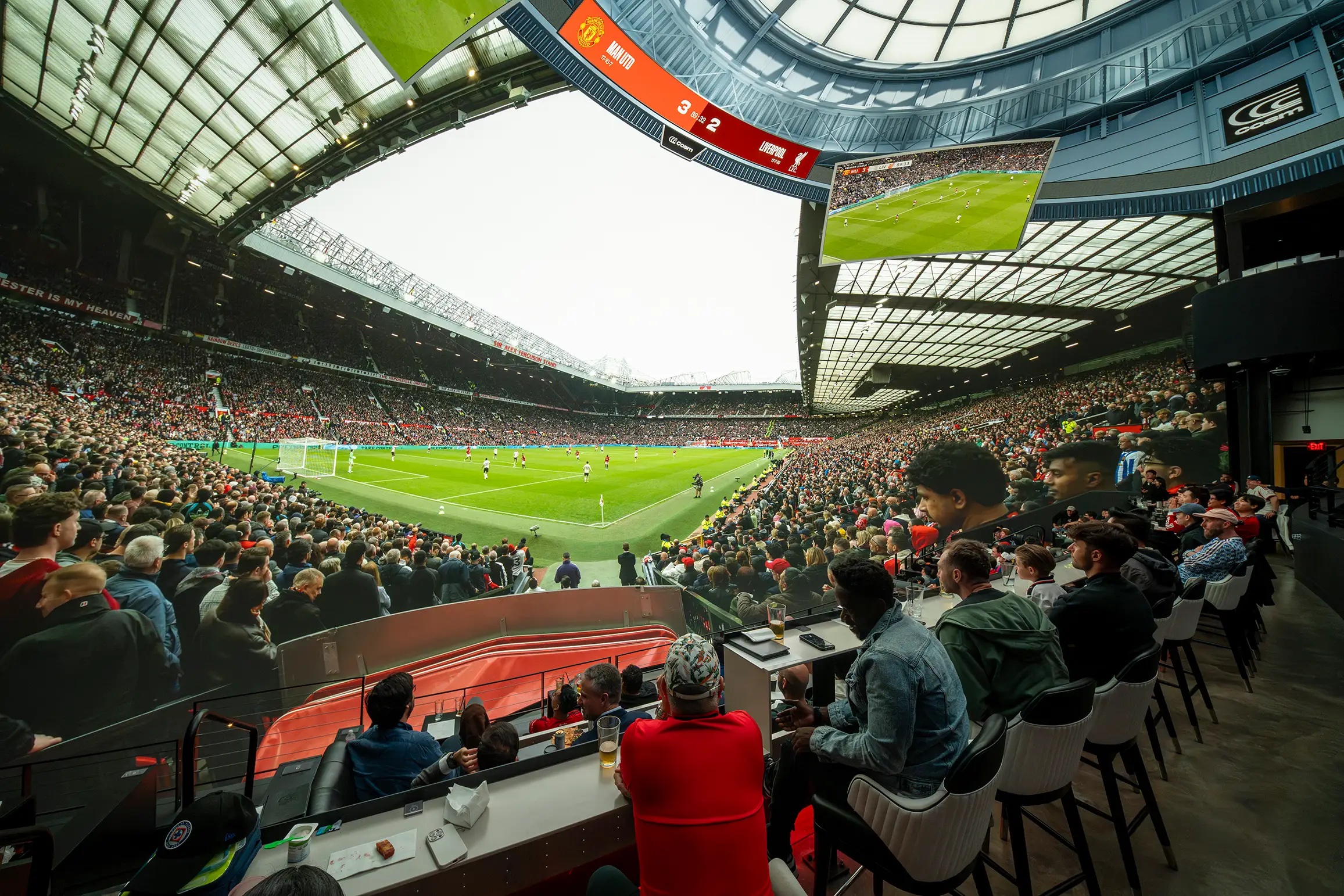
The planetarium hiding inside the sports bar
Cosm was formed in 2020 by combining Evans & Sutherland, Spitz and LiveLikeVR. Stephen T. Winn supplied the founding vision and backing through Mirasol Capital; Terry became its operating leader. The acquisitions assembled dome engineering, computer graphics and immersive production. C360 joined in 2023, adding capture technology and broadcast capabilities. Cosm bought substantial pieces of the machinery before opening its public venues.
That history explains why the company also serves planetariums and science museums. Its technology business offers the CX System LED dome, projection domes and Digistar software. Named customers and projects include Prague Planetarium, Arizona Science Center and the Fort Worth Museum of Science and History. The expertise behind the football spectacle includes explaining the universe to schoolchildren.
LED changes the room’s possibilities. A projection dome receives light; LED panels emit it. Cosm says that approach reduces the cross-reflections that compromise projected images and supports brighter pictures in spaces with ambient light. For hospitality, the implication is practical. People need to read a menu, find a drink and talk to one another while the image does its work.
At the event
Production + stream
LED dome + crowd
The expensive part is getting everything to agree
A curved display alone does not provide a courtside broadcast. Cosm needs event access, suitable cameras, production, delivery and permission to show the result. Its relationships with the NBA, UFC, ESPN, NBC Sports and TNT Sports help connect those pieces. ESPN’s agreement covers selected professional and college events. A customer should check the actual event listing rather than assume every game appears.
The consumer alternatives are familiar: a sports bar, a home television or a ticket to the real event. Sphere is another large-format immersive venue; headset experiences offer another route to presence. Cosm’s particular combination is scheduled distant events, a surrounding LED image and hospitality shared with people in the same physical room. For institutional buyers, the alternatives include other dome and projection suppliers.
The costs belong to different columns. Pollstar reported a Texas public filing that put the Dallas project at about $42 million, an estimate rather than an audited total. Customers face a separate calculation: ticket prices vary by event and section, with food and drink adding to the outing. Company financing, meanwhile, funds expansion across venues, technology and media. None of those numbers is interchangeable.
“We are competing for people’s time.”Jeb Terry / July 2024
The kitchen was the course correction
One revealing early mismatch happened away from the screen. Cosm initially expected a third party to handle food and beverages. Terry told Pollstar that prospective providers wanted a concession arrangement that did not fit the intended experience. Cosm changed course and hired its own chef. Hospitality became an operation it ran itself.
That decision gives the business model its texture. Tickets earn admission revenue; food and drink extend the visit and the spend. Technology sales and media offerings serve institutional customers separately. The venture joins engineering with venue operations. A lost order, an awkward seat or a disappointing meal can interrupt the same sense of presence that expensive hardware creates.
The lesson other operators can copy is to test the whole customer visit. Cosm’s change suggests that outsourcing works only when the supplier’s incentives fit the experience. Owning every task is expensive, so the useful question is specific: which handoff can spoil the reason people came? Here, the meal was close enough to the promise that management brought it inside.

A stadium that changes sports between sittings
The first public locations opened in Los Angeles and the Dallas area in 2024. Atlanta followed on June 10, 2026; Detroit’s grand-opening event was September 10. Different programming lets the same building host different audiences. Sports bring appointments with live action. Immersive art, Cirque du Soleil and cinematic experiences give the calendar other reasons to gather.
In September 2026, Cosm announced a multi-film Universal partnership beginning with Shrek. An amusing technical detail: the original film remains in its 16:9 format while the surrounding dome environments change around it. The familiar movie becomes the anchor for a new outing. The plan does not require stretching every frame into a hemisphere.
Investors are funding that larger calendar. Cosm announced more than $250 million in July 2024. Sony Pictures announced a $100 million investment in June 2026, leading the Series C and taking a minority stake. Those commitments show backing for expansion. They do not, by themselves, establish profitable venues or repeat attendance.
Growth financing
Sony investment
Capital commitments are evidence of backing, not a measure of venue profit.
The seat has to earn a second visit
Cosm’s constraints are the ordinary ones of an unusual venue: construction capital, content rights, reliable production, service and enough customers nearby. Terry has emphasized sites within active mixed-use districts. A remote building with little surrounding activity would therefore depart from the location strategy he described. A dazzling opening also leaves the harder question of whether guests return.
For a visitor, the practical move is to choose the experience before choosing the ticket. The Dome supplies the surrounding display. The Hall is a social viewing space; the Deck is an outdoor terrace. They are different outings. Check the event, section and full evening’s budget. Cosm’s wager makes most sense when the game matters to you and you want company while watching it.