Consider the small IT provider with a big promise: call us whenever something goes wrong. The promise sounds reassuring until you think about the word whenever. Someone must watch the systems, investigate the alerts and answer the telephone. Adding customers also adds obligations. Continuum built its business in that awkward space between winning the account and having enough people to serve it.
- Continuum supplied IT providers with software and shared technical teams.
- Its customers kept the client relationship while delegating agreed support work.
- ConnectWise bought the company in 2019; the product brands followed in 2020.
Its customers were managed service providers, or MSPs: the firms that look after other businesses’ computers. Continuum operated one level behind them. For a reader outside technology, think of a local shop gaining access to a warehouse full of expertise. The shop still knows the customer. It no longer has to stock every skill itself.
The first thing to break was trust
The company’s modern history begins in 2011, when Summit Partners backed a separation of managed services assets from Zenith Infotech. Michael George led the resulting business. A new operation needed time to establish its identity. It got a reputational emergency instead.
CommCentric, the communications agency involved, describes the problem in its case study: Zenith Infotech defaulted on more than $80 million in convertible bonds. Customers confused the separated business, initially called Zenith RMM, with its former owner. Some moved to other providers. The planned six-to-twelve-month brand transition suddenly became too leisurely.
The response was an accelerated identity change and repeated briefings about ownership, financial backing and product investment. The agency says some departing customers returned. Its account is also a reminder that a technically functioning product can lose customers when nobody understands who stands behind it. Continuum had to explain its own continuity before selling continuity to anybody else.
A dashboard cannot take the night shift
Remote monitoring and management software, usually shortened to RMM, lets technicians inspect and administer devices from elsewhere. That is useful. It also raises a question: who acts on what the software discovers?
Continuum paired the tools with a network operations center, or NOC, and help desk services. Later, security operations centers supplied another layer of specialist work. These were different jobs. Network operations dealt with the machinery behind the customer; the help desk dealt with people needing assistance. Security analysts investigated threats. The provider could buy access to a larger operation while keeping its own customer-facing business.
“We are their IT DNA.”
Michael George / on office equipment dealers, 2014
A dealer could understand its clients’ business problems without first assembling every technical capability those problems might require. Continuum’s market position rested on that combination of software and labor.
The bill bought capacity
Consider LeadingEdge, a British IT services firm featured in a 2016 customer case study. It wanted remote management, backend support and frontline troubleshooting for a fixed monthly cost. Its general manager, Dean Parry, described adding clients without adding technical staff. The help desk was white-labelled, preserving the provider’s brand.
That is one customer’s account, rather than a guaranteed saving. Still, it shows what the purchase meant. A recurring bill bought access to coverage and specialist time. Comparing only software-license prices would miss much of the transaction. The useful comparison includes recruiting, training, supervision and the hours when somebody must remain available.
5,800partners
60,000+SMBs served by partner MSPs
The model has conditions. As an operating principle, shared teams need documentation, clear escalation rules and agreed boundaries. A provider whose customers require dedicated local staff may find the arrangement less suitable. Delegating a task also creates coordination work. Anyone copying the idea should price that work alongside the subscription.
Security changed the shopping list
Continuum’s security expansion reveals how the company learned. After early testing, George said partners and their clients differed widely in security maturity. Some needed foundational protection; others needed advanced detection and response. Feedback confirmed demand for capabilities beyond the initial offering.
In June 2018, Continuum acquired CARVIR, adding security expertise and services. George explained the appeal of its model: enterprise endpoint detection technology from SentinelOne, supported by a security operations center that helped manage the complexity. The same staffing question had returned wearing a cybersecurity badge.
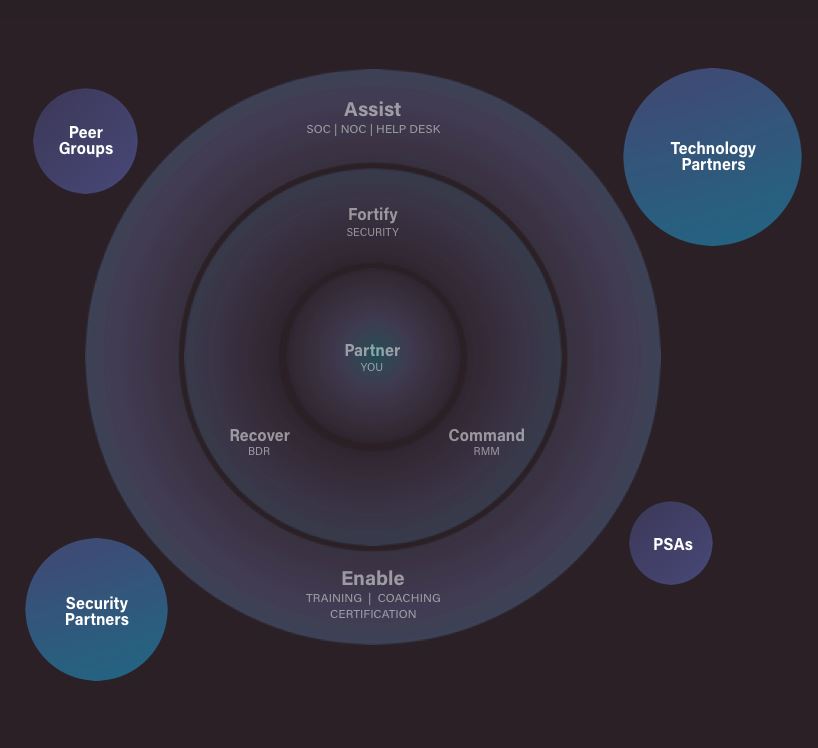
By April 2019, the product names explained the jobs. Command handled remote monitoring. Fortify covered security. Recover addressed backup and disaster recovery. Assist grouped operations and help desk services. Enable collected training, certification and sales coaching. Auvik’s network integration extended visibility to routers, switches and firewalls, while the BrightGauge acquisition added business dashboards.
Recover for SaaS illustrates the practical end of that catalogue. Its product sheet described automated backups to an independent cloud location, configurable retention and the ability to find and restore individual emails or files. For a provider, that meant offering a defined recovery service around a cloud application. Buying cloud software did not remove the separate question of how a customer would recover its data.
These additions made Continuum broader than a single monitoring application. Historically, it competed across categories occupied by Kaseya, Autotask and ConnectWise. A buyer was choosing both a technical toolkit and a way of organizing the firm’s work.
The name disappeared. The question stayed.
On October 30, 2019, ConnectWise announced its acquisition of Continuum. The buyer brought business automation software; Continuum brought service-backed tools and operations teams. In June 2020, Command, Fortify, Recover and Assist adopted ConnectWise branding.
The later platform story belongs to ConnectWise. Its June 2026 announcement described a platform combining service management, RMM, security, automation and AI. Continuum’s earlier story remains useful because its central question is easy to copy: which responsibilities require your own people, and which can a shared operation handle well? Before the next hire or software purchase, write those responsibilities down. Then compare the full cost of serving them.