On March 26, 2024, the problem for CONSOL Energy was above ground. The collapse of Baltimore’s Francis Scott Key Bridge blocked vessel access to its marine terminal. The company still had coal. It still had customers. What it temporarily lacked was a usable exit. For a miner with international ambitions, the distinction was expensive.
- Coal production, processing and shipping formed one connected business.
- The 2024 Baltimore closure exposed the cost of a bottleneck.
- The Arch merger created Core Natural Resources in January 2025.
That interruption reveals more about CONSOL than a photograph of a coal face could. Its business connected underground production, preparation plants, railroads and ocean shipping. Remove one link and the economics changed, even if the coal itself had not.
CONSOL’s name now belongs to an earlier chapter. On January 14, 2025, it completed an all-stock merger with Arch Resources and became Core Natural Resources. Understanding today’s company starts with the network CONSOL brought into that combination.
Three mines. One very busy washing machine.
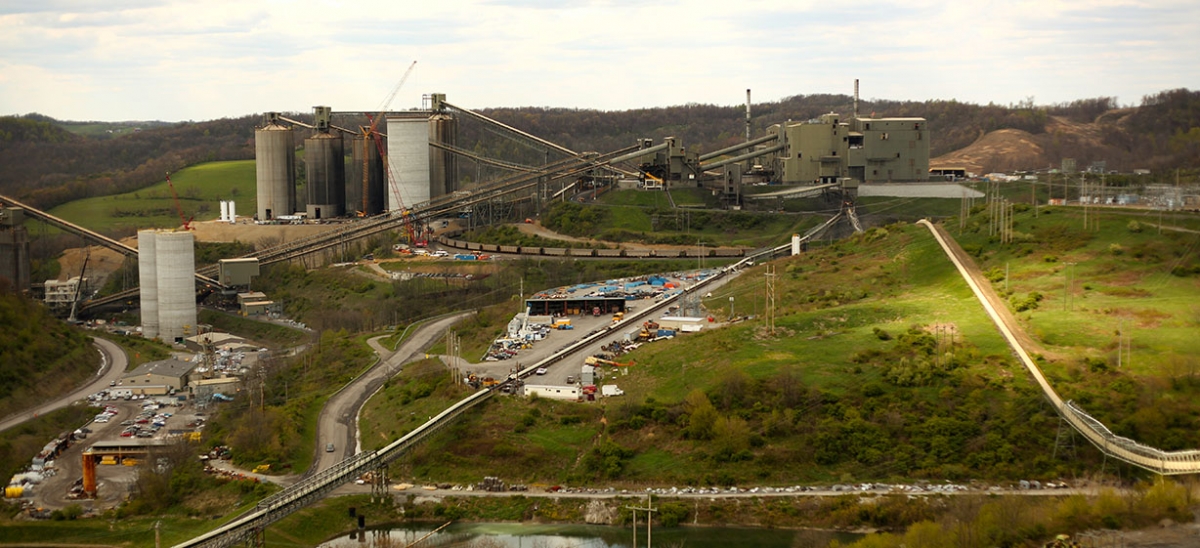
The Pennsylvania Mining Complex brings Bailey, Enlow Fork and Harvey together around a central preparation plant. Underground longwall equipment extracts coal along a working face; conveyors carry material toward processing. Sharing the plant gives three mines a common route from raw output to a saleable product.
The scale is easier to grasp in hours. The plant can clean and process up to 8,200 raw tons an hour. Train-loading infrastructure can handle up to 9,000 clean tons an hour. Separate connections to Norfolk Southern and CSX provide two railroad options. These are capacity figures, rather than a promise that every hour looks like that.
For buyers, the useful product is coal with the right properties, delivered to the right place. High calorific value thermal coal serves power generation and industrial heat. Some Pennsylvania output can cross into metallurgical uses. Itmann, in West Virginia, supplies low-volatile metallurgical coal for steelmaking.
Bailey · Enlow Fork · Harvey → preparation → customer
The customer buys a specification
This is a business-to-business supplier. Utilities, industrial users and metallurgical customers buy tonnage against quality and delivery requirements. In 2024, legacy CONSOL recorded about $1.79 billion in coal revenue: roughly $862 million from power generation, $564 million from industrial uses and $362 million from metallurgical uses. Coal was already serving several different purchasing desks.
Domestic contracts typically ran for a year or longer with fixed pricing. Export sales historically leaned toward spot or shorter contracts, although CONSOL also secured longer export agreements. That mix creates a balancing act: lock in volume and some visibility, while retaining exposure to changing international prices.
Against alternatives such as Peabody, Alliance Resource Partners or metallurgical specialists, the relevant comparison is specific. Which coal fits the furnace or boiler? What does it cost delivered? Can the supplier ship reliably? CONSOL’s preparation and transport infrastructure helped answer those questions. A cheap ton at the mine gate can become an expensive ton at the customer’s gate.
What a missing exit costs
In the second quarter of 2024, terminal throughput fell to 2.3 million tons from 5.4 million a year earlier. Terminal revenue fell to $12.0 million from $31.4 million. The $19.4 million difference measures the year-on-year revenue decline; it is not an audited estimate of the bridge disaster’s total cost.
Management used an alternative East Coast port, accelerated domestic shipments and moved scheduled maintenance into the interruption. Limited vessel access returned in May; the full shipping channel reopened in June. The response offers a practical lesson for any physical business: have another route, then use enforced downtime for work that would otherwise stop production later.
Operational friction also appeared closer to the seam. In early 2024, Itmann faced staffing shortages and long equipment lead times. Development slowed, and shifts were idled. The constraint was people and available machinery. Owning reserves does not automatically create saleable tons.
Baltimore terminal revenue
A wider map, paid for in shares
The Arch combination changed the portfolio. CONSOL contributed its Pennsylvania platform and Baltimore terminal; Arch added metallurgical operations and an ownership interest in Dominion Terminal Associates in Virginia, among other assets. The announcement described a combined business spanning 11 mines and access to two owned or partly owned East Coast export terminals.
The exchange ratio was 1.326 CONSOL shares for each Arch share. At announcement, the companies cited approximately $5.2 billion in combined equity value. That was a market-value snapshot, not a cash purchase price. They initially projected $110 million to $140 million in annual cost and operational synergies, a target rather than a result.
Jimmy Brock’s stated rationale emphasized diversification. The public explanation concerns coal types, uses and geography, rather than one dramatic change of mind. The transaction broadened what the company could sell and where it could send it. It did not make commodity prices predictable.
“Increased diversification across coal types, end uses, and geographies.”
Jimmy Brock · merger announcement · August 2024
Coal’s second job
There is another, smaller story inside the company. CONSOL Innovations works on carbon materials, including CFOAM for applications such as aerospace tooling. Touchstone Advanced Composites turns that materials expertise into tooling and manufacturing capabilities. C-BATT, a venture with X-BATT, is developing battery anode materials. These activities deserve their own commercial tests, rather than being mistaken for the scale of the mining business.
In July 2026, Core announced selection for a Department of Energy grant to pursue a pilot extracting critical materials from Pennsylvania coal waste. The award remained subject to negotiations, with the final amount still undetermined in that announcement. A pilot is a question being tested; it is not proof of profitable extraction.
The part worth copying
The transferable idea is to examine the whole journey to the customer. CONSOL coordinated extraction, processing and shipping, then found ways to keep selling when one route closed. Its stated culture emphasizes safety, compliance and continuous improvement. In a mine, those commitments have to survive staffing decisions and maintenance schedules.
The economics remain conditional. A shared plant needs enough volume to absorb fixed costs. Export flexibility needs available rail and port capacity. Coal demand faces competing fuels, emissions rules and changes in steelmaking. Core’s second-quarter 2026 net income of $126.5 million also included substantial insurance proceeds associated with Leer South; it cannot be read as a pure measure of ordinary mining performance.
For a prospective customer, the next step is concrete: take the required coal specification, volume and destination to Core’s sales team. For an operator in another industry, map the route beyond the factory door. Somewhere along it sits the harbor that can decide whether the product gets paid for.