A pair of custom sneakers is an unlikely place to begin a story about a coal company chief executive. Yet in 2025, Andy Eidson stopped in Knoxville to collect shoes from Brandon Sutton, the designer behind Offbeat Customs. Eidson lived in Kingsport; Tuscaloosa lay down the road. The shoes were headed for a Boys and Girls Club event. Sutton did not initially know much about the customer making the pickup.
Later that evening, Eidson sent a message: two pairs had helped raise $30,000 at Sneakerball. More orders followed, including shoes for Alabama coaches and visitors. Sutton credited Eidson with helping his custom sneaker work become a full-time occupation. College sporting loyalties supplied the joke: the designer opening doors at Alabama was a Tennessee fan. A little houndstooth can apparently survive a border crossing.
Eidson’s working life has a less decorative vocabulary. He is chief executive officer and a director of Alpha Metallurgical Resources, the Bristol, Tennessee-based supplier of coal used by the steel industry. Its mines operate in Virginia and West Virginia; its customers extend well beyond them. Since January 2023, he has been responsible for a business whose fortunes move with steel demand, coal prices, production costs and the practical business of getting a shipment onto a ship.
Before the corner office, the numbers
His route into the job ran through finance. Eidson earned a bachelor of science in commerce and business administration, cum laude, at the University of Alabama, then an MBA at Milligan College. His earlier employers included PricewaterhouseCoopers, Eastman Chemical and Penn Virginia Resource Partners. At Penn Virginia, he worked on coal-segment acquisitions and the budgeting and planning process. Buying a business and setting its budget are different exercises, but both punish a casual assumption.
He joined Alpha in July 2010. Roles in mergers and acquisitions and strategy and business development preceded his appointment as executive vice president and chief financial officer of Alpha Natural Resources in March 2016. He became executive vice president and CFO of Contura Energy that July. In 2019, he also served a brief turn as interim co-chief executive, from May through July. The permanent CEO appointment would come several years later.
The sequence matters because his eventual promotion followed years inside the enterprise. Finance, acquisitions, strategy and an interim executive assignment gave him successive views of the same business. In December 2020, he became president and CFO. By the time the board selected him as David Stetson’s successor, he had already spent more than a decade working within Alpha’s corporate history. The appointment carried institutional memory along with the new title.
- 2010Joins Alpha
- 2016Chief financial officer
- 2020President + CFO
- 2023CEO + director
A succession with several moving parts
The August 2022 succession announcement rearranged more than one chair. Stetson would retire as CEO at year-end and become executive chairman. Eidson would take over on January 1, 2023, and join the board. Todd Munsey, then senior vice president and controller, would become CFO in August 2022, allowing Eidson to concentrate on the presidency before the final handover. Jason Whitehead would become president and chief operating officer when Eidson became CEO.
There was an orderly calendar behind the change: the finance handover first, the chief executive transition later. It also distributed responsibility among people already working in the organization. Whitehead brought the operating role, Munsey took the financial office, and Eidson moved into overall leadership. Describing the promotion solely as one person reaching the top would leave out the other appointments that made it workable.
The financial backdrop was unusually strong. Alpha eliminated its term loan debt during 2022 and returned more than half a billion dollars through share repurchases that year. Eidson became CEO after that year had ended, a distinction worth keeping straight. He had participated as a senior financial and executive leader; the results belonged to the company and its team, rather than to a new CEO retroactively claiming a calendar.
The market does not read the appointment letter
His first year as CEO produced substantial earnings. Alpha reported $270.8 million in net income for the first quarter of 2023 and $354.4 million in adjusted EBITDA. By the end of the year, annual adjusted EBITDA exceeded $1 billion. The company had also put more than $1 billion into its share repurchase program since that program began. Those figures describe a period of financial capacity, with money available for investment and capital returns.
The distinction between net income and adjusted EBITDA matters here. Adjusted EBITDA is a company-defined, non-GAAP operating measure that excludes certain items; it should be read alongside the bottom line. A chief executive with a CFO’s background works with both kinds of number. Readers should too. An attractive operating measure and a profitable business can coincide, but the terms are not interchangeable.
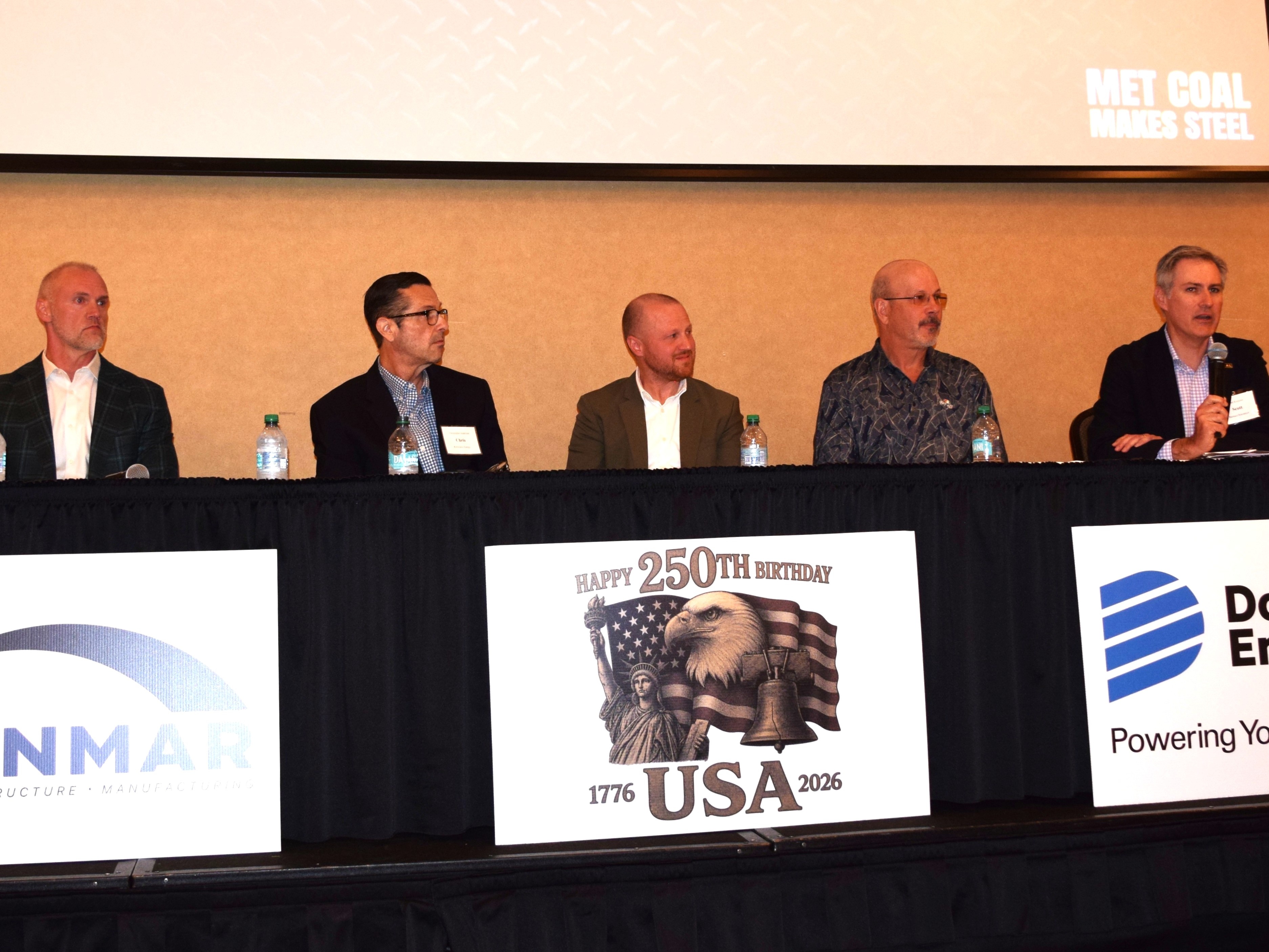
By May 2026, the discussion had changed. At the Metallurgical Coal Producers Association conference in Roanoke, West Virginia, Eidson joined executives from Robindale Energy, Allegheny Met, Blackhawk Mining and Ramaco Resources. They were considering weak prices, future steel demand and how to live through a difficult market. “Right now is not forever,” he told the gathering. The sentence offered a time horizon rather than a date for recovery.
He also described the cost of uncertainty. “I think uncertainty is bad for us,” he said during the conference discussion. His argument connected the coal market to decisions made by steel users: unsettled conditions make people hesitate before committing money to construction and infrastructure. For a supplier, a customer’s postponed project can matter well before any question about the quality of the coal arrives. Confidence has a place in the order book.
Then the wind intervened
Commodity prices are only part of Eidson’s problem. In June 2026, high winds damaged a stacker reclaimer at Dominion Terminal Associates in Newport News, Virginia. The machine moves coal into and out of terminal stockpiles. Wind gusts had exceeded 80 miles per hour during the June 14 storm. The terminal’s second machine remained operational, but the damage interrupted an important link between Alpha’s mines and its overseas buyers.
Alpha owns 65 percent of DTA and uses it for most of its export shipments. It sent force majeure notices to affected customers and pointed to additional capacity at neighboring terminals. The episode gave a concrete shape to supply-chain risk: a coal business with customers around the world could have its plans altered by one stationary machine on the Virginia waterfront. Geography still gets a vote.
In August, Eidson explained that reduced shipping efficiency at DTA was incorporated into lower volume expectations. Alpha planned to use other East Coast terminals to offset part of the disruption. Its second-quarter results included a $12.3 million net loss, $25.6 million in adjusted EBITDA and 3.5 million tons sold. He also described persistent soft market conditions and higher supply costs. The repair timetable and the financial outlook were now part of the same conversation.
This is where the earlier finance work becomes relevant to the present job. A budget must connect a mine’s output, a terminal’s capacity, the cost of supplies and what buyers will pay. A change in one can force revisions elsewhere. The 2026 updates show Eidson explaining that relationship publicly, including the less comfortable task of lowering expectations. There is no elegant piece of footwear for walking around those numbers.
The people between the figures
His public posts offer another view of where he directs attention. He thanked Alpha employees who helped build and restore the road between Bat Cave and Chimney Rock in North Carolina. He also acknowledged A&P’s Paul Panson for contributing equipment and people. In another post, he celebrated Whitehead’s induction into Bluefield State University’s Hall of Fame. These are specific acts of recognition, with named colleagues and work attached to them.
The Alabama connection reaches into engineering as well as athletics. Eidson applauded the university’s Astrobotics team after back-to-back first-place performances in the Caterpillar Robotic Mining Challenge. Alpha engineers had advised students on fabrication and design, and a former Alpha intern, Kendrick Tate, was part of the team being recognized. For an alumnus running a mining business, the overlap was unusually convenient: university pride with a practical engineering application.
Amanda and Andy Eidson are also listed among the Crimson Tide Foundation’s Founders, donors supporting the Crimson Standard initiative for Alabama athletics. The initiative was launched in 2018 as a ten-year, $600 million effort. Their listing places the sneaker anecdote in a wider relationship with the university. The shoes were a memorable errand within an established connection, rather than a sudden appearance in the athletic department’s orbit.
A long game, measured in shipments
The reach of the enterprise remains international. In 2025, Alpha supplied customers in nineteen countries across five continents. Its sales operation combines mining with blending, rail, barge and ocean transport. Eidson’s home base in Kingsport and the company’s headquarters in nearby Bristol anchor the story in Tennessee, but the work leads outward. His remarks about global confidence arise from the markets his company actually serves.
“Right now is not forever.”
Andy Eidson · MCPA conference · May 2026
What comes next is less tidy than the career timeline. The dates of promotions are settled; demand and prices are still being negotiated, shipment by shipment. Eidson’s stated optimism rests on the continuing need for steel and the industry’s experience with cycles. His immediate responsibilities involve costs, customer commitments and the terminal disruption. The long view has to coexist with the next quarterly result.
There is a useful scale change between the two parts of his story. One follows a public company through an executive succession and a difficult market. The other follows a customer stopping in Knoxville, collecting a pair of shoes and returning with more orders. Both involve connections made tangible through repeated work. For Eidson, the public record supplies plenty of numbers. The sneakers give those numbers a person to belong to.