A consumer brand can spend months negotiating a retail promotion, then discover its cost in the least glamorous place imaginable: a payment that arrives short. The retailer has withheld money. Was it the agreed discount? A damaged shipment? A duplicate charge? The answer may be scattered across a portal, a PDF, a sales plan and an accounting system. Someone has to find it before the month can close.
- Confido connects retailer cash, deductions, promotions, forecasts and supply plans for consumer packaged goods brands.
- The company says more than 250 brands use the platform to plan over $30 billion in retail sales.
- Its September 2026 $55 million Series B funds deeper automation and an expansion into food service.
This was the opening Justin Hunter and Kara Holinski saw. The co-founders say they talked with hundreds of brands and found the same pattern: finance teams expected to manage rising retail volume without a matching rise in staff. Every department had software; every department still spent time making its numbers agree with everyone else's. Confido's first answer was to gather remittance documents and apply cash. Its larger answer was to connect the commercial cycle that produced those documents.
The missing dollars are an information problem
A deduction is money a retailer withholds from a payment owed to a brand. Some deductions are proper: the retailer is claiming a negotiated promotion or a contract allowance. Others need investigation. A finance team must identify the charge, find its backup, code it, decide whether to dispute it and make sure the general ledger reflects the decision. At scale, the work is less arithmetic than archaeology.
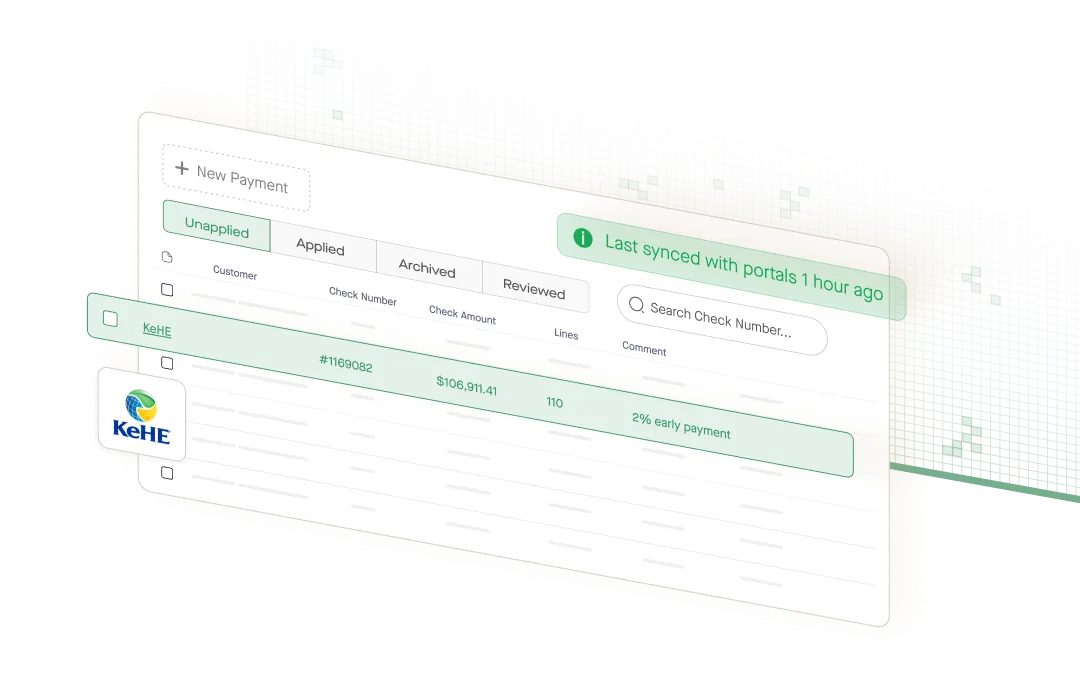
Confido automates collection of payment backup from retailers and distributors, extracts details, matches invoices, classifies deductions and syncs results with accounting systems. A human can still review and approve exceptions. The interesting trick is what happens next. If a deduction belongs to a promotion, the charge can be compared with the original trade plan. Sales sees what a campaign actually cost. Finance sees margin while there is still time to change a decision.
This explains why Confido now sells more than accounts receivable automation. The platform also handles trade promotion management, sales and consumption forecasting, demand and supply planning, and analytics. It separates what a brand ships to a distributor from what shoppers buy at the register. That sounds like bookkeeping until a warehouse fills with goods sold to the channel but not through it. Confido lets those forecasts stay distinct while drawing on the same underlying retail data.
A customer can count the hours
The clearest evidence comes from brands willing to put numbers beside the promise. Every Man Jack, the men's personal care company, described a Walmart cash receipt that once consumed almost a full day and now takes about five minutes. It reported more than 4,000 hours saved annually, worth roughly $325,000 in labor and direct expense. Confido says the deployment paid for itself in the first year. That is a customer case, not a universal return guarantee; the $325,000 figure describes reported savings, not the software fee.
Every Man Jack did more than install a tool. CFO Steve Fox sponsored a named, cross-functional rollout called Project Apollo. The company moved from SAP Business One to NetSuite while bringing cash application, deductions, promotions and planning together. The accounting team reportedly handled triple its earlier transaction volume with fewer people. The lesson available to copy is managerial as much as technical: give the project an executive owner, trace a payment through the ledger, and let sales and operations inspect the same numbers.
DUDE Wipes offers a different measure. Its revenue more than doubled over two years, yet it kept the same accounting team running this process. Its case study says each analyst can handle three times as many deductions and estimates $300,000 in headcount cost avoided over the partnership. The NetSuite integration went live in under a week. These are company and customer reported outcomes; they are most useful as a checklist of things to measure in a trial: backup collection time, payments posted per person, exceptions, and the cost of month-end close.
“What they haven't had is one system where the sales forecast, the trade spend, the deductions, and the supply plan all agree with each other.”Justin Hunter, co-founder and CEO
The product expanded toward the shelf
Confido's early wedge was the finance desk, where repetitive tasks were easy to see. A 2025 $15 million Series A led by Footwork backed a broader ambition. Later that year, Confido acquired Muffin Data, which consolidates retailer and distributor sales data. The purchase connected a second view of the business - what actually moves through stores - to the financial record of what a retailer paid and deducted. The company says customers had been moving from Crisp to Muffin before the deal, a clue that analytics was becoming part of the buying decision.

In September 2026, Insight Partners led a $55 million Series B, bringing Confido's stated total funding to $77 million. The company says more than 250 brands, from emerging names to divisions of Unilever, Mars and Nestlé, use the platform. Its website lists over 70 connections to retailers, distributors, enterprise resource planning systems and accounting tools. That network matters because the difficult part of a shared record is persuading stubborn outside systems to deliver usable data.

The market position is unusually precise. Brands can keep using spreadsheets and staff, or buy separate tools for deduction recovery, trade promotions, forecasting and sales analytics. Confido's claim is that one shared data layer removes the reconciliation between those tools. That proposition has its best economics when a brand sells through many retailers, runs frequent promotions and has enough transaction volume for small errors to compound. A brand with a handful of direct sales and simple books would have less to automate.
There is also a sober way to read the “AI operating system” label. The most valuable feature may be the prosaic one: a clean path from the retailer's check to the plan that produced it. AI can fetch backup and suggest coding. It cannot decide whether a brand should buy another display at a supermarket. Confido's next funding is earmarked for more automated workflows, a fuller planning cycle and food service expansion. The company is asking customers to let software do the chasing while people make the bets.
What the back office knows
A promotion is usually imagined at the shelf: bright tags, an extra display, a shopper reaching for a product. The bill often arrives later, disguised as a subtraction. Confido's useful insight is to treat that subtraction as information about the original decision. The practical move for any growing brand is to follow one retailer payment all the way back to its promotion and forward to its forecast. Count how many times someone retypes the same fact. That count may be a better software budget than any slide about transformation.