The first interesting thing about Kinsa is what happens in the minute before its data exists. A parent presses a thermometer under a child's tongue. Someone taps a symptom into an app. The reading is intimate, ordinary, and usually taken before a doctor is called. Kinsa's entire business rests on that head start.
The second interesting thing is where the reading goes. Stripped of personal identity and combined with other signals, it joins a moving picture of coughs, colds, flu, fever, allergies, and gastrointestinal illness. That picture can tell a family what is circulating nearby. In its enterprise form, Kinsa Insights can tell a pharmacy where cold medicine may run short, a hospital when its emergency department may get busy, or a media buyer where disinfectant advertising is suddenly relevant.
The short read
- Kinsa built a proprietary illness signal from millions of connected household thermometers, app reports, and more than 30 additional data sources.
- Its customers include health systems, pharmacies, retailers, and makers of symptom-relief products such as Zyrtec and Halls.
- The consumer device was the sensor-distribution strategy; SaaS forecasts and enterprise decision support became the higher-value business.
- Healthy Together acquired Kinsa in March 2024 for an undisclosed price.
The dashboard came second
Inder Singh founded Kinsa in 2012 after working on access to AIDS, tuberculosis, and malaria treatments at the Clinton Health Access Initiative. His frustration was basic: public health could count illness after people entered the medical system, but it had little visibility into the days beforehand. Yet households already performed a small diagnostic ritual whenever sickness arrived. They reached for a thermometer.
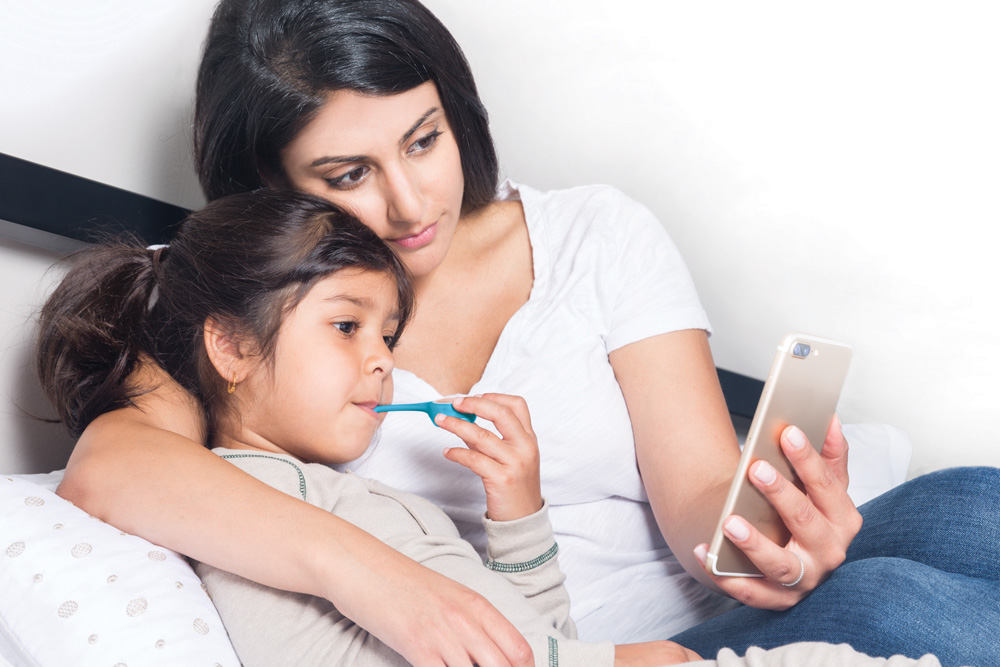
So Kinsa did not begin with a grand surveillance console. It began with a cheap object families could understand. The original Smart Stick plugged into a phone's 3.5-millimeter audio jack, using the phone for power, display, and memory. The app recorded temperatures and symptoms, offered care guidance, and made the experience less miserable for a squirming child. In exchange, Kinsa gained a direct signal from the beginning of an illness episode.
How one fever becomes a business decision
A $15 sensor with a second job
The early Smart Stick sold for roughly $14.99. Kinsa's wireless QuickCare arrived at $19.99. Those prices explain more than a glossy strategy slide could. The thermometer had to be inexpensive enough to spread, because a forecast improves when its observations are plentiful and geographically distributed. Kinsa also placed thermometers in schools through sponsor-funded programs; by 2020, more than 1.5 million devices had been sold or given away, including hundreds of thousands in lower-income school districts.
The enterprise side sells the consequence of that distribution: subscription software, forecasts, and analytic support. Contract prices are privately quoted. The buyers are not purchasing a temperature file. They are paying to decide sooner - moving cough drops toward a rising market, easing media spend in a healthy region, preparing clinical capacity, or warning vulnerable members before the waiting room fills.
The behavior in the home when someone gets sick is to grab the thermometer.Inder Singh, founder of Kinsa
The first thing to fail was the plug
Kinsa had chosen the headphone jack on purpose. It made an accurate connected thermometer unusually cheap. Then phone makers began removing headphone jacks. The clever cost-saving choice became a compatibility trap, and Kinsa discontinued the Smart Stick. In 2018, it launched QuickCare, an FDA-cleared Bluetooth thermometer with its own display. The new model worked even without a phone.
→ 2018
The port vanished; the signal remained.
The wired Smart Stick gave way to Bluetooth QuickCare. Meanwhile, the strategic center moved from hardware margin toward the data network the hardware had helped create.
That forced redesign clarified the economics. Singh explained at QuickCare's launch that Kinsa no longer had to worry as much about device margins because it had illness data to sell. This was not a retreat from the family product. It was the completion of a loop: useful guidance encouraged adoption; adoption created a defensible signal; the enterprise business could then help finance wider distribution.
Earlier than the waiting room
Traditional surveillance is authoritative but often late. A person becomes sick, waits, seeks care, gets tested, and eventually appears in a report. Search queries and social chatter arrive sooner but are proxies for illness; curiosity can look like infection. Retail sales tell you what people bought, not necessarily what they have. Kinsa's distinction is that its signal begins with a physical reading or reported symptom, then gets blended with epidemiological models and many outside sources.
The company has advertised local illness forecasts as far as 20 weeks ahead. Its public case studies say one symptom-relief brand cut retailer forecast error by half and a major national retailer improved forecast accuracy by more than 20 percent. Clorox used geographic fever trends to aim disinfectant ads toward places with rising illness; Kinsa reported a 22 percent engagement lift. These are vendor-reported results, but they reveal the product's real unit of value: fewer wrong bets about where and when demand will show up.
The use cases widened. Halls sought county-level visibility into coughs and colds. Zyrtec used Forecast Advisor to prepare for an allergy season whose timing and intensity shift by place. Highmark Health applied predictive illness intelligence to hospital and emergency-department demand. Superior HealthPlan offered Kinsa reports to providers for staffing and risk-focused outreach. Same engine, different moment of consequence.

The useful copy is not the algorithm
The transferable lesson is architectural. Start with a recurring moment when people genuinely need help. Return immediate value in that moment. Build consent, privacy controls, and aggregation into the product rather than attaching them later. Only then ask whether the resulting signal changes an expensive decision for somebody else.
Four conditions behind the model
- A natural behavior: families already take temperatures; Kinsa did not have to invent the ritual.
- Enough density: a local forecast needs broad, reasonably representative participation.
- A decision with timing risk: stock, staffing, and media become costly when illness arrives somewhere unexpected.
- A humble interpretation: fever and cough are signals, not diagnoses. The data becomes more reliable beside clinical, laboratory, retail, and environmental evidence.
Remove any of those conditions and the proposition gets weaker. Sparse device coverage can distort a neighborhood picture. A symptom may belong to several diseases. Privacy anxiety can reduce participation. A grocery category that barely moves with illness does not need an epidemiological forecast. Kinsa is persuasive when its signal is dense, its uncertainty is explicit, and the customer's next action is obvious.
The forecast finds a larger home
Healthy Together acquired Kinsa in March 2024 for an undisclosed amount. The pairing is legible. Healthy Together sells software for state health and human-services programs; Kinsa brings an illness-forecasting engine, a consumer sensor network, and enterprise relationships. The acquirer said it planned to fold Kinsa's AI prediction into its SaaS platform.
The humble thermometer remains in the story because it solved the cold-start problem that ruins so many data businesses. Kinsa did not ask families to contribute to an abstract map. It offered help while a child was sick. Years later, the map could alert a hospital, redirect a truck, or move an ad budget. A modest sensor became valuable because it arrived early - before the official count, before the empty shelf, and sometimes before anyone else knew there was a pattern at all.