Story · Startups
Commsor Bet That Your Network Was the Product
The community-software startup spent six years arguing that trust, not cold email, is how companies actually grow - then folded the idea, and itself, into The Swarm.
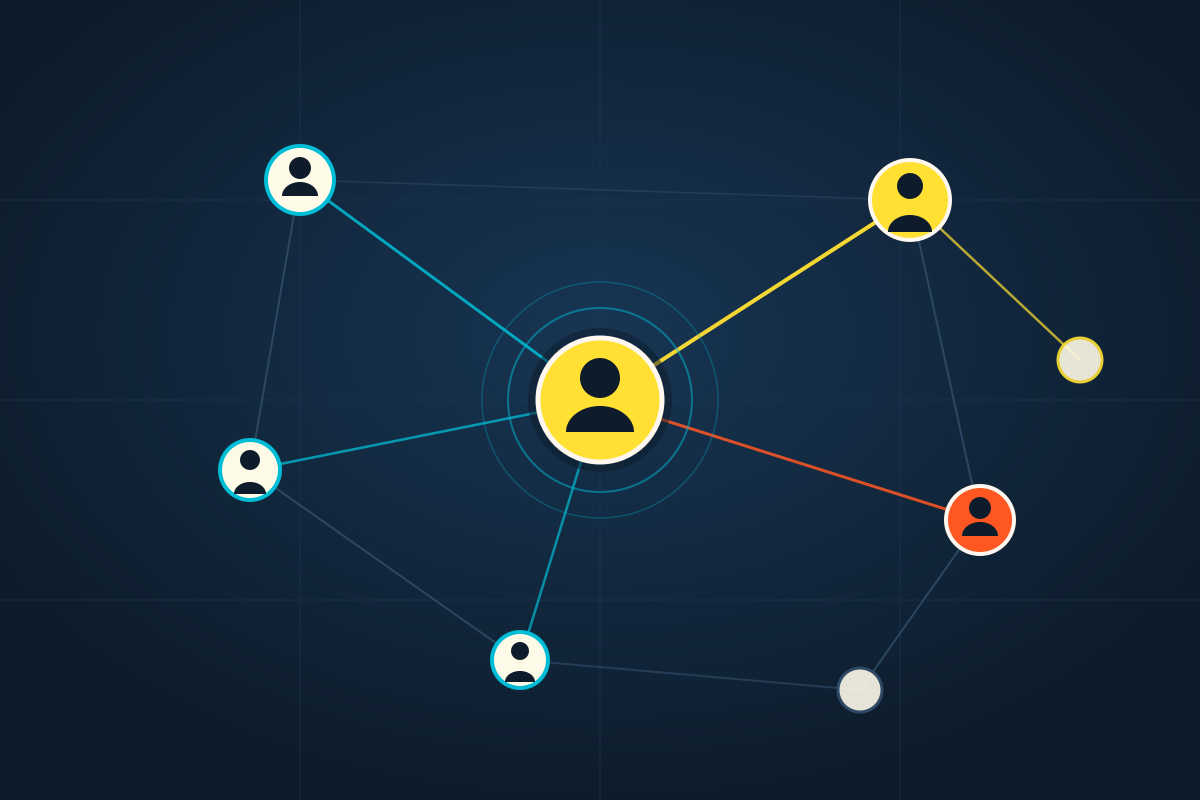
There is a boring truth that every good salesperson already knows and almost no software respected: the fastest way to reach a stranger is through someone they trust. Commsor, a New York startup founded in 2019, spent six years turning that truth into product. It kept changing what the product was called. It never changed the belief underneath.
That is the whole story, and it is more useful than a tidier one would be. Commsor did not blow up. It did not get exposed. It was, if anything, a little too right, a little too early - the kind of company that keeps hearing "yes, obviously" from a market that then hesitates to pay. In early 2025 it was acquired by The Swarm, a relationship-data company that kept Commsor's thesis and quietly retired its features. What travelled was the idea. What got wound down was the code.
01 / THE BELIEFCommunity was never the point. Trust was.
Commsor started life as a "Community Operating System." The pitch, circa 2021, was that companies were pouring money into Slack groups, Discords, forums and events, and had no idea whether any of it worked. Commsor would connect those scattered tools, tie the data together, and finally let a community manager prove impact to a CFO who didn't believe in it.
Underneath the dashboards was a bigger claim, and co-founder Mac Reddin kept saying it out loud: relationships are how great companies grow. Community was just the most visible place that belief showed up. Commsor even gathered its own audience, The Community Club, into a single space - thousands of community professionals who became the company's distribution before it had a finished thing to sell them.
The mascot told on them. Commsor's logo animal was a dinosaur, embraced with a straight-faced 🦕. It read as a joke about being an old idea in a new suit - because trust closing deals is about as old as commerce gets. The suit kept getting re-tailored. The dinosaur stayed.
02 / THE MONEYSixty-six million to prove the obvious
Investors bought the belief before the market fully did. Commsor raised roughly $16M to build toward a "community-led" future, then a $50M Series B, with a cap table that included Felicis, Atomico and Seven Seven Six. Total funding landed near $66M. For a category that barely had a name, that is real conviction - and real pressure to find a buyer who would pay quickly, not eventually.
Here is the quiet tension in that number. Community managers loved Commsor. Community managers rarely control a budget. The people who do control budgets - heads of revenue, heads of sales - didn't yet see "community" as their line item. Commsor had built for the enthusiasts and needed to sell to the accountants. Something had to move.
03 / THE PIVOTFrom community-led to go-to-network
So Commsor changed the wrapper. It repositioned around a phrase it worked hard to popularize: Go-to-Network. Same underlying graph of human trust, completely different buyer. Instead of helping a community manager report on engagement, the software now helped a sales team answer a question their CRM couldn't: who on our side already knows someone on their side?
The mechanics were unglamorous and, for that reason, convincing. Commsor would map a company's extended network - employees, investors, advisors, customers - score how strong each connection actually was, and surface a warm path into a target account. It watched for signals, like a prospect raising money or hiring, and flagged when a real relationship existed to act on. It tracked each introduction and wrote the outcome back to the CRM so the motion could be measured, not just felt.
Cold outbound vs. network-sourced (illustrative)
The repositioning was a genuine skill on display. Plenty of startups die refusing to admit their first buyer was wrong. Commsor kept its conviction and swapped its customer, which is harder than either building or believing on its own. The uncomfortable part is that it also meant walking away from the very community that had carried the brand. The Community Club made sense when community pros were the customer. Once the buyer became a revenue leader, the 5,000-person room it had built no longer pointed at the sale.
04 / THE FOUNDERA Minecraft server was the first lesson
It helps to know where Reddin learned this. Before Commsor, as a teenager, he built and ran The Chunk, a Minecraft gaming network, and sold it in 2016. Running a game server sounds like a hobby until you notice what it actually teaches: a community is an economy. People show up for each other, status is a currency, and the whole thing runs on trust that has to be earned and can be lost overnight. Commsor was that lesson, grown up and pointed at B2B.
You can draw a straight line from the server to the startup. Both were bets that the informal bonds between people are not soft, decorative extras on top of the "real" business. They are the mechanism. Software mostly ignored that because relationships are messy and hard to put in a database. Commsor's entire reason to exist was refusing to accept "hard to measure" as "not worth measuring."
05 / THE EXITThe Swarm kept the argument, not the app
In early 2025, The Swarm - a company built on the premise that relationship data should be foundational go-to-market infrastructure rather than just another feed - acquired Commsor. The framing from both sides was almost suspiciously aligned, because it was true: the two companies had been arguing the same thing from different doors. Commsor's products were wound down, select features folded into The Swarm, and a portion of Commsor's remaining capital redeployed to speed up the acquirer.
Read the acquisition literally and you learn where the value lived. The buyer did not need Commsor's dashboards; it retired them. It needed the thesis, the category vocabulary, and the proof that revenue teams would reach for warm paths if you made them easy to find. Ideas travel between companies. Features usually don't. That is not a sad ending - it is a precise one.
The through-line, 2019 to 2025
- 2019 · FoundingMac Reddin and Jacob Peters start Commsor in New York to make community measurable.
- 2021 · Community OSLaunches the Community Operating System; grows The Community Club to thousands of members.
- 2021-22 · FundingRaises ~$16M, then a $50M Series B. Total funding reaches about $66M.
- 2023 · Go-to-NetworkRepositions around warm intros for revenue teams - same trust graph, new buyer.
- 2025 · AcquisitionThe Swarm acquires Commsor, winds down products, keeps the thesis.
06 / THE TAKEAWAYWhat you can steal from this
If you are building something, Commsor leaves a usable lesson, and it is not "community-led growth won." It is this: pick a belief that outlives your product. Commsor's wrapper changed three times - community CRM, community-led growth, go-to-network - while the belief about human trust never moved. That consistency is what let a community, a category and eventually an acquirer all attach to the same company. A strong point of view is a moat you can keep even when a specific feature can't be.
The second lesson is colder. Being early feels exactly like being wrong, right up until it stops. Commsor spent years hearing that warm intros obviously matter, from buyers who then went back to sending cold email anyway. The market agreed in principle and hesitated in practice, which is the most expensive kind of "yes" a startup can get. Timing is not a footnote to the idea. It is part of the idea.
Cold outreach still clogs every inbox, and everyone still complains about it. The thing Commsor was really selling - reach people through someone they trust - didn't get less true when the company was acquired. If anything, it is now sitting inside a larger platform, waiting for the market to fully catch up to a bet a dinosaur made in 2019.
Follow the thread
- Commsor.com - go-to-network
- The Swarm acquires Commsor
- The Swarm - relationship data
- Commsor on LinkedIn
- TechCrunch on Commsor
- Mac Reddin, interview
FAQQuestions people ask
What was Commsor?
A New York software company founded in 2019 that started by helping businesses manage and measure community, then pivoted to "Go-to-Network" - tools that map a company's relationships and surface who can make a warm introduction to a target account.
Who founded Commsor?
Mac Reddin, who served as CEO, and Jacob Peters, in 2019. Reddin had previously run and sold a Minecraft gaming network called The Chunk.
What happened to Commsor?
In early 2025 the relationship-data company The Swarm acquired Commsor. The Commsor products were wound down, with select features folded into The Swarm and a portion of its capital redeployed to accelerate the acquirer.
How much did Commsor raise?
About $66M in total, including a roughly $16M round and a $50M Series B, from investors that included Felicis, Atomico and Seven Seven Six.
What is "Go-to-Network"?
Commsor's term for reaching buyers through trusted relationships instead of cold outreach - the software maps a company's collective network, scores connection strength, and helps teams request introductions that actually land.