A freelancer can land a client, deliver the work and get paid, then discover that the business day is still going. Someone has to categorize the expense, estimate the tax and work out how the owner should pay themselves. In a one-person company, that someone has a familiar face. Collective sells a way to hand over this second shift.
- Books, formation, invoicing and tax support in one subscription.
- LLC: $199/month. S Corp: $349/month, with payroll.
- Built for U.S. solo owners; savings depend on the business.
Its proposition is unusually concrete. A designer wants to design. A consultant wants to consult. Neither profession automatically confers expertise in employer registration. Collective combines financial software with people who handle the recurring work around it. The useful question is how much coordination a subscription can remove.
01 The paperwork after the paperwork
Hooman Radfar met Ugur Kaner and Bugra Akcay in 2018. They shared experience as immigrants and entrepreneurs, and a frustration with the administrative load of independence. Radfar had co-founded AddThis, later acquired by Oracle, and worked at Expa. Collective launched publicly in September 2020 with an $8.65 million seed round.
The name came from freelance collectives: independent people pooling resources. The company gave that idea a financial form. It could help an owner establish an LLC, pursue an S corporation tax election, keep books and file taxes. Instead of assembling a little finance department from separate vendors, the owner could buy a coordinated service.

That distinction matters because forming a company is a moment; operating one is a calendar. Payroll returns, reconciliations and tax deadlines keep arriving. Collective’s expertise lies in connecting those obligations for a narrow customer: the self-employed owner whose business needs more financial attention than they want to supply.
02 The $349 question
Collective now lists two monthly plans. The $199 LLC tier covers formation or entity review, automated bookkeeping, invoicing, monthly reports, quarterly tax estimates and basic individual returns. The $349 S Corp tier adds the election filing, annual business return, employer registration, salary support, payroll and a dedicated account manager. Personal tax returns are an add-on for S Corp members.
Subscription arithmetic only. State fees, insurance premiums and add-ons can increase the total. Annual billing is advertised at a discount.
The S Corp pitch rests partly on how an owner’s income is treated. A working shareholder must receive reasonable compensation before taking non-wage distributions. Salary attracts employment taxes; eligible distributions receive different treatment. Collective helps manage the machinery around that distinction. The IRS can reclassify distributions as wages when compensation is inadequate.
So a headline savings figure needs a pencil beside it. Subtract the subscription, state charges and other incremental costs, then consider the time recovered. With modest profits, the extra structure may buy little advantage. With more complex needs, a specialist accounting firm may fit better. Collective’s own savings estimates describe particular member cohorts, not a guaranteed result for the next applicant.
03 Where the customer got stuck
One of Collective’s more instructive changes happened inside payroll setup. Gusto’s September 2026 partner case study describes an earlier flow that sometimes sent members to support calls. An embedded window displayed payroll steps alongside Collective’s broader progress tracker. The product could ask for information more easily than it could explain the request.
Collective rebuilt the experience using Gusto’s SDK, launching in May. Explanations could appear beside the decisions. Gusto reports typical completion falling from about half a day to under thirty minutes, with roughly 80% fewer setup support tickets. These are partner-reported results. The lesson is practical: teach at the point of confusion. Missing bank details still cannot be designed away.
04 The back office starts to drive
Funding followed the broader bet. General Catalyst led a $20 million Series A announced in May 2021. In July 2023, Collective announced another $50 million from investors including Gradient Ventures, Innovius Capital and QED. It said the money would accelerate AI deployment and expand its ability to serve demand.
The automation initially served the people doing the accounting: categorizing expenses and reconciling accounts. March 2024 brought Collective Accounting, combining reports, invoicing and payment collection. A shared financial picture could make the service easier to deliver and the business easier for its owner to understand.
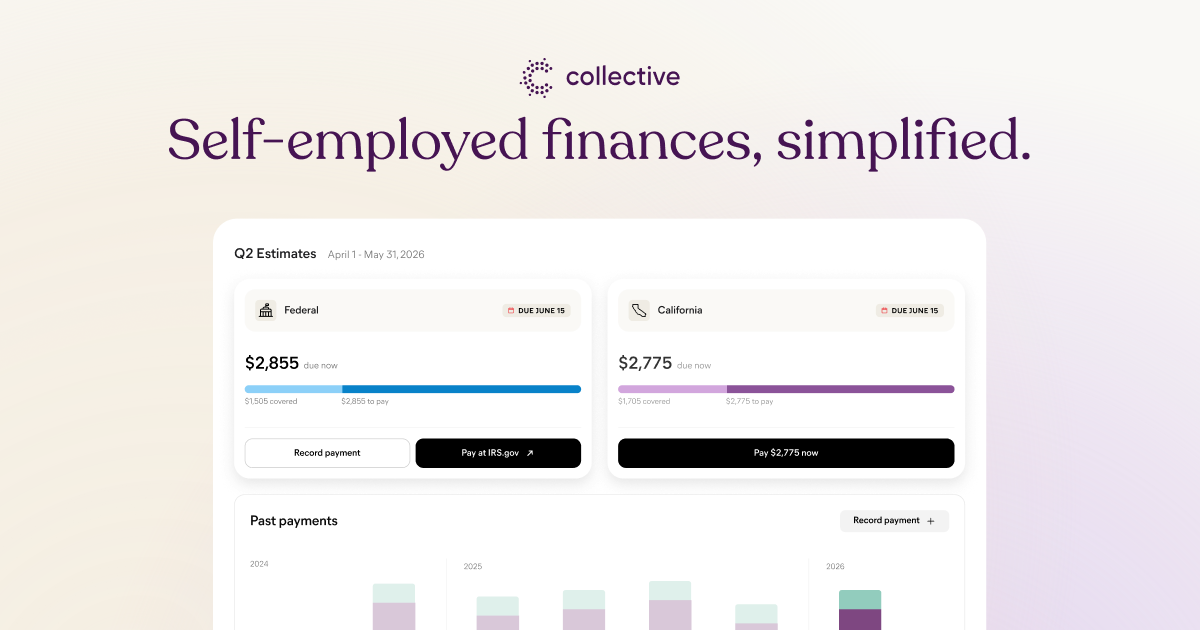
In April 2026, Collective acquired Open Ledger, an accounting infrastructure startup. Radfar described the ambition plainly: “The future is a back office that drives itself.” Forecasting cash flow and acting on financial information belong to that stated vision. An acquisition announcement is a direction of travel, not proof that every promised capability has shipped.
“The future is a back office that drives itself.”Hooman Radfar / April 2026
July brought a more tangible expansion: Insurance Center, with business coverage through Coverdash and health coverage through Solo Health. Insurance premiums can touch payroll and taxes, so the adjacency makes sense. It also extends Collective’s recurring relationship with the owner beyond bookkeeping.
05 Competing with the open tabs
Collective sits between do-it-yourself software and a traditional professional firm. QuickBooks, Gusto, formation services and a tax preparer can address the same underlying chores separately. Lettuce competes more directly for solo owners. Collective’s argument is that someone must make the pieces agree, and that someone need not be the customer.
Its current about page reports more than 10,000 members. The appeal is easy to grasp: one place to see the business, fewer handoffs to supervise, and people available when context matters. The copyable idea is equally small. Find the administrative work customers keep inheriting. Connect it. Explain it where they stumble. Give them back a working afternoon.