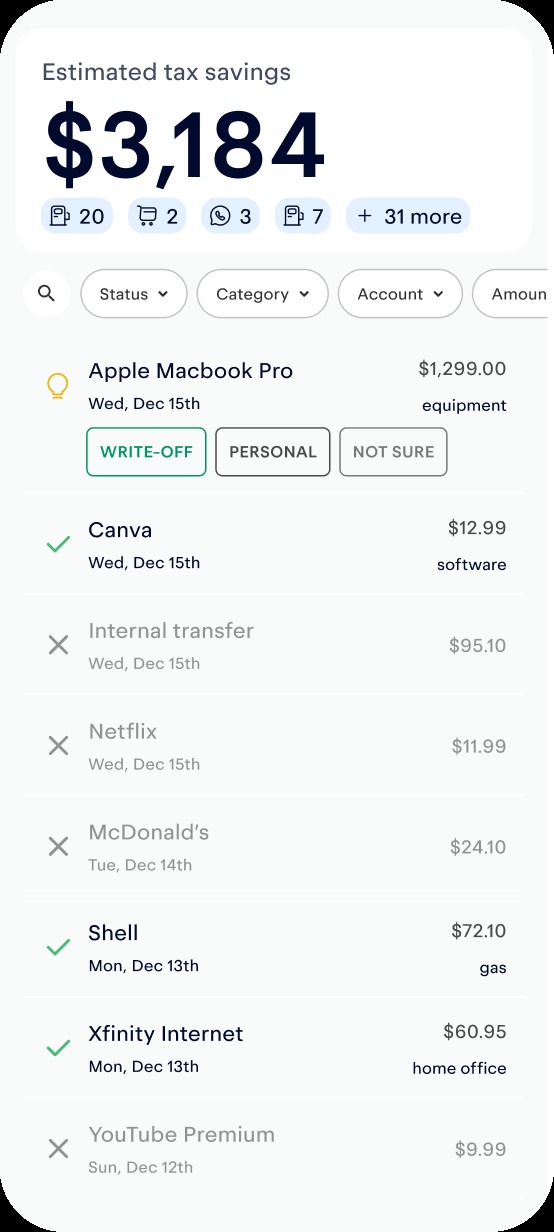
A dog walker buys extra leashes, parking, and bags for the work nobody wants to describe too closely. The customer sees a normal Tuesday. A tax preparer sees possible business expenses. Paul Koullick saw the gap between the two, and in 2019 used those purchases to explain the young company he had started with his childhood friend and former debate partner, David Kang. Keeper’s original proposition was almost absurdly small: connect an account, watch purchases, and ask which ones belonged to the job.
- Keeper started as a write-off finder for people paid as contractors.
- It added filing because a list of deductions still left customers with a return to finish.
- Today it combines account-linked records, guided preparation, AI assistance, and review by tax professionals.
- Its listed consumer plans run from $20 a month for bookkeeping only to $399 a year for Premium.
That small question was well chosen. A salaried worker usually has taxes withheld before the paycheck arrives. The independent worker collects the full payment, pays business costs, and must reconstruct what happened later. Receipts disappear. A phone bill is partly personal and partly work. A rideshare driver’s car has two lives. The burden is less arithmetic than memory.
A text message with an accountant’s instinct
Keeper graduated from Y Combinator in winter 2019. By March, it had 200 paying customers; the seed round announced the next month was $1.65 million, led by Matrix Partners. The first product watched transactions through Plaid and sent short text questions about possible write-offs. A yes could teach the system to recognize similar purchases. It sounded sophisticated from the outside. Kang later said the earliest backend was mainly Google spreadsheets.
The founders did not wait for a polished system to learn what contractors needed. Kang said they posted on Craigslist and pitched rideshare drivers during actual rides. That method would make a dreadful brand campaign. As customer research, it put the pitch in front of the people whose tax habits mattered. The early users gave Keeper a narrow opening: spot costs they had paid, but might never tell an accountant about.
“If you’re a dog walker, there are so many things you need to be writing off, like your poop bags, your extra leashes, your parking.”Paul Koullick, 2019
The joke works because the paperwork does not. Tax law cares about the purpose of an expense, while a bank statement knows only the merchant and amount. Keeper’s published method uses the customer’s job, transaction history, and previous choices to estimate whether a purchase belongs to the business. High-confidence items can be added; uncertain ones go back to the customer. In a company-designed test using a fictional graphic designer, its first pass reached 68% overall accuracy, and a short user session lifted that to 83%. Those are results for an illustrative dataset, not a promise for every bank account.
Illustrative test published by Keeper; the example uses fictional transactions.
The missing last mile
Finding deductions solved only the first half of the customer’s problem. In 2020, Kang described the old routine plainly: users could export what Keeper found, then go elsewhere to file. Filing became a natural next product and a new source of revenue. By 2021, when Keeper announced a $13 million Series A, the company was promising a fuller tax platform for gig workers, creators, and freelancers. It said more than 100,000 workers had found over $70 million in write-offs through its software. That is the company’s tally of identified deductions, not a measure of tax refunds.
The consumer-facing name lost “Tax” in a 2022 rebrand. Koullick said the original app had been about finding breaks; Keeper now filed returns, handled other credits and deductions, and offered audit support. The wider name followed the wider job. A 2024 description of its “three-step filing” flow made the ambition clearer: give Keeper the documents and transaction history, answer a smaller set of tailored questions, then review and sign the prepared return.
That last step is Keeper’s clearest place in the market. Traditional do-it-yourself software asks the taxpayer to interpret a trail of forms and prompts. An independent accountant can take the whole file, but the time and price can feel out of reach for a gig worker or a small solo business. Keeper tries to use software for collection and preparation while retaining a professional at the point where errors matter. Its own marketing promises more than any sensible tax product can guarantee for every customer; the concrete distinction is the workflow and the review.
A clever answer nobody asks for
AI brought Keeper another lesson in friction. Its research team said an early AI Accountant could answer demanding tax questions in tests, yet the first assistant was slow and fragile outside that domain. The user-facing version drew little engagement. People typed “hello,” “help,” or broad subjects such as “quarterly taxes.” The failure was not simply bad answers. It was an interface that expected ordinary people to frame expert questions before receiving expert help.
Keeper changed the invitation. Beside an uncertain expense, a “Not sure” action can bring the specific transaction into a question for the assistant. Behind the chat, the company describes routing different questions to different systems, checking responses, and bringing in human staff when needed. It reports lower support costs after those changes, though that is an internal measure. The transferable idea is plainer: place help at the moment of doubt, with the relevant facts already in view.
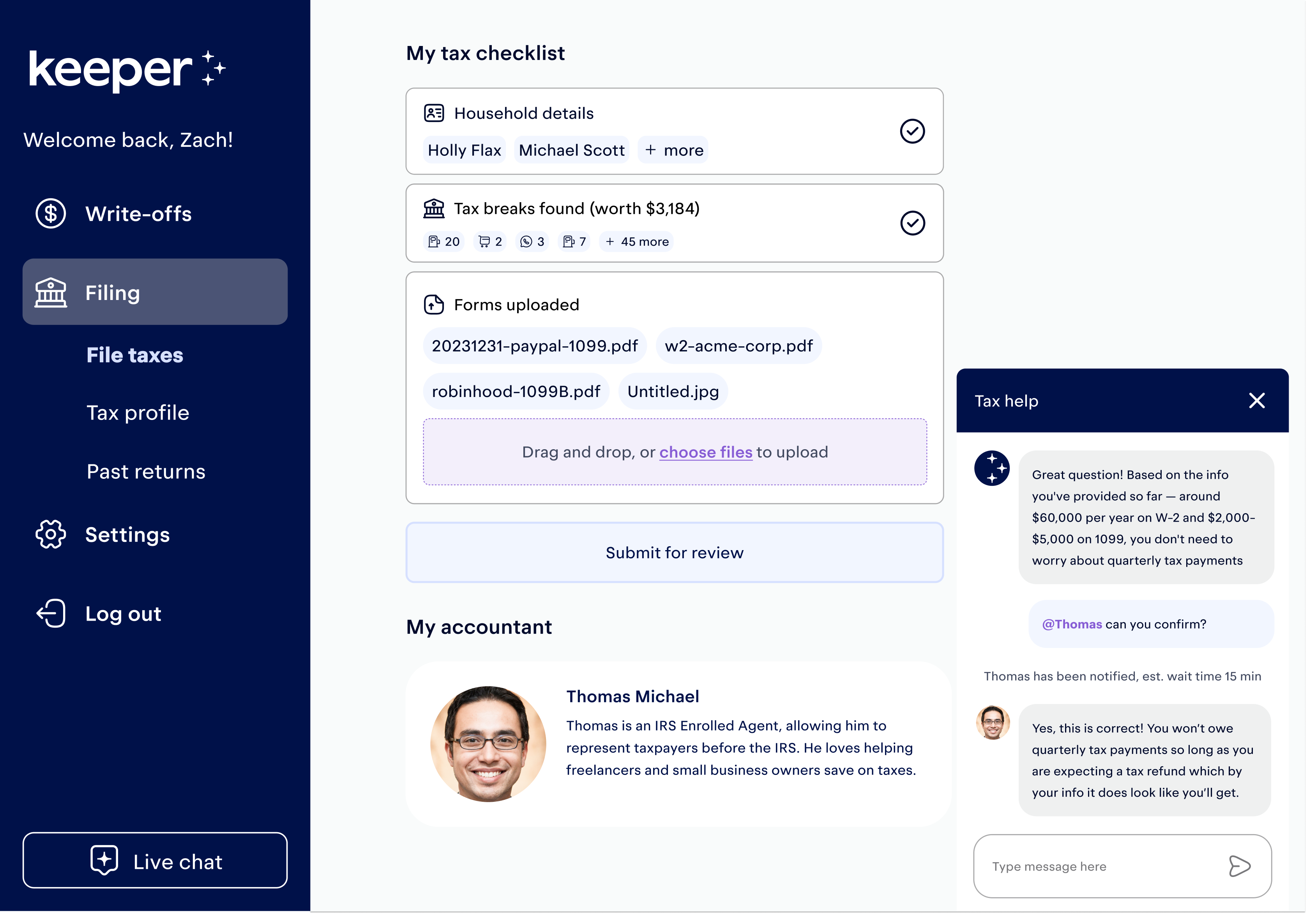
Keeper now reaches beyond its first audience. Its site names freelancers and 1099 contractors, but also people with rental property, investments, K-1s, foreign income, and small-business returns. S-corporation and partnership filing is available through business services and add-ons. The expansion creates a familiar tax-company dilemma: each added case makes the product more useful, and each edge case raises the price of being wrong.
The price of taking the whole job
Keeper’s subscription ladder shows how it parcels out that work. A bookkeeping-only plan is listed at $20 a month. Standard is $199 a year and includes deduction tracking and federal and state filing with expert review. Premium is $399 a year, adding help such as quarterly payments, more complicated individual scenarios, prior-year work, and accountant access. Business returns and specialist services can carry separate fees. The company says subscription payments, rather than ads or customer-data resale, fund the service.
The price comparison is less obvious than it looks. A person with a clean W-2 and no business spending may gain little from year-round deduction hunting. A contractor with mixed income and a shoebox of expenses may gain considerably, provided they review suggested write-offs honestly and keep enough records to support them. Keeper’s method depends on connected data and customer corrections; the model cannot infer the business purpose of every coffee, mile, or phone charge from a merchant name.
In 2025 Koullick handed the CEO role to Kang, saying Keeper had been used by more than 1.5 million Americans. It remains a company built around a modest observation: people often need tax help long before filing day. The dog walker’s bags were never the whole business. They were a way to see the scattered decisions that become a return, one ordinary purchase at a time.