An accountant brings home a software problem. His son happens to be a software engineer. In most families, this would end with someone being asked to fix a laptop. In Archit Gupta’s family, it helped produce a company. During a visit to Delhi in 2010, Gupta talked with his father, Raja Ram Gupta, about the difficulties of filing taxes online. His father was a practising chartered accountant. Even he found the process troublesome.
The difficulty had an oddly modern shape. A task had moved onto a computer without becoming especially comfortable for the person sitting in front of it. There was an Excel-based tool to download, information to enter carefully, an XML file to generate and a manual upload to complete. Each step made sense to the system. Together, they asked rather a lot of the human.
Gupta went back to California and investigated whether he could build a self-service alternative. The conversation gave him a practical starting point: someone who knew the rules still needed better tools. His father supplied an accountant’s view of the problem. Gupta brought the engineer’s suspicion that a process this awkward ought to yield to software.
The engineer who changed the assignment
His education had prepared him for a different kind of complexity. Gupta studied computer science and engineering at IIT Guwahati, then completed a master’s in computer science at the University of Wisconsin-Madison. He began a doctorate, but left the programme in 2008 to work at Data Domain in California. Research had given way to startup engineering.
At Data Domain, he experienced a technology company from inside the machinery. The business was subsequently acquired by EMC. He had friends building companies, and Silicon Valley offered ample encouragement to regard an unsolved problem as a possible occupation. Returning to India meant choosing a problem whose daily vocabulary included income, deductions and returns.
It is an appealingly unromantic beginning. Tax filing comes with a ready-made audience of people who would prefer to be doing something else. The founder’s opportunity lies in respecting that preference. A customer who finishes quickly and leaves contentedly may be an excellent customer, even if they never develop an emotional attachment to the form.
Gupta has described enjoying the supposedly unglamorous territory of taxes as a finance and technology enthusiast. That interest matters. Someone has to care about the fiddly parts on behalf of everyone who would rather close the tab. In 2011, he founded ClearTax.
A deadline makes a demanding customer
The first filing season brought a test that was difficult to dress up. Gupta initially promoted the product by emailing people he knew. A return was filed within hours of the website going live. Roughly a thousand people used it in its early days. There were customers to help before there was much of a marketing apparatus.
Those customers also brought specifications. People needed support for circumstances such as rental income and more than one salary. A tax return has a way of refusing to resemble the tidy example in a demonstration. The team added features while handling the filing rush, learning about real financial lives through the questions arriving at the product.
“Make no mistakes in people’s taxes.”
Archit Gupta’s early guiding principle
The brief was unusually unforgiving. A small error in an entertainment app might spoil a few minutes. A tax product works with information people have reason to care about. Convenience has to travel with accuracy. The attractive screen is only the visible end of a much longer chain of calculations, checks and explanations.
Gupta’s approach placed design close to the centre of that chain. Reducing the information a user had to type could reduce the opportunities for confusion. Automating the extraction of information from Form 16 removed another piece of manual work. The result asked the software to do more so that the taxpayer could do less.
That choice gives a revealing measure of the founder’s work. A customer does not arrive wanting to admire the architecture. They arrive with documents and a question about what to do next. Every instruction has to earn its place. Good design in this setting can mean the disappearance of a question that never needed to be asked in the first place.
Ten minutes, after three years
ClearTax’s arrival at Y Combinator in summer 2014 makes a convenient milestone. Getting there was less tidy. In a later first-person account, Gupta recalled that the company had faced closure earlier that year. He described a team whose confidence in one another and the product survived the pressure. The accelerator’s investment became a turning point.
There had also been an earlier rejection from Y Combinator for a different startup idea. For ClearTax’s application, the team had something concrete to explain: a working product and customers. Gupta and his colleagues practised with accelerator alumni before the ten-minute interview in California. Brevity, it turns out, can require a great deal of preparation.
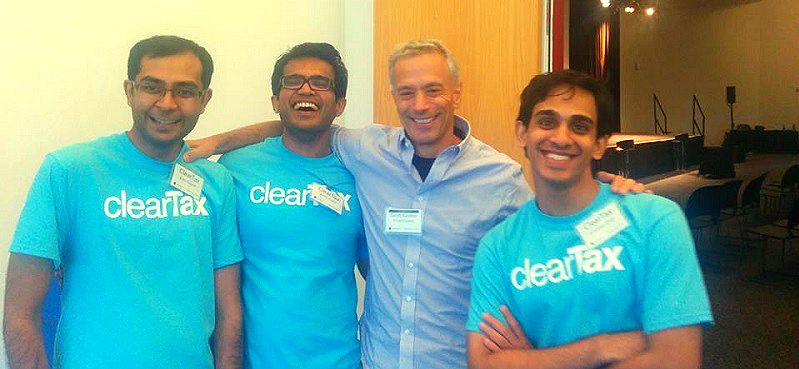
The team itself had formed through another kind of gathering. Gupta met Ankit Solanki and Srivatsan Chari at a hackathon in Delhi. They became his co-founders, with Solanki associated with technology and Chari with product and business responsibilities. The founder story contains several people who knew different parts of the same problem.
One detail from that accelerator summer is particularly apt. The team returned to Delhi for the July filing rush before heading back to California. An impressive invitation could wait for its place in the diary. Customers had a deadline. For a tax company, the calendar is a fairly senior member of management.
- 2011ClearTax begins
- 2014YC summer batch
- 2017Enterprise SaaS work
- 2021The name becomes Clear
A shorter name, a longer job
The company’s assignment expanded. India’s introduction of GST in 2017 opened a different set of software problems. Accountants and businesses needed to organise invoices, compare records, resolve mismatches and prepare filings. The unit of work was growing beyond one individual’s annual return.
For Gupta, the enterprise opportunity brought the company closer to finance departments dealing with complex operations. In 2025, he described the development of the enterprise business from 2017 and the move towards larger organisations. The customer’s difficulties could involve several states and complicated tax structures. A simple interface still mattered, but it now sat above considerably more plumbing.
ClearTax became Clear in 2021. The change reflected ambitions extending into a broader range of financial software. That October, the company announced a $75 million Series C led by Kora Capital, with Stripe among the participants. The announcement marked resources for another stage of work rather than a tidy final chapter.
Gupta spoke that year about expanding enterprise software and serving companies with substantial invoice and GST workloads. In his own year-end account, he also highlighted new products, acquisitions and the company’s first employee stock-option buybacks. The public story had acquired investors and financing rounds; the internal one included people who had helped build the product.
There is a useful continuity beneath the changes in company vocabulary. A consumer wants to finish a return. A finance team wants records that agree and processes that keep moving. The scale differs, but both pay a price when a computer hands unresolved complexity back to its user.
The enterprise turn also changes the meaning of finishing. One taxpayer can submit a return and leave. A company’s finance department has another invoice, another reconciliation and another reporting task waiting. Serving that customer asks a founder to understand a sequence of work, including the handoffs between people. The product has to fit into a working day already populated by other software and other obligations.
Stray Dogs in Sweaters
Gupta has an interest with a more immediately entertaining vocabulary: Ultimate Frisbee. In Delhi, he played with a team called Stray Dogs in Sweaters. This is a name that deserves to survive any number of corporate rebrands. He has described the sport as a source of friendship, with tournaments bringing music, meals and time together.
His playing connections crossed into his working world. He recalled playing against Yahoo co-founder David Filo and alongside WhatsApp co-founder Brian Acton in Mountain View during summer 2014. Technology’s familiar names appear here with a flying disc between them, rather than a term sheet.
“On the field, I tune out. I can be goofy. Nobody cares who you are.”
Archit Gupta on Ultimate Frisbee
The appeal in his description is partly the change of role. In the office, people depend on the CEO for decisions. On the field, he can join the game without carrying the same identity. His public biography also lists chess, reading, food and music among his interests. There is a person here who occasionally gets to think about something other than the next filing season.
The form keeps changing
By 2026, Gupta was talking about finance work that continues between filing dates. In an April interview, he described tax compliance becoming more continuous and stressed the importance of clean, reconciled data before adding AI. He also discussed the UAE as a strategic market. The Delhi conversation had led into a business serving problems across borders.
His account of leadership had changed in duration, too. He described moving from the next milestone towards the next decade, with more attention to people, culture and decisions whose results take time. It is a sober ambition for a founder whose early customers needed something useful almost immediately.
The original irritation remains easy to recognise. A person has a task to finish. A system has information it needs. Somewhere between them sits a piece of software that can make the afternoon easier or considerably worse. Gupta has spent fifteen years working in that gap. The form looks simple. Making it feel that way keeps him occupied.