A thousand dollars arrives in a business account. That sounds like a thousand dollars to spend. Except some belongs to the tax bill, some to the next software renewal, and some to the owner who has quietly forgotten to pay herself. The balance is correct. The conclusion is wrong. Novo has built a business around making that distinction easier to see.
- Checking without a monthly maintenance fee, built for US independent businesses.
- Invoices, bookkeeping, and budget buckets live around the account.
- Credit requires approval; faster money movement can carry fees.
The company says more than 250,000 businesses use its platform. Think consultants, designers, online sellers, and service firms. Their financial department may be the same person who answers the phone. For that person, an account that merely stores money leaves quite a lot of work unfinished.
First, fix the front door
Michael Rangel and Tyler McIntyre founded Novo in 2016; the platform launched in 2018. But the useful origin story is a procedural headache. An Alloy case study describes slow, manual customer onboarding that hurt conversion and retention. Before customers could appreciate better banking software, they had to get through the application.
Novo adopted Alloy’s identity decisioning system. The vendor reports a 50% reduction in manual reviews and account opening in under ten minutes. Those are case-study results, rather than a promise about every application. Still, the lesson travels: a polished product has limited value when the paperwork keeps people outside.
“Alloy enabled us to get to the market quickly”
Tyler McIntyre · co-founder · Alloy case study
There is a related preference in Novo’s published culture: “Hierarchy Is Not Authority.” The careers page describes a workplace where employees should act on problems and question ideas regardless of who proposed them. Its listed offices span New York and three Indian cities. Those are employer descriptions, but they fit a product whose promise depends on thousands of small operational decisions going right.
The envelope gets a software update
Novo Reserves takes a household budgeting habit and puts it inside business checking. Owners can create up to 20 categories and automatically assign percentages of incoming money. Taxes, payroll, profit, a replacement van: each gets a place. Money that once looked available now arrives with a purpose attached.
There is a crucial mechanical detail. These buckets are part of one checking balance, not separate bank accounts. A label does not create a legal wall around the money. The account’s published annual percentage yield is 0%. Reserves organizes cash; it does not turn cash into an interest-earning investment.
One deposit. Four jobs.
Move the slider to split an imaginary deposit. Illustrative percentages, not tax advice or a live Novo account.
The buckets change the plan. The total stays the same.
The account becomes a workbench
The rest of Novo follows the same logic. Send an invoice, track its progress, receive the payment, and see the transaction in context. Connect accounting and payment tools already used by the business. The current checking page advertises more than 40 native integrations, including Stripe, Square, Shopify, QuickBooks, and Xero.
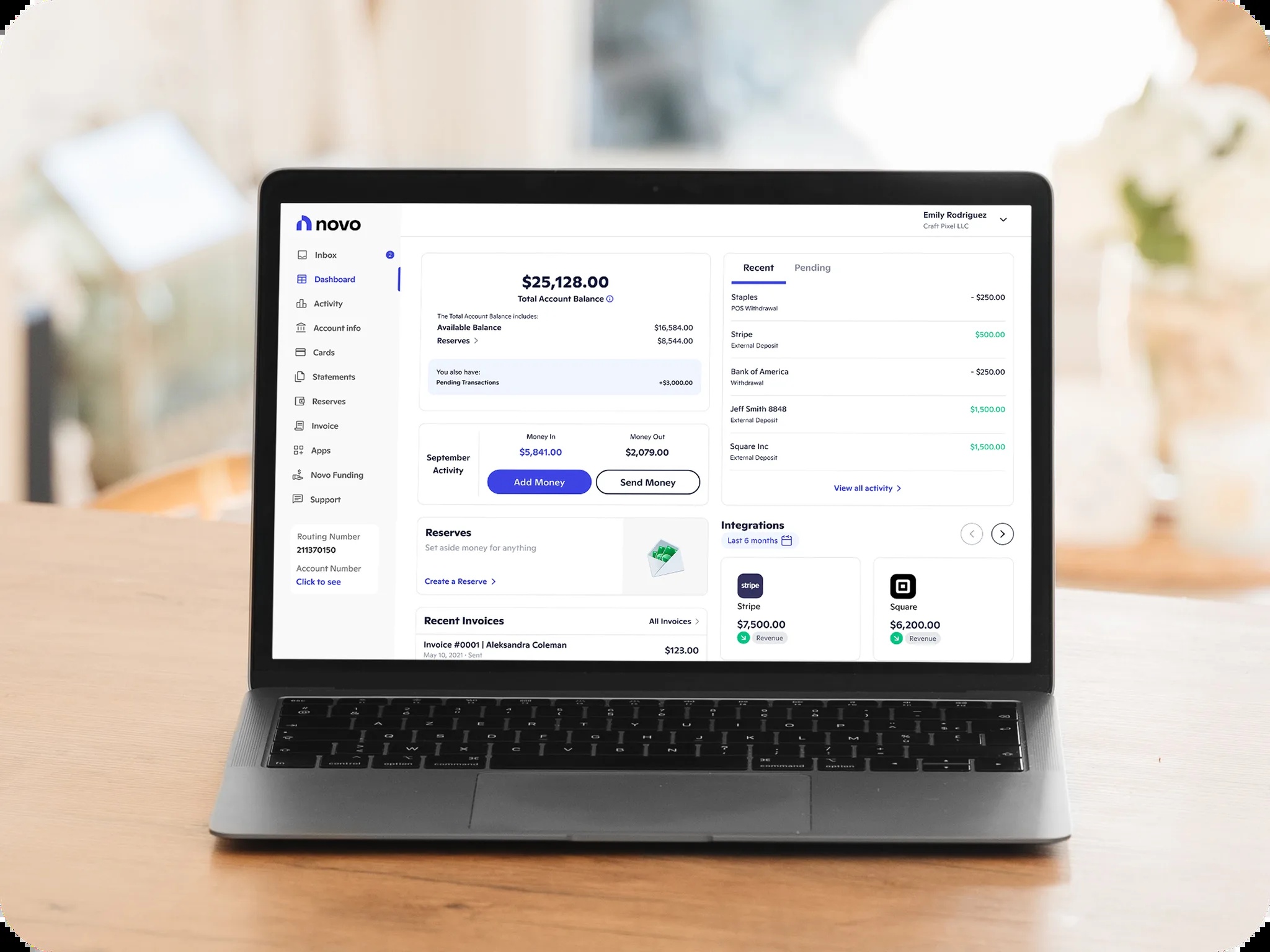
Bookkeeping adds automated expense categorization, receipt management, and monthly financial overviews. External business accounts can connect through Plaid. The attraction is less retyping and fewer loose ends. An owner still needs to check the categories and reconcile the records. Automation can do repetitive work without becoming an accountant who knows the whole business.
This is also a statement about expertise. Novo concentrates on the software and workflow surrounding money, while Middlesex Federal Savings, F.A., provides deposit banking services. Novo itself is a fintech company. The distinction explains how a banking experience can come from a business that does not hold a bank charter.
Free checking, paid convenience
The basic account has no monthly service charge or minimum balance. Standard incoming and outgoing ACH transfers are free. Speed has a price: the published schedule charges 1.5% for Express ACH, with a 50-cent minimum and $20 maximum. Outgoing domestic wires can cost up to $45. Free checking deserves a precise definition.
$0.50 min / $20 max
Novo earns money through card interchange and financing, alongside charges for selected services. A merchant’s card-acceptance economics help support an account with no monthly maintenance bill. Payment processors can also charge their own fees. Sending an invoice for free does not mean accepting every payment method costs nothing.
The next product was time
A business can be profitable and still face a miserable Friday: payroll is due, but a customer pays next Tuesday. Novo’s expansion into financing addresses that interval. In August 2023 it launched Novo Funding with a $125 million facility from Victory Park Capital. That facility financed working capital; it was distinct from the company’s venture equity.
The current lineup separates merchant cash advances from Continental Bank-issued business loans, advertised up to $50,000. Offers depend on eligibility and underwriting. There is also a Continental-issued credit card with no annual fee. Its advertised 2% cashback requires a Novo checking balance of at least $5,000; below that, the rate is 1%.
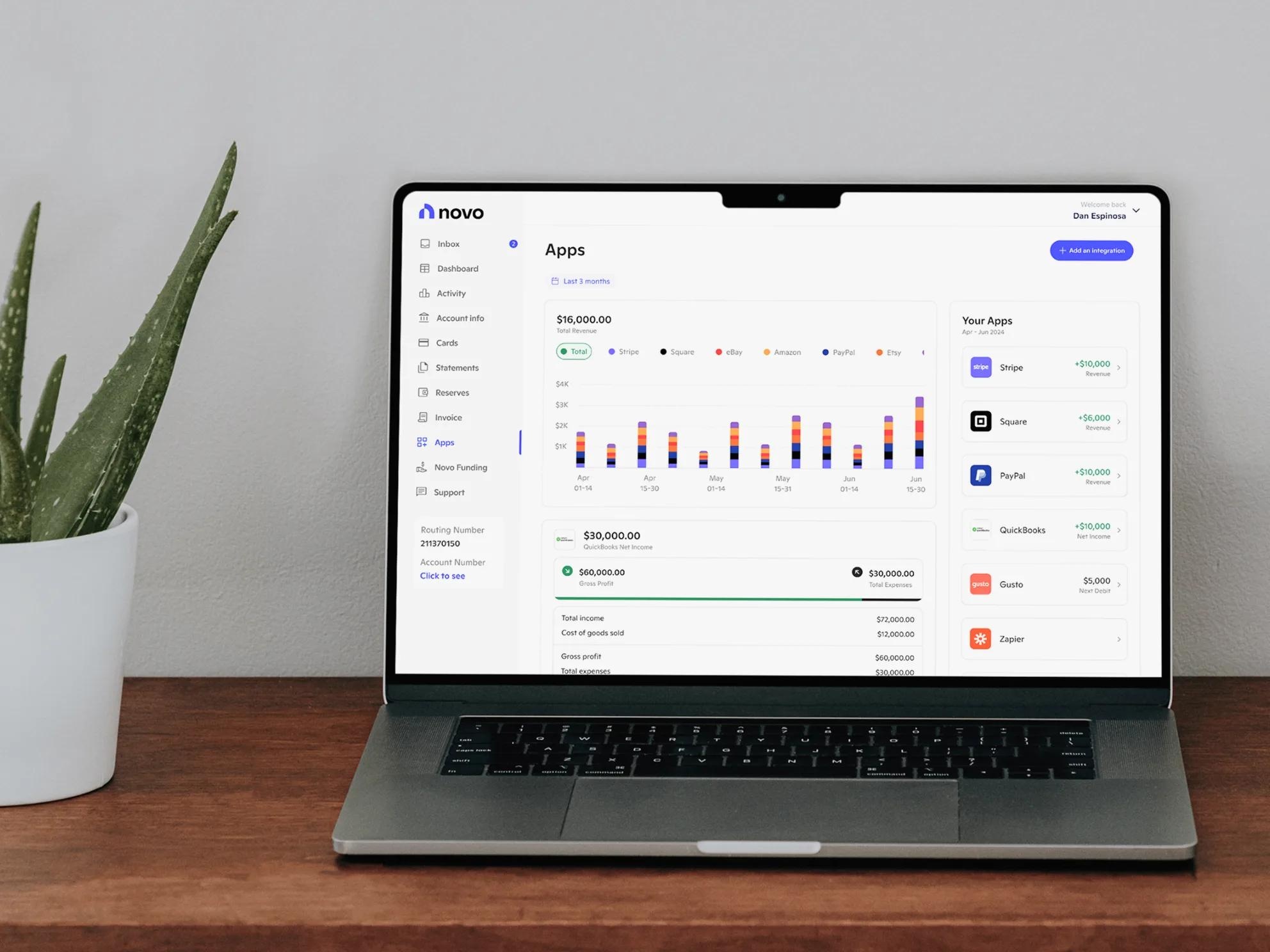
The direction became clearer in 2024. Ruby Money announced its acquisition by Novo and the shutdown of its standalone app. Its tax automation technology would join a broader platform. That October, Novo announced bookkeeping, the credit card, and Invoice Flex. The checking account was becoming the place where several financial chores could meet.
For an owner, the financing decision still comes down to the offer. Compare total repayment, payment frequency, and the cash left for ordinary expenses. Fast access can solve a timing problem. It cannot make an unprofitable job profitable, and moving the borrowing into a familiar dashboard does not remove its cost.
Copy the habit, then choose the account
There are alternatives. Bluevine offers interest-bearing checking. Lili combines banking with financial tools. Mercury spans banking, accounting, spend management, and treasury. Integrations alone do not separate Novo from this crowd. Its case rests on whether a particular independent business finds the daily routine easier, at a cost that makes sense.
A cash-heavy shop needs another arrangement because Novo does not accept direct cash deposits. Someone seeking interest on idle cash should compare other products. A new account does not guarantee credit. And a reserve labeled “tax” cannot determine the correct tax bill.
What can anyone copy? Assign incoming money before treating it as spendable. Connect the records. Review the exceptions. Novo packages those habits around an account. The insight is modest enough to be useful: a balance becomes more informative when you can see the promises already attached to it.