At 13:24 UTC on October 16, 2023, Cointelegraph posted the news that crypto traders had been waiting for: approval of BlackRock’s spot Bitcoin exchange-traded fund. There was one problem. It had not happened. Bitcoin raced toward $30,000 before retreating. A publication covering the market had briefly become an event inside it.
- A specialist publisher serves readers with news, analysis, guides and interviews.
- Commercial content, partnerships and startup services turn attention into income.
- Its defining challenge is keeping speed, commercial access and editorial judgment in balance.
That afternoon offers an unusually useful way into Cointelegraph. Crypto information has a peculiar property: the reader may act before finishing the sentence. A headline becomes an order. An order becomes a price. The publisher’s product is therefore partly information, partly the confidence that someone checked it before pressing send.
01 / A newspaper for an unfinished industry
Founded in 2013, Cointelegraph grew around a subject that kept expanding its vocabulary. Bitcoin led to Ethereum, decentralized finance, NFTs and arguments about digital ownership. Its early history includes co-founder Toni Lane Casserly. Today the site covers this sprawling territory through news, market analysis, opinion and price coverage.
The audience has several different jobs to do. A newcomer needs a wallet explained. A trader wants to understand a price move. A founder needs to follow regulation. Cointelegraph Learn separates guides, practical tutorials and explainers; Research goes further into market structure and technical questions. Readers can choose their depth rather than swallow the whole fire hose.
Long-form journalism supplies another gear. Cointelegraph Magazine’s first feature, published in October 2019, examined Sweden’s embrace of a cashless economy. That is a pleasing origin for a crypto magazine: start with what people actually do with money. The company also produces podcasts and video interviews, turning the same beat into several reading and listening habits.
02 / Two customers walk into a newsroom
Consider the economics. Readers want useful information without another subscription. Crypto businesses want those readers to notice them. Cointelegraph connects the two through advertising, paid content and partnerships. Its disclosure also allows affiliate links. The company says more than 200 people work across its global operation, so free access comes with a substantial business behind it.
Each connection depends on readers returning.
Its policy says commercial customers cannot review, delay or suppress editorial stories. That boundary is central to the offer. A business can buy distribution; the newsroom says it retains control over coverage. For readers, labels matter. A commissioned article and an independently chosen report may share a website while answering to different briefs.
CoinDesk, The Block, Blockworks and Decrypt offer alternative ways into the same sector. Cointelegraph’s particular mix stretches from beginner education to trading information and startup support. Its advantage is the convenience of that range. Its burden is helping readers understand which kind of material they are looking at.
03 / Putting a price on the head start
In February 2021, Cointelegraph launched Markets Pro with data company The TIE. VORTECS compared current trading and sentiment conditions with historical patterns. NewsQuakes organized potentially market-moving announcements. A March 2021 company article, preserved in syndication, put the subscription at $99 a month. That historical price gives the proposition a useful concreteness: quicker, organized information was something readers might pay for.
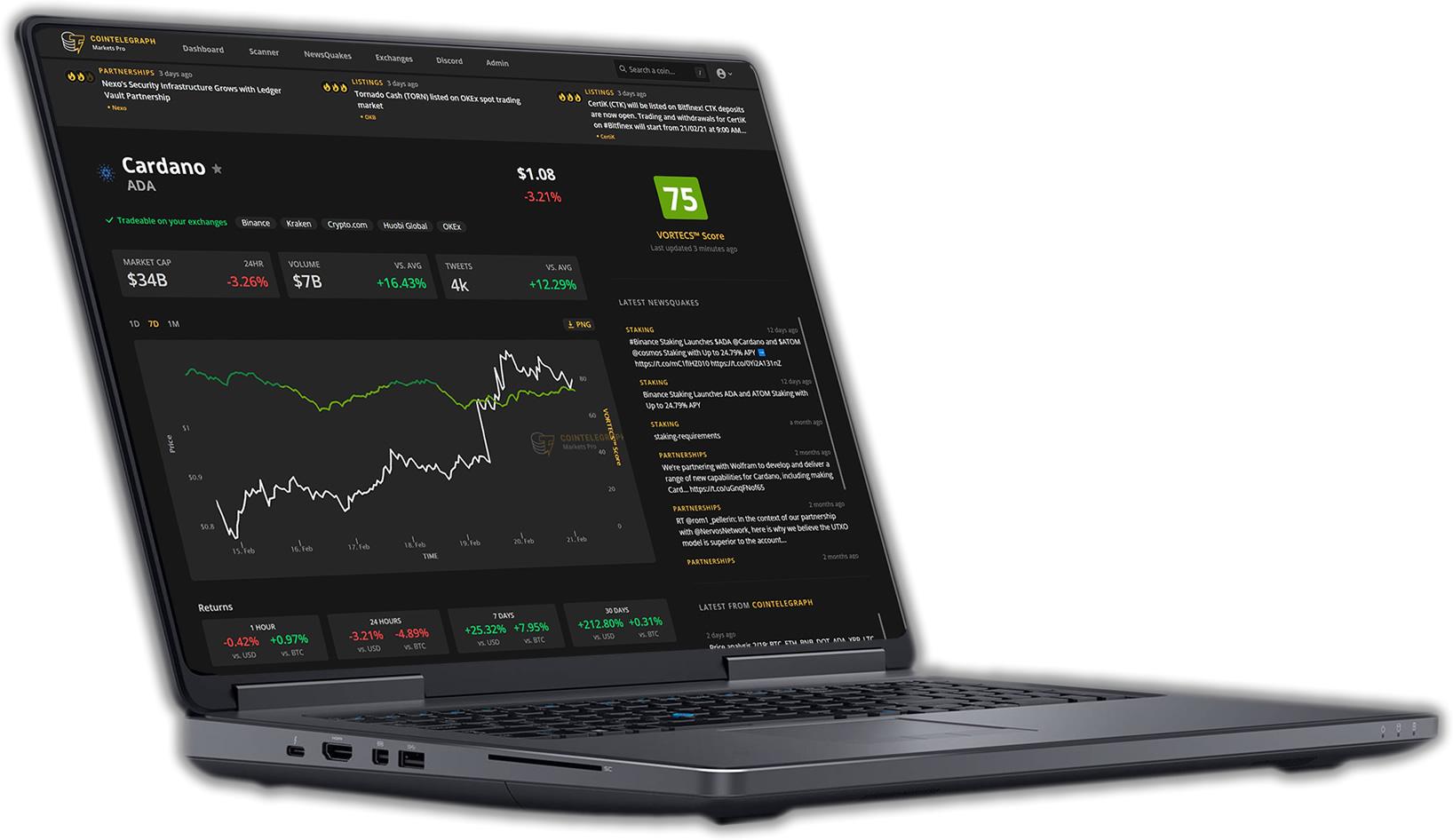
The distinction between pattern and prediction matters. Yesterday’s resemblance can organize research. It cannot ensure that tomorrow’s buyer appears. Then-CEO Jay Cassano put the sensible limit of the pitch into the launch announcement:
“History doesn’t predict, but it can be deeply informative.”
Jay Cassano / Markets Pro launch, 2021
The accelerator took the business a step closer to the companies it covered. Its January 2023 launch offered commercial media support in exchange for tokens or equity through a separate arm. By 2026, the advertised offer was a 12-week program for companies with working products and traction, including conditional funding for top participants. Those entry requirements expose a basic truth: publicity needs something real to amplify.
04 / The check that came too late
Return to that ETF post. Cointelegraph’s reconstruction traced the claim through Telegram and an internal Slack channel. A social employee published before source confirmation and editorial approval. The control failed at the handoff into public distribution. There was no corresponding false article on the website, but the social post already carried the brand’s authority.
- Unverified claim published on X
- Post removed; confirmation sought
- Retraction issued after BlackRock’s denial
The company apologized and announced a review of social-media procedures. The market cost was visible in the price reversal and liquidations, although total losses cannot cleanly be assigned to one post. The operational lesson travels well beyond crypto: a claim does not become verified because someone copied it into a workplace channel.
05 / Give the reader a reason to return
Cointelegraph kept broadening its operation. Gaming.News launched as a separate brand in March 2025. Jon Rice returned as editor-in-chief that August. A September open letter emphasized accuracy and context; the editorial policy dated April 2026 describes multiple review stages and publishing controls. These are public commitments whose value depends on daily execution.

For someone building a specialist business, the useful idea is to serve the same audience at several levels: explain the basics, cover developments, then offer deeper tools or services. The conditions matter. Trading tools depend on imperfect history. Startup promotion depends on existing demand. Journalism depends on enough independence to disappoint a paying customer.
For the reader, the practical use is simpler. Start with an explainer, follow the reporting, check the content label and open the underlying announcement before acting on a consequential claim. Cointelegraph can make a complicated industry easier to follow. Its own history demonstrates why following should leave room for checking.