There is a curious problem with brain games: you can become splendid at one and still forget why you entered the kitchen. CogniFit has built a company around that awkward gap. Its puzzles are the most photogenic part of the product, but the more consequential move happens before anyone starts playing: it asks people to establish a cognitive baseline.
- Founded in 1999 by psychologist Shlomo Breznitz.
- Measures 22 cognitive skills through a 17-task general battery.
- Pairs results with adaptive exercises and repeat assessments.
- Serves individuals, clinicians, schools and research teams.
- Now sells a measurement workflow as well as a game subscription.
This is a company with two shop windows. One invites a person to test memory, attention or processing speed on a phone, then work through short, adjustable exercises. The other opens onto clinics, schools and trial sites, where a professional needs to assign tests, examine reports and follow change over time. CogniFit says its platform has reached more than 6.4 million users and over 6,600 clinics and institutions. Those are company figures, useful for scale, not evidence that every user’s daily life improved.
A driving test became a much larger question
Breznitz, a psychology professor at the University of Haifa, founded CogniFit in 1999. The early focus included cognitive training for driving performance. That is an unusually concrete place to begin: a driver must notice, divide attention, decide and respond. It also hinted at the difficulty that would follow the whole industry. Improving a screen task is measurable. Improving the act of driving, or living, takes a different kind of proof.
The company spent its first decade developing and testing the idea, then brought assessment and training into homes at scale. During the 2013–2017 period, it says its consumer audience passed four million. From 2018 onward, the center of gravity moved toward professional and enterprise care. There is no documented single catastrophe or boardroom revelation behind that shift. The visible change is in the customers: from a person seeking a sharper mind to an institution that needs a repeatable measure, a report and a way to manage many people at once.
“Our cognitive skills are not fixed. At all ages the brain has the ability to respond to new information and new stimuli.”Shlomo Breznitz, quoted in CogniFit’s remembrance
Breznitz died in 2026. His premise remains in the software, though the current pitch is less romantic than the old promise of a “brain gym.” It is a proposition about instruments: if cognition can be sampled reliably, a change might be noticed earlier, discussed more clearly and tested against an intervention.
The game comes after the measurement
The general Cognitive Assessment Battery uses 17 tasks to measure 22 skills, including working memory, focused attention, inhibition, planning, visual perception and response time. A user completes an assessment, gets a profile and can start exercises chosen and adjusted for that profile. As scores change, the exercises change difficulty. A later assessment gives the person, or the professional overseeing them, another point on the chart.
That loop is what a reader can copy, even without CogniFit: record a starting point, define the task, make practice challenging enough to matter, then check progress with a measure that does not simply reward familiarity with the game. It is also why a clinical report belongs in different hands from a cheerful consumer dashboard. CogniFit describes its assessments as aids to evaluating functioning; a qualified professional is responsible for diagnosis and treatment decisions.
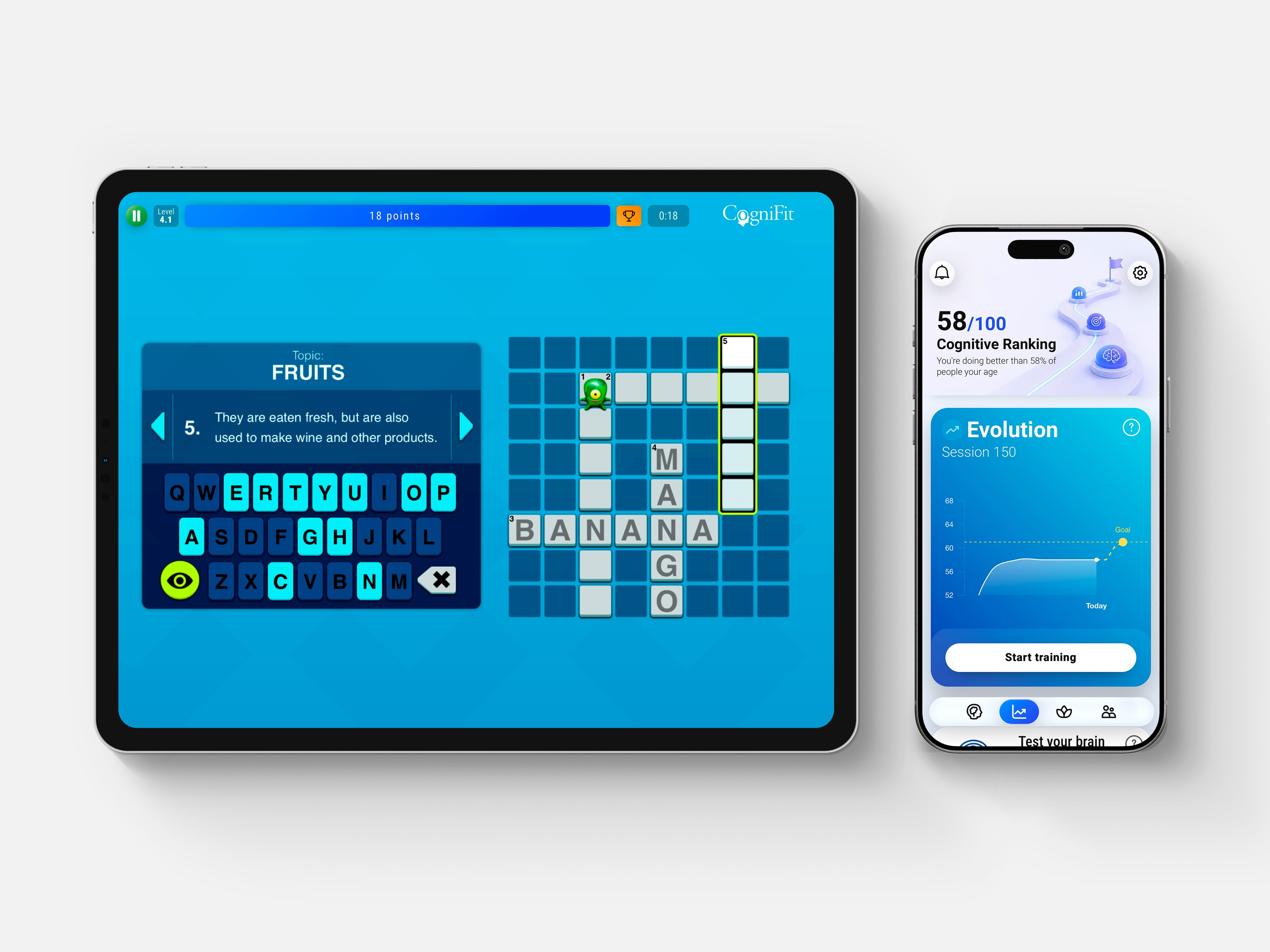
For a household, the use can be simple: try a baseline test, pick a program, and see whether scores move with regular practice. For a clinician, it can mean inviting patients to complete assessments remotely and tracking a cognitive profile. An educator can use the tools to investigate learning gaps. Researchers can build assessment protocols and collect repeated measures across a study. Employers and white-label partners buy access to the same underlying system for their own groups or products.
The price of a sharper score
CogniFit’s business model follows those different buyers. A consumer can try an initial test and some games free. Its US web help page, updated in March 2026, lists a basic plan at $19.99 a month or $119.99 a year, and premium at $29.99 a month or $169.99 a year. The premium tier opens more training programs and games. App-store and country pricing can differ. Professional accounts add subscriptions and assessment or training licenses; organizations can buy deployments, integrations and clinical-trial services.
The financial history is older and quieter than the product story. Dealroom lists $5 million from Milk Capital in July 2008 and another $2.6 million in April 2010, both recorded as Series A financing. Public valuation information is scarce. What is visible is a long operating life in a market where many brain-game brands sell short bursts of motivation. CogniFit’s attempt at distinction is a single system connecting assessment, personalized exercises and professional monitoring.
The user total is company-reported. The research index includes trials, reviews, theses and other works, not 209 positive clinical trials.
Evidence has a shape, and edges
CogniFit’s research catalogue is unusually broad: 209 entries as of its June 2026 update, spanning randomized studies, validation work, reviews, conference reports and dissertations. The company itself notes that appearing in the index means a study used or assessed its tools; it does not mean the result was favorable. That distinction is more valuable than an impressive number on a sales page.
A 2021 meta-analysis of commercial brain-training programs included CogniFit among seven products studied in older adults. The broader field remains contested, particularly when claims jump from doing better on trained tasks to performing better in ordinary life. A 2017 randomized trial of a commercial program found no transfer to the cognitive tasks it tested after ten weeks in young adults. Neither result resolves every CogniFit use case. Together they tell buyers what to ask: which population, which outcome, which comparison group and how long did the effect last?
A cognitive score can help structure a conversation or a study. It should not be sold as a diagnosis, proof of dementia prevention or a guarantee that a person will remember every name at dinner.
The newer customer is asking an even narrower question. In August 2026, CogniFit said Eurofins Optimed was using its digital cognitive assessments in an ongoing early clinical research study. The study details remain confidential, but the service is specific: standardized cognitive measures collected over time, potentially from remote participants, for researchers who need a digital endpoint. This is much closer to laboratory plumbing than to a leaderboard.
In September, CogniFit published a survey designed with SharpBrains of 324 professional platform users in 43 countries. It reported enthusiasm for routine cognitive checkups, while respondents cited cost and clinical validation as leading barriers. The sample consists of engaged users, so it cannot speak for every clinician. It does capture the company’s present tension: the technology to generate scores is plentiful; the work is making those scores affordable, interpretable and useful in real care.
That is the most interesting turn in CogniFit’s story. Brain games attract attention because they are playful. The durable question is whether a person’s change can be measured honestly enough to guide a next step. The company has spent twenty-seven years trying to make that question its business. A good score is pleasant. A score that helps someone decide what to do is worth rather more.