The peculiar thing about Driver is that the company’s mistake becomes visible only after you list everything it got right. Two physicians found a real problem. They raised roughly $90 million. They recruited more than 30 respected cancer centers. They built software for patients and doctors, opened automated pathology labs in the United States and China, and designed a service that could carry a frightened person from a tumor sample to a specialist’s appointment. Then they put a $3,000 checkout screen in front of the patient.
- The idea: show cancer patients relevant standard treatments and clinical trials beyond the walls of their local hospital.
- The offer: records, tumor analysis, matching, expert video review, referral, and follow-up for $3,000 plus $20 a month.
- The first failure: conversion. Hundreds used a subsidized beta; paid enrollment was reportedly in the single digits.
- The lesson: healthcare products need a payer and a distribution path as deliberately designed as the clinical workflow.
A map for the worst week of your life
Driver began in May 2015 with William Polkinghorn and Petros Giannikopoulos, doctors who had met on their first day at Harvard Medical School. Polkinghorn had practiced radiation oncology at Memorial Sloan Kettering. Their observation was both simple and uncomfortable: a patient’s options depended partly on where that patient walked in. A doctor at one institution knew its trials, its specialists, and its routines. Another hospital possessed a different inventory. The science might be global; the shopping aisle was stubbornly local.
Driver proposed to occupy the empty space between the patient and the hospital. A patient would consent through an app, and Driver would acquire the medical record and tumor material. Its systems would compare the case with guideline-based treatments and trial criteria across a participating network. An oncologist could discuss the matches over video. Driver would then arrange the evaluation, deliver the records, and monitor what happened next.
records
tumor
options
oncologist
care
The interface looked like search. Underneath it was a logistics company wearing a lab coat.
That last detail is what separated Driver from a trial directory. It did not merely point at a destination; it tried to escort the patient there. In one public example, a man with prostate cancer used Driver to find options that avoided hormone treatment. The platform assembled roughly nine possible trials. He did not enroll because his condition remained stable, but he described Driver as filling holes in the information available from his own institution.
“There is an air gap between knowledge and patients that has existed in cancer care since the 1850s.”William Polkinghorn, co-founder and CEO
The impressive part was also the expensive part
Most software companies rent infrastructure. Driver manufactured a miniature health system. Its patient and clinician apps sat on top of record-acquisition operations, trial inventory, matching software, nursing support, legal processes, pathology, appointment coordination, and surveillance. It operated automated tumor-analysis machines in San Francisco and China. Staff worked across San Francisco, Shanghai, New York, and Boise. By the end, the workforce was about 85 people.
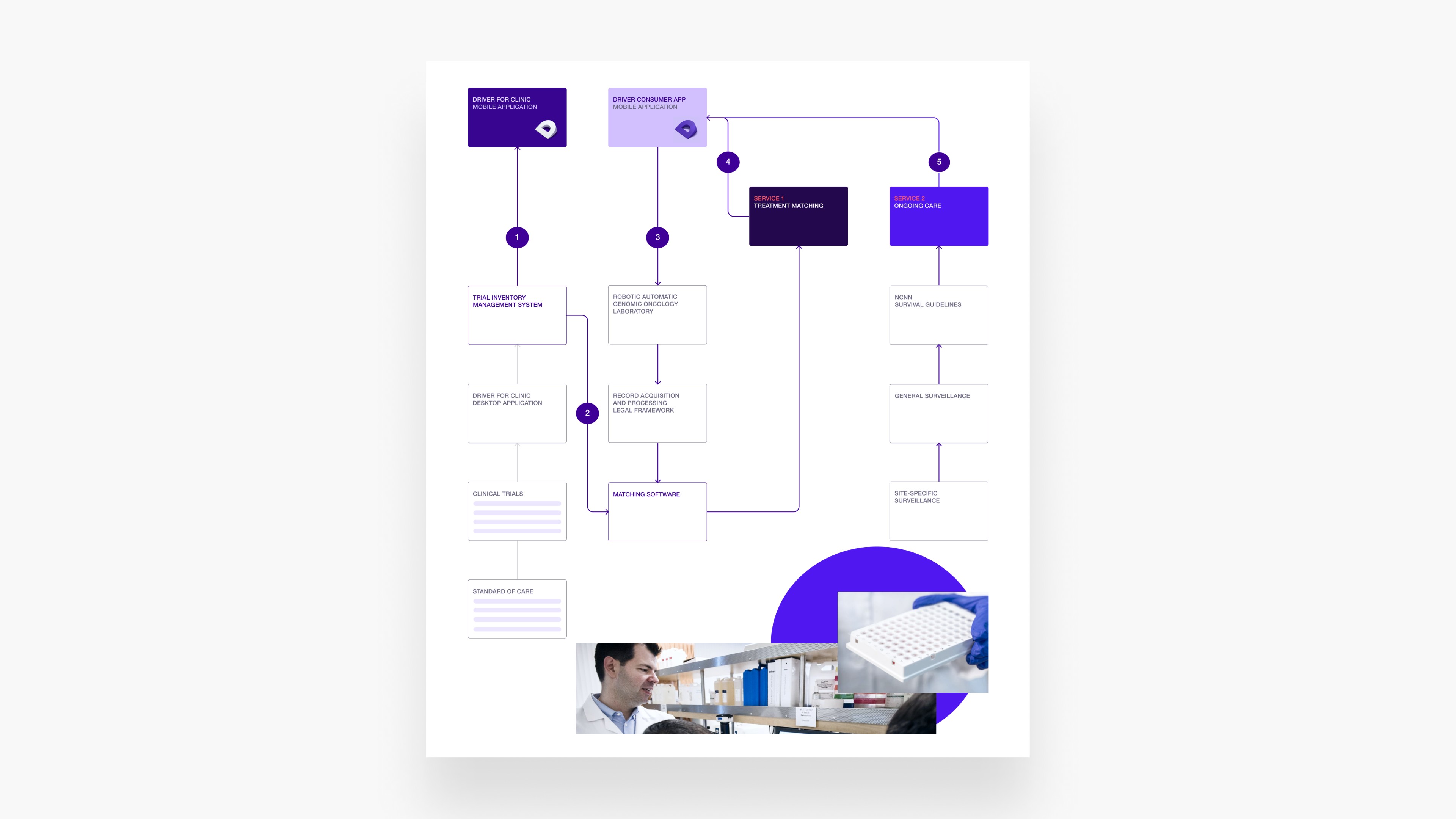
The network gave the system reach and credibility. Its founding members were the US National Cancer Institute and China’s National Cancer Center. Mayo Clinic, Cleveland Clinic, Massachusetts General Hospital, UCSF, UCLA, Duke, UNC, Emory, City of Hope, and the National Cancer Centre Singapore were among the participating institutions. Driver said a validation exercise with NCI showed that its technology could predict eligibility for trials at NCI’s Center for Cancer Research.
But the network members were not customers in the usual sense. They did not pay Driver for the relationship. The institutions supplied treatment inventory, specialists, validation, and a handsome row of names for the launch announcement. Revenue was meant to arrive elsewhere: first from patients, and eventually from employers, insurers, drug companies, or other institutional buyers. Those later arrangements never closed.
The checkout was the clinical trial
Driver’s paid service launched in the United States and China on September 6, 2018. The price was $3,000 upfront and $20 each month during treatment. Travel was not included. Neither, of course, was the treatment itself. For a wealthy patient seeking an additional set of eyes, the price could look modest beside the value of another option. For many people facing deductibles, missed work, transport, and a new diagnosis, it looked like one more locked door.
The company had seen hundreds of people use the app during its beta period, which began in 2017. Almost all had been subsidized by Driver while the team refined the system. Once the company asked patients to pay, sign-ups reportedly landed in the single digits. The free beta had demonstrated need and curiosity. It had not demonstrated a market at that price.
There was a deeper mismatch. Driver described the first barrier to care as knowledge. Knowledge mattered, but an app could not remove insurance restrictions, travel costs, referral patterns, uneven broadband, or the preference of some patients to defer to a trusted doctor. A rural patient might learn about a suitable trial at a famous coastal center and still be unable to move closer to it. The platform made the option visible; visibility was not the same as access.
On October 16, about 40 days after the public launch, Driver let go of its staff. It had been seeking another round, but revenue had not arrived quickly enough to persuade investors. Polkinghorn’s postmortem was unusually plain: the company had made a large direct-to-consumer bet, needed revenue sooner, and tried to do too much. Its wide build was not irrational. Every added component repaired a genuine break in the patient journey. Together, they consumed the runway before the business model completed its own trial.
“One of the biggest things we got wrong is, we tried to do too much.”William Polkinghorn, after Driver’s shutdown
What is worth stealing
The company’s failure does not make its product logic useless. Driver understood that a list of trials is not a patient outcome. Founders working in healthcare can copy the way it joined discovery to action: retrieve the record, explain the match, place a clinician in the loop, and own the handoff. They can also copy the decision to show standard care beside experimental options. A patient needs a field of choices, not a slot machine labeled “clinical trial.”
- Start with one expensive handoff. Prove that a narrow group of patients reaches a useful consultation before building every adjacent service.
- Design the payer early. The beneficiary may be the patient; the sustainable buyer may be an employer, insurer, provider, or trial sponsor.
- Count completed journeys. Network logos and free registrations matter less than paid cases that reach review, referral, and treatment.
- Keep the local doctor inside the product. Trust and continuity are distribution, especially when the recommendation requires travel or a new institution.
A leaner version would likely need a narrow cancer type, a smaller geography, a partner already responsible for the cost, and no proprietary lab until volume justified it. Even then, matching works best when insurance coverage, transport, clinical capacity, and physician trust line up. Remove those conditions and the result may be an exquisite catalog of doors the patient still cannot open.
Driver wanted to give ordinary patients the informational advantage of an insider. That remains an appealing mission. Its brief life added a less romantic insight: the shortest route through a complicated system is not always a straight line. Sometimes the detour through reimbursement, local care, and modest scope is the only road that stays open.
Keep exploring the Driver case
The company is no longer operating, but its launch material, product design, social archive, and contemporaneous reporting preserve a useful healthtech postmortem.