Business Model
B2B enterprise SaaS - recurring revenue from cancer centers, oncology networks and life sciences.
The AI infrastructure for modern oncology - reading the whole chart, all thousands of pages, and showing its work.
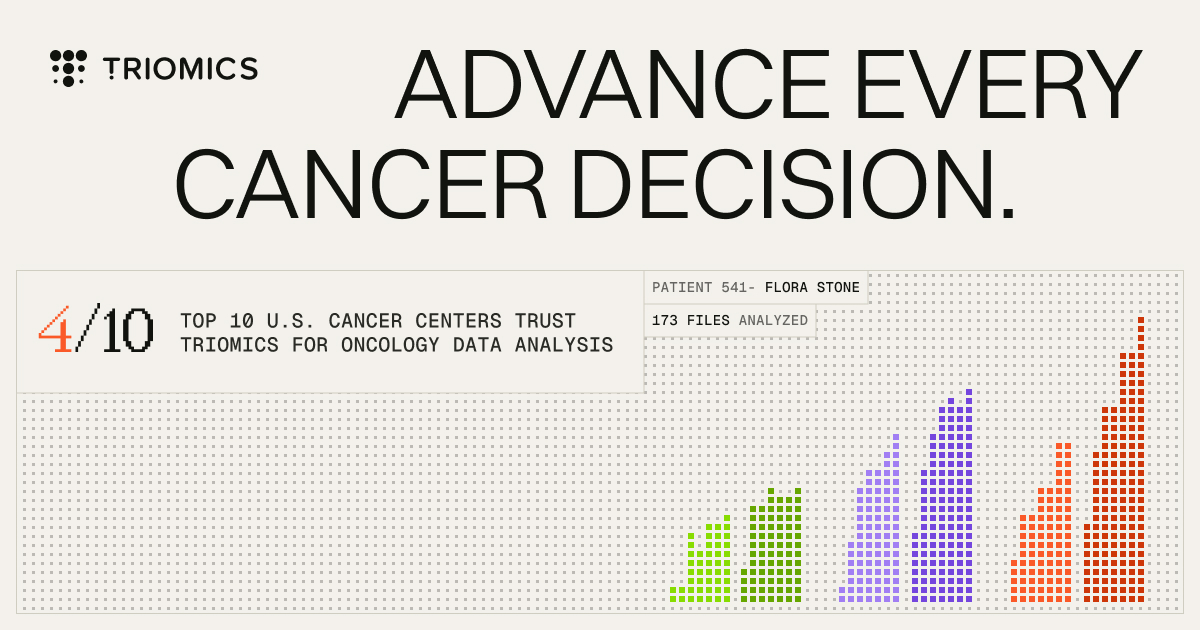
THE SUBJECT: Triomics, the New York oncology-AI company, photographed through its own product frame - where 173 files on a single patient collapse into one decision.
A single oncology patient's record can run into the thousands of pages - pathology reports, clinical notes, genomic panels, and scanned faxes. For years, cancer centers have paid highly trained staff to read all of it by hand to answer one question at a time: Does this patient qualify for a trial? What's their current disease status? Which registry field goes where? Triomics is trying to make that manual reading obsolete.
Founded in 2021 by Sarim Khan and Hrituraj Singh, Triomics builds task-driven AI agents that embed directly into clinical workflows and process medical records at scale, in real time. The company describes itself plainly - "the AI infrastructure for modern oncology" - and the framing is deliberate. This is not a chatbot bolted onto an EHR. It is a layer meant to sit underneath the work oncology teams already do.
The two founders were college friends before they became, respectively, an MIT biotech researcher and an Adobe AI researcher. That combination - clinical data fluency plus applied machine learning - shows up in the product's core conviction: general-purpose models write summaries, but oncology needs something that can reason across an entire chart and cite exactly where each answer came from.
Cancer care is, by the founders' own account, the hardest place to build AI. Records are long, unstructured, and inconsistent. The stakes are clinical. And clinicians will not trust a black box. Triomics' answer is an oncology-specific model, OncoLLM, that returns auditable, cited responses - every claim linked back to the pathology, molecular data, or note it was drawn from.
By 2026 the approach had reached 4 of the top 10 U.S. News Best Hospitals for Cancer, including Memorial Sloan Kettering, MD Anderson, Yale Cancer Center, and Mount Sinai - alongside several of the largest community oncology practices. In May 2026, Battery Ventures led a $22 million Series B to scale it further.
"Oncology is the hardest place to build AI, yet the most important."- Hrituraj Singh, Co-Founder & CTO
One oncology-specific engine, several workflow agents that sit inside the tasks cancer teams already perform.
A large language model built specifically for oncology. It reasons across an entire patient chart - notes, pathology, imaging, molecular data and scanned documents - and returns auditable, cited answers with source attribution.
Patient Records Interpretation for Semantic clinical trial Matching. Screens patients against active trials and delivers cited evidence linked to pathology, molecular and clinical notes. Reported 95% accuracy and a 40% lift in trial matches.
Auto-generates pre-charting notes in physician-preferred formats, assembling current disease status, treatment timeline and biomarkers - reported to cut new-patient prep time by up to 80%.
Produces structured abstractions for NAACCR, SEER, COC and QOPI measures, linking each field to its source document with 96% accuracy so centers meet federal reporting deadlines.
Reported gains, peer-reviewed in Nature Digital Medicine and presented at ASCO
Figures reported by Triomics and cited in company and press materials. Treat as approximate, workflow-dependent results.
Who its customers are. Triomics sells to cancer centers, oncology networks, and life sciences organizations. Its footprint includes 4 of the top 10 U.S. cancer hospitals - Memorial Sloan Kettering, MD Anderson, Yale Cancer Center and its Smilow Cancer Hospital partner, and Mount Sinai's Tisch Cancer Center - plus Regenstrief/IU Health, Texas Oncology, and large community practices. Over the past year the company says its enterprise base grew roughly fourfold and recurring revenue roughly tenfold.
The problem it solves. Oncology drowns in unstructured data. Trials fail to enroll enough patients while eligible patients never learn they qualify. Staff burn hours preparing for visits and abstracting registry fields under federal deadlines. Triomics targets that specific, expensive inefficiency rather than the general documentation burden.
How it's different. Most healthcare AI in this moment - Abridge, Microsoft's Nuance/DAX - focuses on ambient scribing and general summaries. Triomics trains its models specifically on oncology data and workflows, and designs every answer to cite its source. That "show your work" architecture is what makes clinicians willing to rely on it.
Where it fits. Triomics positions itself as infrastructure, not a feature: the layer that turns raw records into structured, trustworthy data feeding trial matching, visit prep, and registry reporting. Investors framed the Series B the same way - Battery Ventures called it "the precise infrastructure oncology has desperately required."
"We have seen medical records with thousands of pages of information."- Sarim Khan, Co-Founder & CEO
It builds oncology-specific AI agents that turn unstructured cancer patient records into structured, cited data for clinical trial matching, visit preparation, and cancer registry reporting.
Sarim Khan (CEO) and Hrituraj Singh (CTO) founded the company in 2021. It is headquartered in New York.
More than $36M total, including a $22M Series B led by Battery Ventures in May 2026 and a $15M Series A in 2024.
It is used by 4 of the top 10 U.S. cancer hospitals, including Memorial Sloan Kettering, MD Anderson, Yale Cancer Center, Mount Sinai, and Texas Oncology.
Unlike general ambient-AI tools such as Abridge or Nuance, Triomics trains its models specifically on oncology data and workflows, and every answer cites the source documents it came from.
Sources: Triomics, TechCrunch, HIT Consultant, Forbes, PR Newswire, Y Combinator, Crunchbase. Figures are company-reported and approximate.