The letter arrives after a bad month, perhaps a terrible year. It says an account is overdue. The person reading it may owe the money and still have no plausible way to pay the amount demanded. A creditor wants a recovery; a collection team wants a response; the borrower wants the phone to stop ringing. Everyone is describing the same account, yet each is solving a different problem. Clerkie was built in that gap.
- Clerkie started with consumer financial guidance and launched Fiber for creditors in 2021.
- Fiber now covers account inventory, recovery CRM, communications, payment plans, reporting and an AI agent.
- Its commercial argument is simple: a payment a borrower can actually make is more useful than an impossible demand.
- Published Fiber terms describe per-account and transaction-based fees; the actual rates sit in customer order forms.
A family bill became a systems problem
Guy Assad’s account of Clerkie’s beginnings is unusually concrete. After his father’s cancer diagnosis and death, medical and credit card bills accumulated. Assad spent months negotiating with medical companies and collectors to find repayment plans his family could manage. He knew how the system worked, he later said, and the process was painful anyway. A borrower without that knowledge faced a steeper climb.
At McKinsey, Assad and future co-founders Sebastian Wigstrom and Gray Hoffman saw the other side. They worked with large banks on digital operations and found rigid systems for handling delinquency. A bank could have an incentive to keep someone paying, but its machinery was better at moving an account through a process than understanding what payment might be possible. The company first approached the borrower through a consumer financial app. Fiber, officially launched in 2021, put the same question inside the creditor’s operation.
“These systems are incredibly arcane and rigid.”Sebastian Wigstrom, Clerkie co-founder and CTO
There is a useful distinction here. Debt advice can tell a person to call a lender, request a settlement or make a budget. Software inside the lender can actually surface an offer, record consent, route the account and let the person pay. Clerkie moved toward the part of the system that could turn advice into an available action.
What Fiber puts on the desk
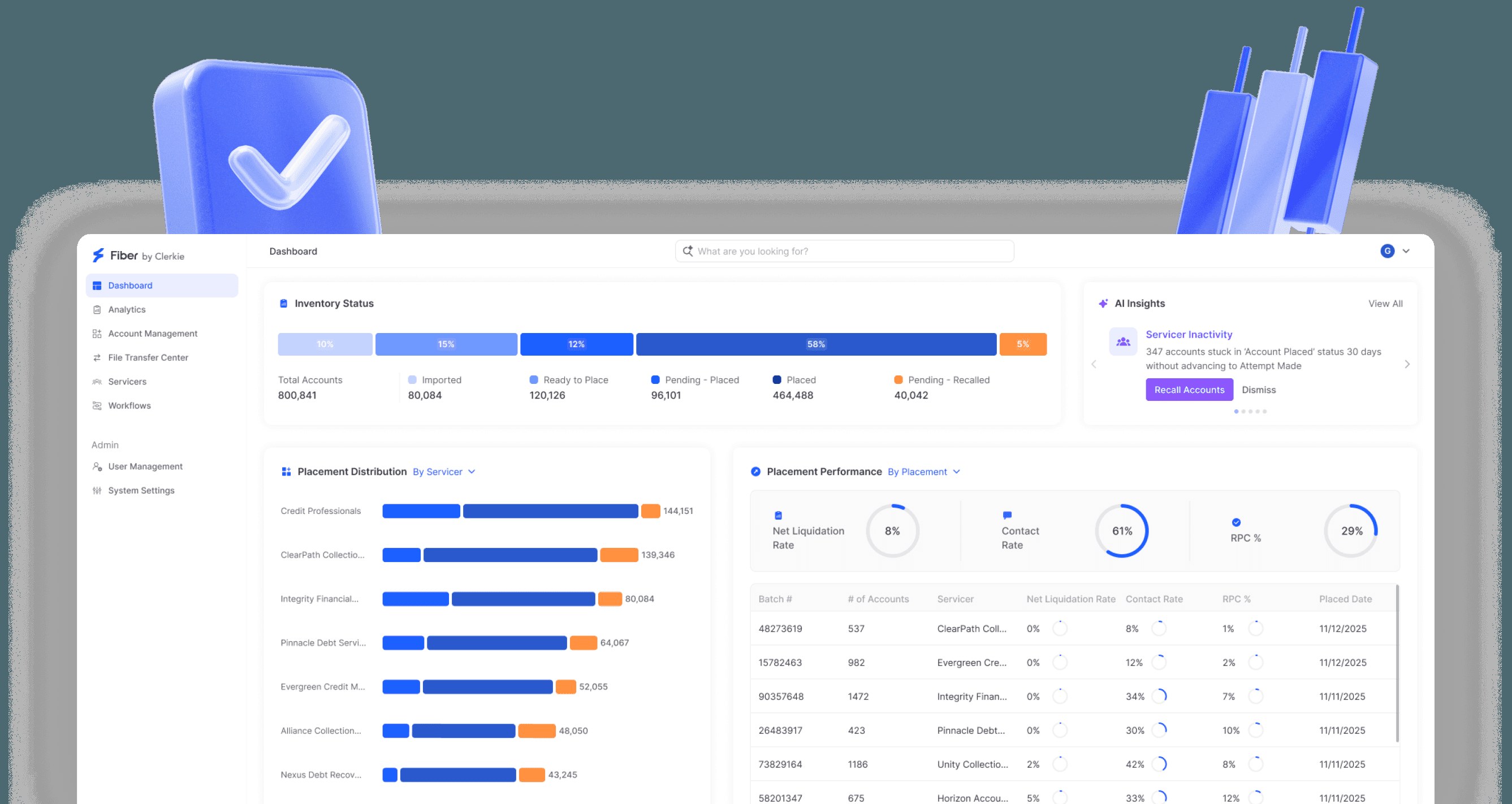
Fiber is sold to creditors, collection agencies and debt buyers. Its inventory management system helps creditors place accounts with recovery partners and keep their data in sync. A recovery CRM gives agencies a place to import files, work accounts, monitor agent performance and build reports. The company also sells communications, scoring, workflow automation and a payment portal as connected parts of the stack. An AI agent is pitched for repetitive work such as authentication, negotiation logistics and payment handling, with a human handoff for more complex cases.
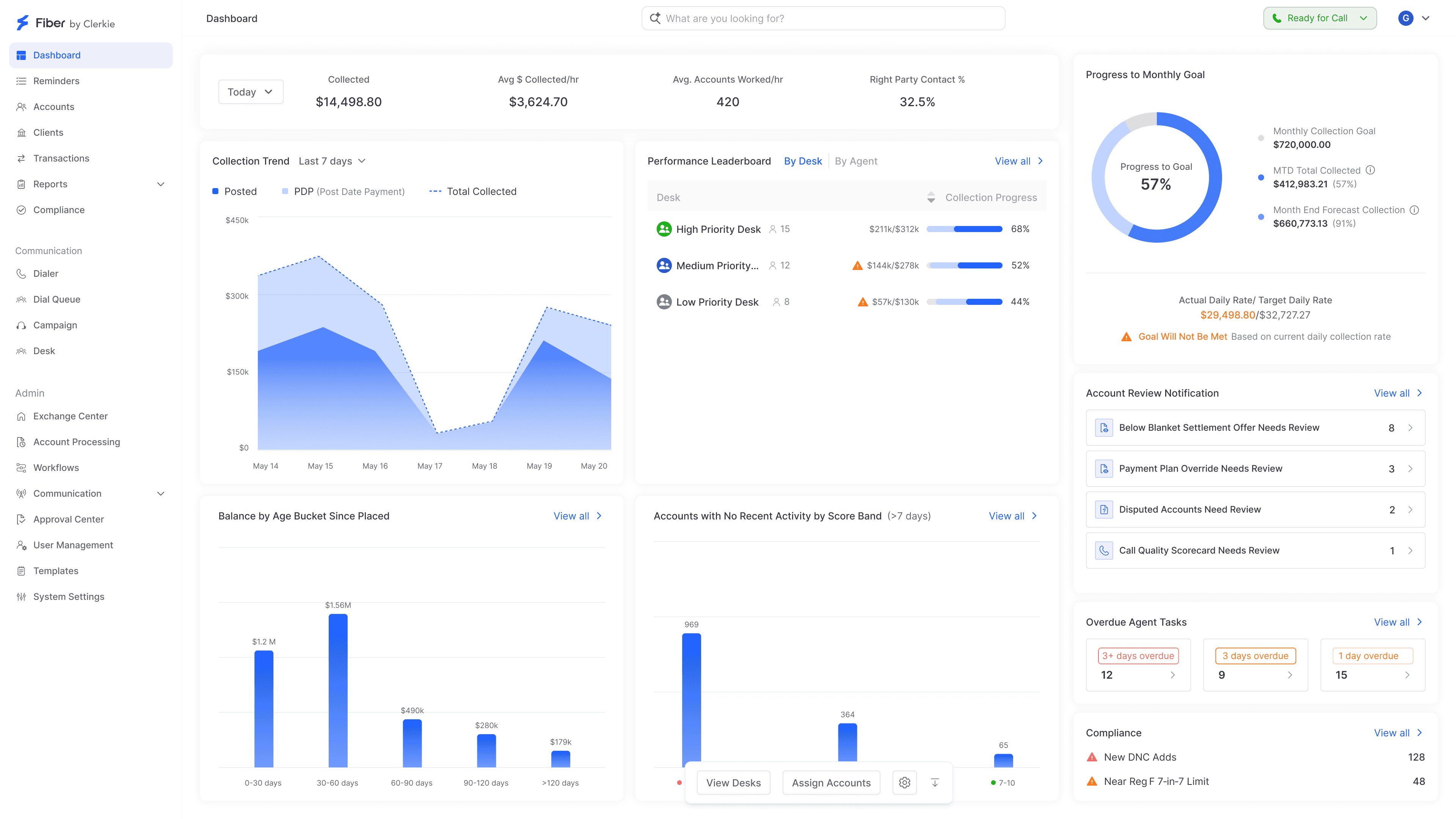
The product detail that matters most may be the least glamorous: file intake. Collections work often starts with data arriving from another institution. Fiber says its import wizard can partially accept files with missing or incorrect information, allowing valid accounts to proceed while exceptions are addressed. That is a narrower claim than “AI transforms collections,” and a more useful one. A delayed placement, a wrong field or a missing document can stop an account before any clever repayment strategy begins.
Compliance is another part of that plumbing. Fiber describes rules that can block outbound calls, texts or emails according to client, location and asset type. The product promises guardrails; the practical burden still depends on how a customer configures them. Its own terms put responsibility for lawful payment instructions and disclosures on the customer. The point of the software is to make policies executable and visible, not to remove judgment from collections.
A payment plan has two customers
The borrower does not buy Fiber. The lender or agency does. That commercial fact gives Clerkie a harder design problem than a consumer budgeting app has. A lender wants repayment and fewer losses. A borrower wants room to breathe. Clerkie’s premise is that these goals overlap when an account is handled early enough and an offer fits the person’s circumstances. In 2023 the company described identifying borrowers who might become delinquent and presenting debt workout options before default. A consumer might encounter a self-service portal, an adjusted payment arrangement or a settlement path.
The company has offered a striking data point: among client agencies that implemented and optimized a connected portal, it reported an average 70% lift in self-service payments and up to a 12% reduction in blended collection cost. Those are Clerkie’s figures, not an independently audited comparison, and the qualifier matters. A portal works best when the account data is accurate, the offer is authorized, the consumer trusts the message and the payment is affordable. A polished screen cannot repair an impossible balance by itself.
The business model is more specific than the usual enterprise software shorthand. Fiber’s published inventory management terms bill by active account in each billing period, using the maximum number present during that period. The payment portal add-on carries a fee for each successful transaction. Database access and storage can add further charges. Dollar prices are negotiated in order forms. That structure makes the buyer’s economics clear: the platform must save work or improve recovery enough to cover both the account volume and the payment activity it generates.
The unromantic moat
Clerkie competes with collection software, lender-built tools and digital recovery vendors. TrueAccord and InDebted, for example, also sell technology-led approaches to collections. Fiber’s particular pitch is breadth: the records, the agency workflow, the outreach rule, the repayment experience and the report belong to the same connected system. This is a claim about coordination as much as algorithms. An AI recommendation is of little use if it cannot reach the account, respect contact restrictions or be carried through to a payment.
There is also a reason to be measured about the grand promise. A creditor must permit a workout, its records must be right, and any automated conversation must follow the rules for that account. Borrower trust is fragile, especially when an unfamiliar name appears in a debt message. The software can lower friction only where institutions give it room to do so. Clerkie’s own story began with the anxiety of not knowing whom to trust; that remains the hardest interface to design.
The company announced a $33 million Series A in April 2023, led by Left Lane Capital, bringing its stated total funding to $41 million. The money was earmarked for engineering and scaling debt workout tools. By 2026, the Fiber site presented a fuller product family: CRM, inventory management, an AI agent and modular additions around communications and payments. It is a long way from a friendly personal finance assistant. Yet the question underneath has barely moved. Can a person pay this debt, under these terms, at this time? For an industry built around balances, it is almost a radical thing to ask.