The useful thing about an interim title is that it comes with a clock. Claudia Michon arrived at Pendo to keep marketing moving while the product-software company conducted a CMO search. It sounded like stewardship: maintain momentum, mind the machinery, leave the keys labeled. A little more than two months later, by her own account, the engagement had widened into a redesign of how the marketing organization works in the AI age.
The early moves were conspicuously unglamorous. Pendo's marketing team moved onto Notion as a shared, AI-first operating system. Functional leaders formed a task force to identify work that agents could handle. The company assigned an AI engineer exclusively to marketing. Product marketing was reset to be more strategic and nimble. There was no robot-written anthem, no synthetic spokesperson grinning under studio lights. Michon went after the wiring.
This is a revealing instinct. Marketing is often judged by what escapes the building: the campaign, the launch, the line everyone repeats. Michon keeps returning to what happens before any of that - the structure that lets a team find context, make a decision and ship without rebuilding the same staircase every Tuesday.
A career spent making crowded choices feel navigable
Michon's route to enterprise software did not begin in enterprise software. Her public career includes L'Oréal and Godiva Chocolatier, where products can be held, smelled, tasted and displayed beneath flattering retail lights. Then came corporate partnerships and marketing at Women for Women International, followed by brand and product strategy work at Peak Marketing. The objects changed; the problem remained familiar. Give people a reason to care, and make the next decision easier.
In 2016, she published a LinkedIn essay titled Nostalgia For A World Of Fewer Choices. The title now reads like a private joke the profession told about its own future. Software buyers would soon face a forest of overlapping clouds, platforms, copilots and agents, each promising to simplify the forest. A product marketer's work is partly the humane arrangement of abundance.
From object to system - the products grew more abstract
At Salesforce, abstraction became the daily material. As director of product marketing for Community Cloud and Salesforce CMS, Michon worked on the layer connecting companies with customers through websites, portals, forums and apps. She wrote about using CRM as the foundation for customer-centric digital experiences. In 2018, she produced and spoke in the Community Cloud keynote at Dreamforce, a production that had to turn architecture, customer evidence and theater into one legible promise.
There is a straight line from that work to her later insistence on shared context. Customer experience fragments when systems do not talk. Marketing work fragments for the same reason. The customer sees an awkward journey; the team feels a scavenger hunt.
“Critical thinking and story-telling are the two top skills I look for in a PMM.”Claudia Michon, on product marketing in the AI era
She used the product before making it the pitch
By 2024, as senior vice president of product and solutions marketing at Automation Anywhere, Michon was speaking publicly about AI's effect on the craft. Her position was neither a eulogy nor a parade. Generative AI, she said, is assistive technology. Every product marketer should become AI-literate, but the durable work still depended on critical thinking and storytelling. The machine could accelerate output. It could not be trusted to decide what deserved saying.
That distinction sharpened at Airtable, which she joined in March 2025 as head of product and solutions marketing. Before accepting, she described speaking with CEO Howie Liu and members of the team to establish what the company needed, whether she was the person for the job and whether the job was right for the person. It is an unusually symmetrical way to describe executive hiring. Both sides are products under evaluation; neither gets to skip discovery.
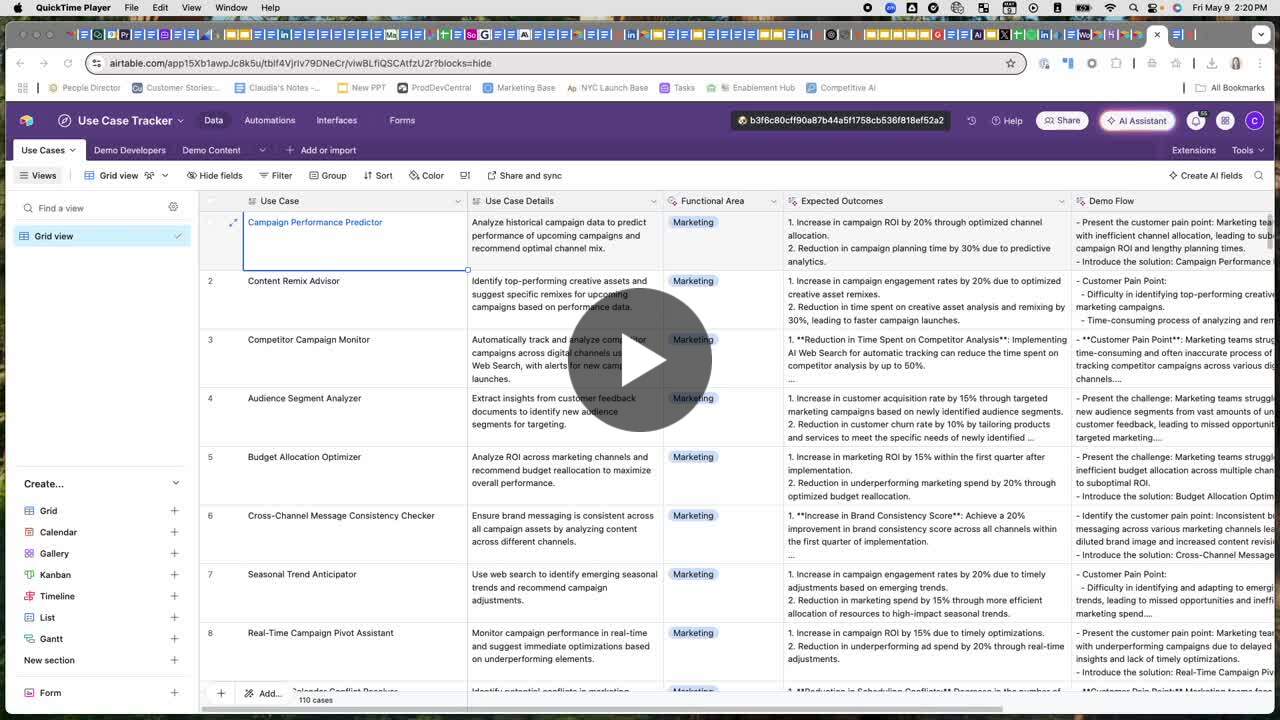
Soon after arriving, she built an Airtable app for product marketers who needed many product demos and too few hours. A base list of use cases became a structured system enriched by AI fields, buyer pain points, expected outcomes and supporting content. Her ten-minute walkthrough promised more than 100 tailored use cases. The number was catchy. The method was the real message: do not merely ask AI to write faster; construct a better environment for thinking.
When Airtable launched its AI-native direction later that year, Michon singled out the company's AI Playbook, a library of use cases and templates. Again, she gravitated to the bridge between possibility and practice. A feature becomes useful when someone can see where it belongs in Tuesday morning's work.
The operating model implicit in Michon's public work
Interim does not have to mean idle
Pendo sits in a fitting corner of the software world for Michon's latest experiment. Its products help companies understand behavior, collect feedback and guide users inside digital products. The company sells a way to observe adoption. Michon's marketing redesign appears to apply the same curiosity inward: where does work stall, what do people repeat, and which signals should change the next action?
Her public account of the first stretch at Pendo is cheerful but specific. The marketing organization embraced Notion without what she called “one single protest.” Functional leads began identifying opportunities for automation. An AI engineer arrived to support marketing alone. The detail about protest is funny because it is small, and important because every replatforming project eventually meets the person whose spreadsheet has achieved constitutional protection.
Adoption is the hidden test of any operating model. A beautiful workflow that colleagues avoid is merely office décor. Michon's earlier work in product adoption and customer experience gives her a useful sensitivity to the issue. She seems interested not only in whether a system can work, but in whether people will actually work inside it.
“What initially started as a few marketing initiatives has blossomed into a full rethink of how Pendo marketing operates in the AI age.”Michon on her first months as Pendo's interim CMO
The wager is that marketing can become more strategic by making its recurring mechanics less heroic. Release work should not require a fresh rescue every time. Useful context should not live in the one meeting someone missed. Automation should not be a private trick performed by the team's most technical enthusiast. Put the pieces into a system, and the humans regain time for the work Michon refuses to outsource: thinking clearly, finding the story and deciding what to leave out.
The machine gets the repetition; people keep the argument
There is a tendency to discuss AI at work as a contest between person and machine, as though the office has room for only one chair. Michon's practice suggests a more prosaic negotiation. Let software draft, classify, connect and multiply. Ask people to choose the premise, detect the nonsense, understand the customer and carry responsibility for the decision.
Her management record offers a related clue. Recommending a former colleague from Women for Women International, Michon wrote that one of her proudest accomplishments was hiring someone smarter than herself and learning from her. It is an unshowy theory of leverage: build a system that increases the intelligence available to the team, whether that intelligence arrives as a gifted colleague or a carefully bounded tool.
Away from the org chart, her listed interests include painting, cooking, cycling, hiking, kayaking and far-flung travel. Each is a useful counterweight to a career spent naming invisible software. Paint and onions resist jargon. Hills do not accept calendar invitations. A kayak offers precisely one dashboard, and it is wet.
She also turns up in the less polished corners of professional life: answering practitioners' questions, sharing resources, advertising roles and publicly advocating for former colleagues. Sharebird placed her on its 2025 list of product marketing mentors. Recommendations attached to her LinkedIn profile describe someone who combines the science and art of marketing with operational precision. Such testimonials are inevitably partial, but they rhyme with the work she chooses to show. Her demos expose the steps. Her posts name the teammates. Even the Pendo update distributes credit across the people rebuilding each function, a useful habit in a field that too easily mistakes the person holding the microphone for the whole production.
The permanent CMO search at Pendo will eventually end. Michon's interim chapter, by definition, has an exit built into it. The more durable question is whether the operating changes remain after the title changes hands. If they do, the work will have achieved a marketer's quiet ideal: the campaign may pass, but the choice becomes easier for the next person.