The machine had done its job. The people were still working. In a case study Civicom published in September 2021, a healthcare research center had turned to automated transcription during the pandemic. Physician recordings went in; text came out. Then came the medical terminology that needed repairing, the punctuation that needed rescuing, and the phrases nobody could decipher. The promised shortcut had acquired a second shift: checking the shortcut.
- Civicom combines software with people who run the work.
- More than 30 brands share technology and operational support.
- Research services span recruiting, interviews, transcription, and AI reporting.
- The customer still owns the final judgment.
The correction bill
The client returned to Civicom’s TranscriptionWing. Human proofers and editors cleaned the machine transcripts. The company’s account describes a familiar disappointment: a task finished quickly by software can leave the next person with more work. This was one unnamed client’s experience, rather than a universal verdict on speech recognition. But it supplies a useful way into Civicom’s business.
Count the whole job. That is the lesson a buyer can copy. Measure the time spent correcting, coordinating, and checking alongside the time a tool saves. The likely attraction of Civicom is clearest where those surrounding tasks are expensive, specialized, or difficult to leave unattended.
Thirty brands. One set of plumbing.
Founded in 2000 by David West, Civicom is a private parent company whose interests include market research, conferencing, transcription, outsourced operations, and virtual assistance. Its corporate website describes more than 30 autonomous brands supported by shared technology, capital, and operations. Each keeps its own customers and specialist identity. The resulting business looks less mysterious when you follow the work.
A sales professional speaks notes into Hey DAN, which helps put them into CRM records. A healthcare practice uses WelcomeWare’s video kiosks and remote assistants to handle reception and administration. A researcher needs interviews recorded, participants connected, and usable evidence delivered. Different customers; similar gaps between a tool being available and a task being completed.
WelcomeWare’s partnership with Raintree makes the mechanics more concrete. The service connects patient check-in with an established clinical software system, with a live person available through video. WelcomeWare also lists PTPN, the rehabilitation practice network, among its partners. These relationships put the service alongside systems and organizations that practices already use, rather than asking each clinic to construct a reception workflow from separate components.
Its research customers include agencies, corporate insights teams, and independent professionals. In March 2026, the business reported more than one million facilitated interviews and focus groups for over 1,000 clients. Those are company figures, but they establish the intended market: professional research with operational consequences when a session goes wrong.
The focus group gets in the car
Consider another company case study, published in November 2022. An automotive manufacturer wanted to observe reactions to an emerging vehicle feature. Three participants and a moderator would sit inside a car. Client observers would watch remotely. A conference-room camera was not going to solve this particular problem.
Civicom put a 360-degree CCam camera between the front seats, added smartphones at either side of the windshield, and placed an internet hotspot on the hood. The equipment captured different perspectives as the discussion moved from conference room to vehicle and back again. The setup is an excellent reminder that research technology sometimes requires finding somewhere sensible to put a power box.

For online work, CyberFacility combines web rooms and audio conferencing with advance participant checks and live facilitators. CiviSelect handles recruitment. ChatterBox supports online communities. These services sell relief from the logistics around the conversation, allowing moderators to spend their attention on what participants are saying.
Now the draft has receipts
Quillit extends that approach beyond the interview. Publicly introduced in July 2023, it helps researchers summarize qualitative material, compare segments, organize analysis, and assemble reports. Civicom announced Anthropic’s Claude as its language-model provider in April 2025. The valuable distinction is the route back to evidence: clickable and playable citations connect findings with transcript passages and recorded responses.
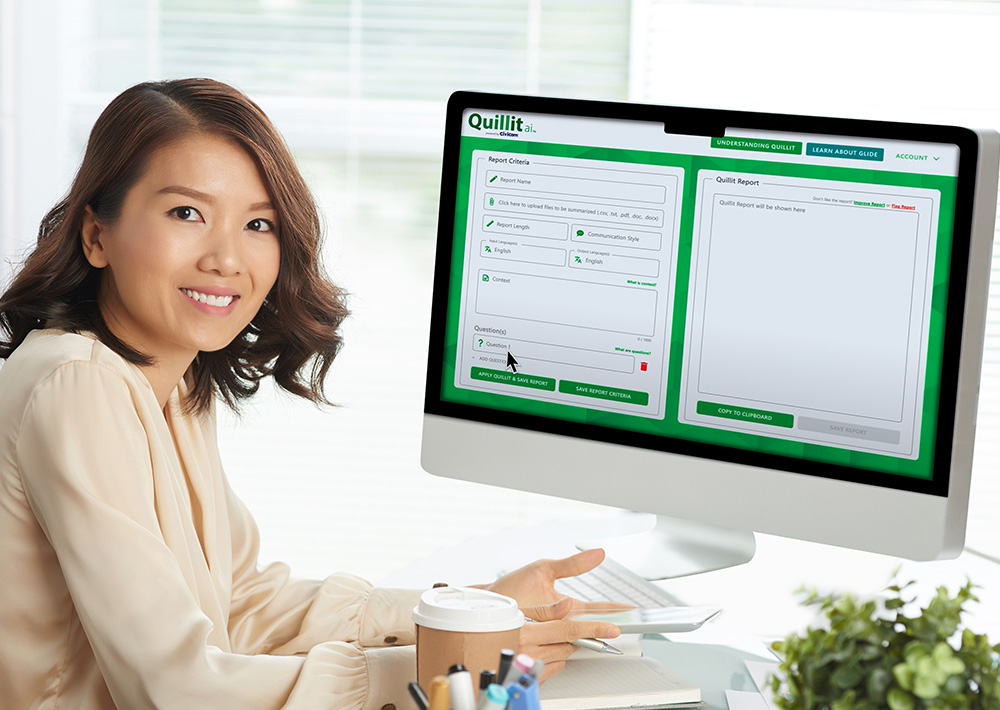
In March 2026, Civicom announced support for up to 300 files in a report query, interface changes, and PowerPoint exports. Its October 13 announcement described expanded deck creation from structured reports with validated citations. The direction is clear: reduce the repeated handling of material between interview, analysis, report, and presentation.
“Quillit reduces the production work surrounding those decisions while keeping the researcher responsible for the final interpretation.”
Annie McDannald, Global Vice President · October 2026
That responsibility matters. A citation gives the researcher something to inspect; it does not settle whether a recommendation is sound. Civicom’s January 2026 ISO/IEC 27001 announcement adds an information-security credential, particularly relevant to sensitive studies. Neither security controls nor faster drafting removes the need for informed review.
Price the work that remains
Quillit’s public pay-as-you-go rates list Basic at $20 and Pro at $35 per hour of content or 8,000 words. Annual plans are also offered. These are analysis-platform prices, not an all-inclusive budget for recruitment, facilitation, incentives, or a finished research engagement. The broader service business works through project quotes and brand-specific arrangements.
Per hour of content or 8,000 words. Published rates checked October 16, 2026.
Research buyers can also consider platforms such as Dscout or Remesh, or assemble separate tools and suppliers. Civicom’s pitch centers on connected services and operational help. The tradeoff is situational: a team with straightforward needs and strong internal support may find less value in another service layer. Poor recordings and weak study design also leave problems that downstream software cannot simply wish away.
A sensible buying exercise would start with one representative project. Record the hours spent preparing files, resolving participant problems, checking quotations, and formatting the deliverable. Then repeat the exercise with the proposed service. Include the bill and the remaining internal work. That comparison would test Civicom’s central proposition in the buyer’s own circumstances, where a polished product demonstration cannot supply the answer.
The tenth that was there first
There is one more recurring calculation. Civicom says its founders committed 10% of profits to worthy causes in 2000. Its Feathers Project connects sponsors with beneficiaries through technology, while its relief work includes the Philippines, where it has substantial operations. The commitment concerns profits, rather than revenue.
That detail fits a company preoccupied with what happens after the connection is made. A call needs facilitating. A transcript needs checking. A clinic needs someone to greet the next patient. Civicom has built a portfolio around taking responsibility for those ordinary, consequential moments.