The first thing Circle Medical asked for was an insurance card. In 2015, its app let a patient scan that card, choose a time and place, and wait for a doctor to arrive. The doctor did the travelling. For a company built by software people, it was a wonderfully physical solution: put a human being on the road.
- Primary care by video, with selected in-person appointments.
- No membership fee; accepted insurance or self-pay.
- A house-call beginning, a national ambition, and a costly billing lesson.
George Favvas, Jean-Sebastien Boulanger and Brent LaRue founded the company in 2015. Favvas and Boulanger came from Montreal. American healthcare presented a puzzle. As Favvas put it then: “It’s complicated to figure out how insurance works and what doctor you can see based on the insurance you have.” The inconvenience began well before the examination.
That observation explains much of Circle’s subsequent evolution. The place where care happens can change. The work required to reach it keeps demanding attention.
The doctor takes the commute
The original service offered ordinary primary care: wellness exams, vaccinations, chronic-condition management. Early workplace visits included Airbnb and Y Combinator. An employer supplied a private room; Circle required enough confirmed appointments to justify the trip. Convenience still needed a workable route.
Favvas described the early economics in striking terms: a Circle doctor might see about eight patients a day, compared with roughly sixteen at a conventional clinic. His argument was that avoiding office overhead could leave room for travel and longer visits. Those were the founder’s contemporary claims, rather than audited proof of a superior model. But the trade-off was visible. A travelling clinician has only so many hours.

By January 2020, UCSF Health was announcing an affiliation with Circle covering two San Francisco clinics and shared clinical leadership. Circle now describes that relationship as a four-year partnership entered in 2019. It belongs to the company’s history; treating it as a perpetual endorsement would stretch the record.
Then the appointment stopped travelling
The pandemic changed the setting. Circle expanded remote primary care, keeping an in-person component. A screen removed the clinician’s journey as well as the patient’s. This is the practical significance of the shift: the company could serve people without recreating a full neighbourhood clinic everywhere it went.
Capital followed. In November 2020, WELL Health completed an approximately US$14.3 million investment to acquire majority control, initially about 58% on a fully diluted basis. US$5 million was fresh money issued by Circle; the rest bought existing shareholders’ interests. Calling the whole transaction a cash injection into the startup would miss the distinction.
Today, the proposition is adult primary care through scheduled video appointments and selected physical locations. The service menu spans preventive care, hypertension, thyroid conditions, ADHD, anxiety, depression, sexual health and hormone care. Its position sits between a local general practice and a narrowly focused online treatment service. A patient can bring more than one kind of problem through the same door.
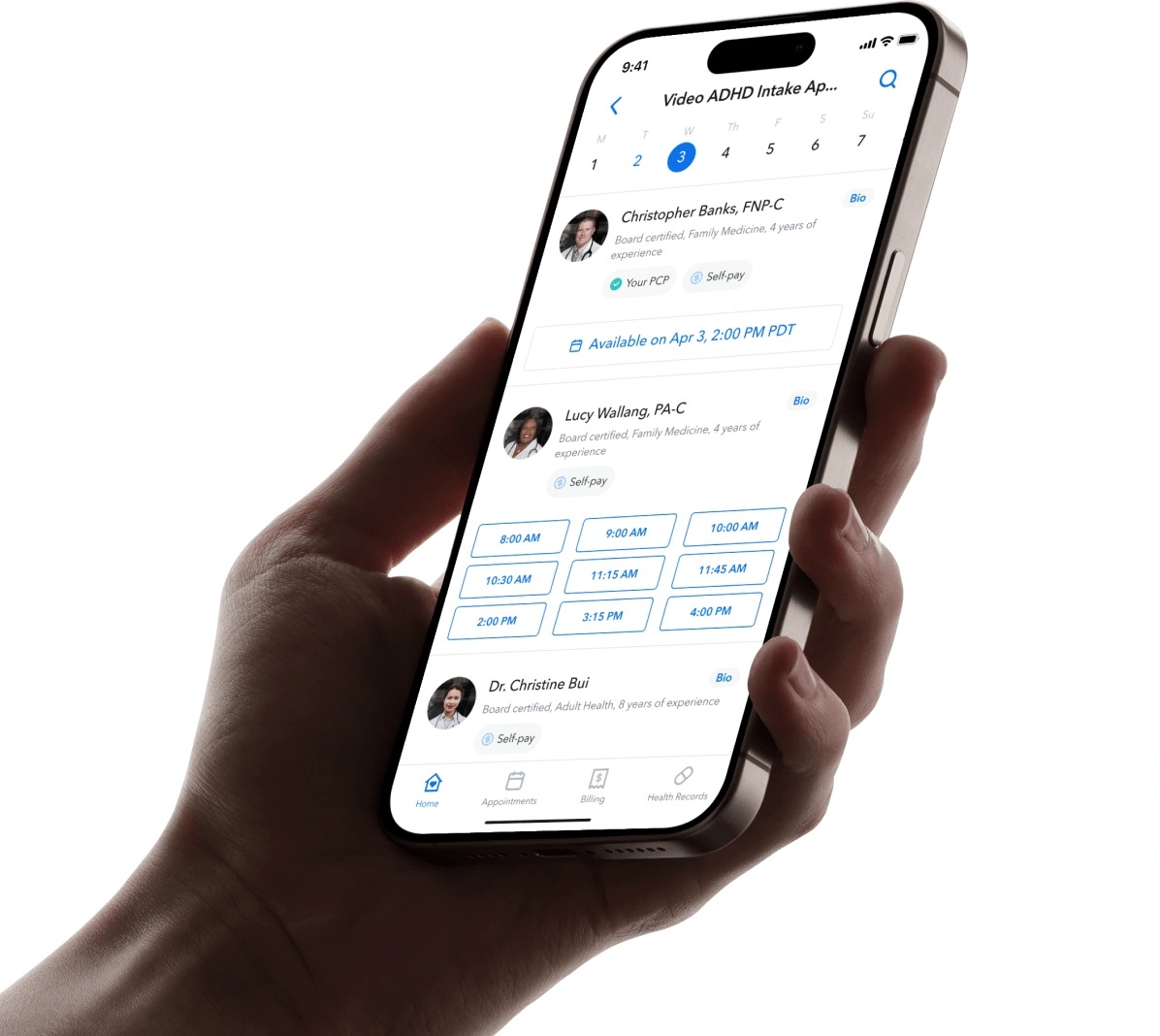
The likely customer is an adult trying to fit repeat care into an already crowded day. A medication review or a discussion of test results need not start with a trip across town. But geography still matters: patients must check availability where they will receive care, and a listing in the network does not mean every service is available at every location.
The price belongs to the pathway
Circle charges for appointments, without an annual membership. Its published standard video self-pay price is $120; standard in-person appointments and annual wellness exams are $200. Insurance can reduce the patient’s share, but a deductible does not disappear because the interface looks friendly.
ADHD care offers a useful example. The published pathway begins with a $179 intake, followed by a $120 comprehensive health assessment and a $120 diagnosis-and-treatment visit. That is $419 in self-pay appointment charges before medication or additional testing. Ongoing monthly follow-ups are listed at $120. A prescription depends on clinical judgment.
The app handles booking, records and communication with the care team. Behind it sits proprietary medical-records software. The expertise here crosses disciplines: clinical care, product design and the operational business of getting an appointment billed. Selling visits makes those disciplines depend on one another.
There is also a difference between buying an appointment and building a relationship. Chronic conditions require return visits, monitoring and adjustments. Circle’s combination of records, messaging and follow-up scheduling aims to keep those encounters connected. For a patient comparing it with an occasional urgent-care visit, that continuity is a meaningful part of the proposition.
The bill behind the booking
The costs of getting that machinery wrong became public. In June 2026, two Circle entities and chief medical officer Nicole Tsang agreed to pay $3.325 million to resolve federal and California allegations concerning provider identification on claims and supervision. The alleged conduct ran from 2018 through May 2025. The settlement involved no determination of liability; WELL reported no admission of wrongdoing.
WELL said Circle had invested in billing operations, legal, regulatory and internal-audit functions. It also confirmed Georgia Psarras as permanent CEO after an interim appointment in September 2025. The sequence supports a sober lesson: access and oversight have to grow together.
Access and oversight have to grow together.The lesson in Circle’s expansion
There is a useful idea to copy here. Map the patient’s entire errand: finding a clinician, checking coverage, attending, obtaining records and arranging follow-up. Improve the connections. The approach depends on available clinicians, accepted coverage and problems suitable for remote care. For someone considering the service, the useful comparison is the complete course of care: the appointments required, the clinician available, the insurance benefit and the arrangements for anything that needs an examination room. A video visit cannot provide every examination, procedure or emergency response.
The scale figures need similar care. In June 2026, WELL reported connections to 99 payers and approximately 14,000 health plans across 32 states. Those are measures of reach, rather than evidence that everyone covered has used the service. Eligibility opens a door; an available appointment and a workable care plan determine whether someone can walk through it.
Circle’s careers page speaks of empathy, accessibility, integrity and urgency. Its real test is whether those commitments survive the unglamorous work. The waiting room may disappear. The responsibilities behind it remain.
Keep the conversation going
Explore Circle Medical, its care menu, appointment pricing and locations.