The useful thing about a career in advertising is that it teaches you to notice the distance between what a company says and what a person hears. Cindy Gustafson has spent more than two decades inside that distance. She began with media plans, built a studio devoted to inventive ones, moved into the operating rooms of consumer brands and, in January 2025, took the chief executive's chair at Nutrafol. The ascent looks tidy from afar. Up close, it is less a ladder than a long experiment in getting nearer to the customer.
Her first assignments supplied good raw material. At Chiat Day in Los Angeles, she worked on the launch of XM Satellite Radio and on Wonderbra. At BBH New York, Levi's and Johnnie Walker followed. These were brands with voices already loud enough to carry across a room. The planner's job was subtler: decide where that voice belonged, what it should mean there and whether anyone on the receiving end might care.
Mindshare became the long middle act. Gustafson worked across Gillette, American Express and Unilever, eventually leading planning for Team Unilever. In 2013 she founded the agency's Invention Studio, whose premise was unusually direct for its moment: merge data, science and creativity, then use media as part of the idea instead of merely the place where the idea was purchased. The studio worked for clients including American Express, Kimberly-Clark, LG and Unilever. Its approach later spread to offices in six other countries.
planning
Studio
marketing
CMO
CEO
The useful troublemaker inside the building
Invention Studio made Gustafson an internal founder. She had to create a capability without the romance of a garage or the freedom of a blank balance sheet. There were clients to serve, colleagues to recruit and old habits to persuade. One prominent result was Dove's #SpeakBeautiful program, built with a new social algorithm developed alongside Twitter. The point was not technology for its own sake. It was to turn the medium into an active participant in the campaign.
Her related framework, Planning for Agility, helped teams map culture and prepare useful responses before a moment arrived. The name sounds procedural. The instinct beneath it is creative: spontaneity is often the result of preparation. In 2016 Mindshare named her its U.S. chief strategy officer. The same year, the American Advertising Federation inducted her into its Advertising Hall of Achievement. Ad Age's 40 Under 40, Adweek Media All-Star and Cynopsis Top Women in Digital recognition joined a shelf she rarely foregrounds in interviews.
“Know the rules well, so you can break them effectively.”Cindy Gustafson, writing as a Forbes contributor
That sentence became the compact philosophy atop her Forbes contributor page. Her 2018 essays were practical and pleasingly impatient with office folklore. One argued that would-be founders need not resign to build something new; another suggested replacing the ceremonial mentor with a “third-base coach,” the advocate close enough to the action to tell you when to run. Even her piece about a difficult boss put responsibility back on the employee. Gustafson's advice was rarely scented with incense. It usually came wearing sensible shoes.
From advising the brand to carrying it
In 2018 she crossed from agency strategy into WW, formerly Weight Watchers. Over four years she helped build a global marketing practice, modernize the brand, broaden its audience and strengthen performance marketing. Her remit included brand strategy, insights, media, advertising, ambassadors, recruitment and retention. She also built a multi-tiered influencer practice in-house. The role converted recommendations into consequences. A strategist can leave the room after the plan; an operator wakes up with the result.
BARK recruited her as chief marketing officer in May 2022. It was a different sort of subscription business, playful in public and analytical underneath. Gustafson spoke admiringly of its voice and its relationship with millions of customers. The official portrait from that chapter catches the fit: she sits below an enormous turquoise BARK wordmark, a wall of toys behind her and a small white dog regarding her with the grave attention usually reserved for biscuits.
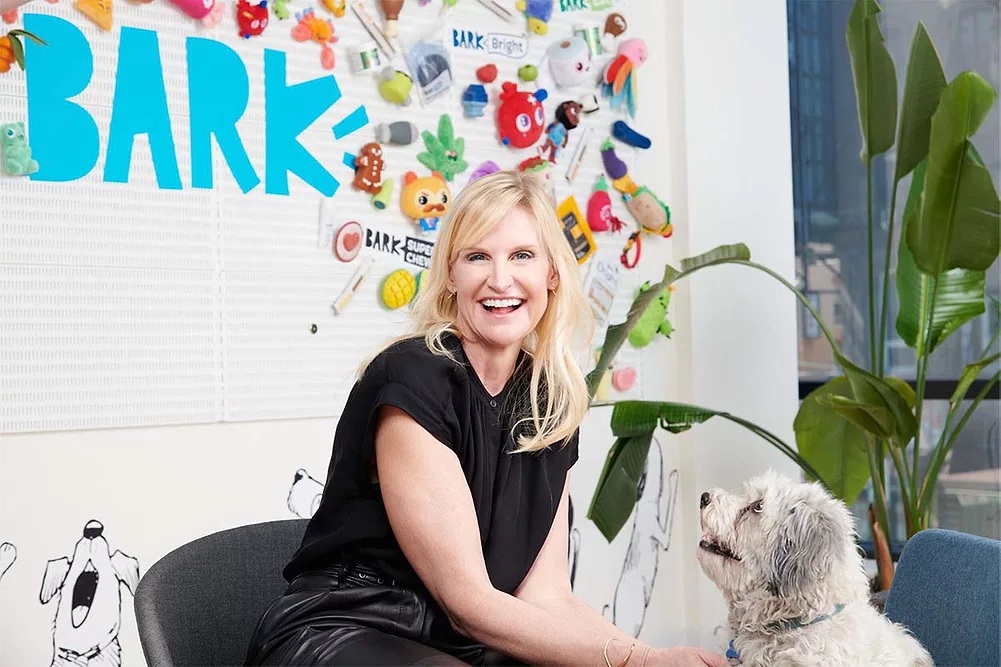
The photograph is funny, but the job was serious. BARK wanted a more unified experience across categories and greater momentum in food. Gustafson arrived with experience in e-commerce, subscriptions and consumer goods, plus a stated fondness for brands with a mission. She would later describe that attraction as a “gravitational pull” toward companies with genuine empathy for the customer. It explains the sequence from WW to BARK to Nutrafol better than any tidy industry label.
A customer before an executive
Gustafson's Nutrafol story began before her employment contract. She became a devoted customer in 2021. When she joined as chief marketing officer in 2023, her aim was to help more people understand what the company did and to serve more of them. Becoming chief executive was not, she has said, even a thought at the time.
The succession was announced late in 2024. Co-founder Giorgos Tsetis would become chairman and a strategic adviser to Unilever Wellbeing; Gustafson would take over in January. Founder transitions invite unnecessary theatre, so the pair chose patience. She later described the handoff as slow, methodical and organic. The company came along during the process. Their shared commitment provided the continuity.
Her first full year as CEO brought double-digit growth. Nutrafol expanded into Ulta Beauty in the summer of 2025, launched a product for men over 50 and developed the myNutrafol app as a companion to the customer journey. By June 2026, Gustafson confirmed the business was approaching $1 billion in annual sales. She paired that number with another: two million customers served. The first suggested scale. The second, in her telling, suggested how much remained to do.
“We have been so fixated on really delivering against what a customer needs and what a customer is looking for, and staying very, very grounded in that.”Cindy Gustafson on the Glossy Beauty Podcast, 2026
The discipline of not adding everything
Approaching a billion dollars tends to make companies acquisitive about their own ideas. More products promise more shelf space, more occasions and more reasons to issue a press release. Gustafson points to Nutrafol's small portfolio as a feature. “We are not that kind of a business,” she said when comparing it with brands that carry hundreds of stock-keeping units. The useful constraint is that each addition has to earn its place.
The same logic shapes the app. It began as an experience for customers who purchased directly, then opened a guest path for people who bought elsewhere. Gustafson said it was not built simply to sell. Its purpose was to nurture the journey, help customers track progress and remain engaged beyond checkout. That is humane language for retention, but it is also commercially precise. In a subscription business, the relationship after purchase is the business.
- Focus over proliferation. A small portfolio makes every launch consequential.
- Service after the sale. The app extends the relationship into an ongoing routine.
- Retail without amnesia. Wider distribution does not erase the direct customer connection.
- Mission as operating system. The founder handoff preserved continuity without pretending nothing had changed.
There is no shortage of dashboards in Gustafson's working world. She came up through media, ran performance marketing and now leads a digitally fluent consumer company. Yet her public vocabulary keeps returning to need, empathy, usefulness and focus. The numbers matter because they report whether those ideas survived contact with the market.
Her private amusements, at least according to an older professional biography, are nicely specific. She aspired to golf like Phil Mickelson, cook like Tom Colicchio and shop like Rachel Zoe. The combination suggests standards, appetite and a dangerous acquaintance with a credit card. More revealing is the career joke embedded in it: expertise is admired, but there is always another craft to learn.
The person at the other end
Gustafson lives in Larchmont, New York. Her professional reach has been wider: global marketing at WW, international agency clients, and brands found in mailboxes, retail aisles and bathroom cabinets. Still, the governing unit of her work is singular. Not an audience segment. A person deciding whether to believe a promise and whether to return tomorrow.
That is the connective tissue from a young planner working on satellite radio to a chief executive managing national retail and a customer app. Each job has reduced the distance between the idea and its consequence. Gustafson's career has moved steadily inward, from choosing the medium to shaping the message, from shaping the message to running the brand, from running the brand to carrying the company.
The title may now be CEO, but the planner's question remains intact: what does the person on the other side actually need? It is not a decorative question. At Nutrafol, it determines what gets built, what does not and how a focused business intends to keep growing.