The interesting thing about a career spent taming complicated systems is that the scenery can change completely while the work remains familiar. For Chuck Donnelly, the scenery has included a California space-science lab, Space Shuttle ground control, a genetics research institute on the Maine coast, a traditional music school, and a Portland software company. The common object in view was information: how to capture it faithfully, how to move it without damage, and how to make it useful to the next person.
At UC Berkeley's Space Astrophysics Group, Donnelly directed development of software for orbiting platforms, worked on ground control for the Shuttle, and led work on embedded systems and radio-astronomy algorithms. His publication trail reaches the Berkeley SETI program. In 1995, he shared in a team award for the EURD space-telescope instrument, which later flew aboard Spain's MINISAT satellite.
Space instrumentation is a severe tutor. A distant machine cannot be coaxed with a sticky note, and a weak interface does not become charming merely because everyone has learned its quirks. Signals need context. Systems need discipline. The software must respect the physical work it serves.
The frontier moves indoors
Donnelly took that systems discipline into biology at The Jackson Laboratory in Bar Harbor. He spent years there and became director of computational sciences, leading work on difficult computational problems across research areas. His projects received support from the National Institutes of Health, Howard Hughes Medical Institute, and JAX itself.
The scale had changed from orbit to organism, but biology offered no shortage of unruly data. A research colony accumulates identities, pedigrees, genotypes, phenotypes, treatments, observations, samples, schedules, and decisions. Lose the relationship between those facts and the experiment may still look busy while becoming less intelligible.
Donnelly co-authored a 2010 paper on JCMS, an extensible colony and phenotype data-management system, and a 2013 protocol on mouse-colony data management. That protocol treated the database not as clerical decoration but as part of responsible research, tied to ethics, cost, and data integrity. It is a modest-sounding argument with large consequences: the apparatus of science includes the system that remembers what happened.
“In biomedical research, data should be treated as first-class corporate assets. They were expensive to create, they are expensive to maintain, and they have future business value.”Chuck Donnelly and Julie Morrison, “Making Data Fly In-Formation,” 2019
RockStep Solutions grew from this environment. Donnelly, the software engineer, co-founded the company in 2013 with Julie Morrison, a microbiologist whose own career included IDEXX and NASA's Jet Propulsion Laboratory. The pairing mattered. Specialized software has a habit of becoming either technically neat and professionally tone-deaf, or professionally fluent and technically brittle. RockStep began with both vocabularies in the room.
Software that learns the nouns
The first courtesy of useful vertical software is that it learns a profession's nouns. In RockStep's case, those nouns included studies, cohorts, animals, breeding, genotypes, phenotypes, samples, doses, observations, necropsy, and audit trails. The verbs mattered too: design, randomize, schedule, collect, harmonize, analyze, and collaborate.
Climb was built as a cloud platform for non-GLP preclinical work, the exploratory research that precedes the tightly regulated GLP stage. It brought animal and vivarium management together with study design, workflow execution, sample tracking, and data capture. The intention was not to make scientists admire software. It was to make the software recede while preserving the story of the experiment.
This was a response to an awkward contrast. The science could be advanced while its operations depended on paper, spreadsheets, disconnected databases, and local workarounds. Each handoff invited transcription errors or lost context. Each private naming convention made later comparison harder. The flashiest analysis in the world cannot restore metadata nobody recorded.
The RockStep operating idea
Donnelly's public writing returned to digital transformation, but with a practical bias. RockStep discussed phased adoption, stakeholder buy-in, and the slow work of mapping real operations before replacing them. A laboratory is not improved by dropping a fashionable platform onto it from altitude. Its staff know which exceptions are meaningful, which steps protect quality, and which apparent inefficiencies are doing hidden work.
By 2020, Climb was in use at more than 30 pharmaceutical companies and research institutions. RockStep later partnered with Dotmatics, connecting Climb to a wider drug-discovery informatics environment. The product also became a bridge between organizations: an experimental workflow could travel with more of its meaning intact.
“Our aim is to improve in vivo drug discovery laboratory operations and data management with our highly scalable cloud laboratory informatics platform - Climb.”Chuck Donnelly, announcing RockStep's Dotmatics partnership in 2021
A second kind of listening
There is another line on Donnelly's résumé that rescues the story from becoming a sermon about metadata. He is a traditional musician. His personal site is a cheerful time capsule of gigs, benefit performances, recording sessions, and travels to Ireland. He played in Maine venues, recorded guitar, and invited fellow musicians to bring their instruments along.
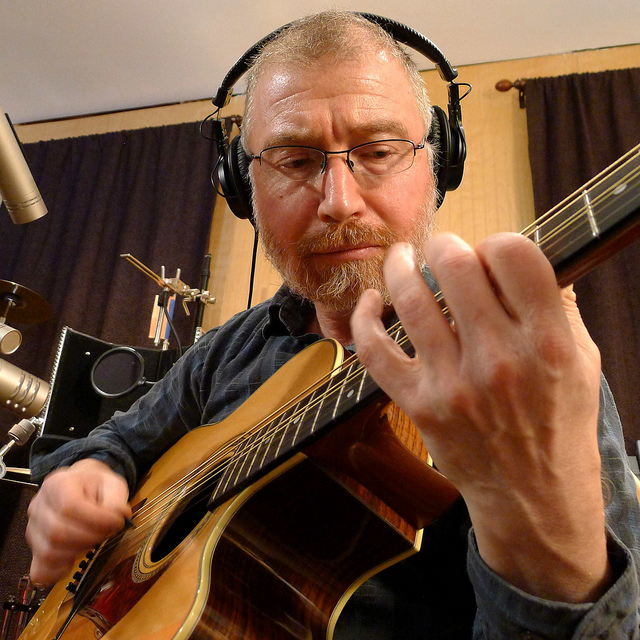
In 2012, he co-founded the Acadia School of Traditional Music and Arts in Bar Harbor and served as its executive director. The school brought together students and performers working in Irish, old-time, Acadian, Cajun, and Cape Breton traditions. Its schedule mixed intensive instruction with public concerts. Donnelly told the Portland Press Herald that he wanted to reach families and musicians serious about expanding both their knowledge and their understanding of how the music is played.
It would be too tidy to claim that playing guitar caused a software strategy. Still, both practices reward a recognizable kind of attention. Traditional music is held in patterns, variation, memory, and exchange. A player listens for structure without flattening the individual voice. Good laboratory software faces a related social problem: create enough shared form for people to work together, while leaving room for the experiment that does not resemble yesterday's.
The Acadia school and RockStep overlapped during their early years. That is an instructive detail about Donnelly's public life. The entrepreneur was not waiting to become one-dimensional. A person can pursue federal research grants and organize a week of fiddle classes, reason about cloud architecture and turn up for a community benefit. The calendar may object, but the character is coherent.
The handoff
On July 28, 2025, Instem acquired RockStep Solutions for an undisclosed amount. Instem's Provantis software served GLP preclinical study management; Climb covered the more flexible non-GLP work that comes earlier. The combination promised a longer digital thread from exploratory research through regulated studies and submission.
For RockStep, the acquisition was a product argument made corporate. The seams between research stages matter. Data does not become valuable merely because it exists. It becomes valuable when its provenance survives, its terminology can be understood, and the next system can receive it without an interpretive séance.
The deal also completed a twelve-year founder chapter. RockStep had moved from a Maine startup supported by SBIR funding to a platform used by pharmaceutical companies, biotech organizations, contract research organizations, government labs, and academic research groups. It arrived inside a larger company because its missing piece fit a larger workflow.
“Some people can't wait an extra year or two for a treatment to be approved. They can't afford to be on a clinical trial that fails. That's what motivates us.”Chuck Donnelly, on RockStep's motivation
Donnelly's career offers a useful correction to the mythology of sudden invention. Climb did not descend as an immaculate idea. It followed years of working near instruments, researchers, colonies, algorithms, and databases. It took shape through conversations with scientists and through the unromantic labor of requirements, roadmaps, grants, partnerships, and product revisions.
The connecting skill was not prophecy. It was noticing where information lost its shape. In space science, that could mean a signal traveling from an instrument. In computational biology, a phenotype detached from the conditions that produced it. In a company, it could mean knowledge trapped with one team. In a music session, it might be the moment a tune passes from one player to another and remains itself while becoming something new.
Donnelly spent his working life near those handoffs. RockStep was the commercial expression of that attention. The company gave preclinical research a system designed around its actual motions, then joined a platform that could carry the data farther. For a founder who began around orbiting instruments, it is an appropriately grounded legacy: mind the interfaces, preserve the signal, and help the next person hear it.
Keep exploring